broken drill bit - how do I get it out?

Ian_Edwards

Well-Known Member
Joined
9 Feb 2002
Messages
2,221
Location
Aberdeen Scotland
Visit site
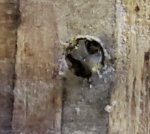
broken drill bit.jpg

Sorry about the slightly fuzzy photo, this is a 3mm HSS drill bit broken at the surface on the edge of a piece plywood. You can see it's drilled into the end grain of one of the laminates.
I was drilling a pilot hole for a 1 1/2 inch number 6 screw for a hinge. I reversed the drill to back the bit out when it snapped, obviously a mistake.
There are bits of micro fibre reinforced epoxy around bit but drill mostly is in the plywood. The broken drill is virtually flush with the plywood, not enough to get a grip on it with pliers or a vice grip.
Anyone any ideas of how to get the broken bit of the drill out?
If I could get some sort of coring device that would work, filling the enlarged hole with a bit of dowel or similar, wouldn't be a problem.
Any ideas before a make an even bigger mess of it.
 
I would try a pair of needle-nosed pliers (or failing that tweezers) and trying to twist it out - ought to work if the bit wasn't jammed
 
Drill around it and extract with needle nosed pliers. then resin it up. Leave to set and re-drill to suit.

Agreed, a hole each side. Long-nose Vise-Grips are good, you have any.

Why did you reverse the drill? That might have caused it to jam. Leave it turning forwards full speed as you pull it out. That will clear the hole.
 
A short length of steel tube, a piece of car brake pipe is ideal, file crude teeth across the end with a triangular file and carefully use it as a drill, sleeved over the broken drill, to slowly increase the hole diameter and release the broken drill. Then fill with epoxy and start again.

Www.solocoastalsailing.co.uk

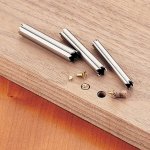
screw extractor.jpg

If you make the teeth as shown, and run your drill in reverse (slowly), it will extract the plug with the remains of the screw in it.
 
Agreed, a hole each side. Long-nose Vise-Grips are good, you have any.

Why did you reverse the drill? That might have caused it to jam. Leave it turning forwards full speed as you pull it out. That will clear the hole.
I'll try the long nose vice grips and dill some holes.
I've also found some small core drill on the internet, if the holes and vice grip is making to much of a mess I'll buy one, it's a cockpit table I'm refurbishing, with folding leaves, there quite a lot of work gone into it already, I don't want to mess it up, more than I have already.

Why did I reverse the drill? ... I've no idea, I don't think I was really thinking about it, it's not something I'd normally do, and I regretted it as soon as I'd done it.
 
If you get some circlip pliers like these you can poke the legs down the flooks of the drill then turn anti clockwise

knipex-snap-ring-pliers-49-21-a41-64_400_compressed.jpg
 
Get a big soldering iron and heat it until the wood burns away. Don't try this at home.
I was going to suggest heating up a bit of thin wall tube and slipping it over the drill. I was thinking blowlamp rather than soldering iron.
I like Poignard's method.
I'm afraid I would probably just knock it in a bit and leave it there if I thought I could get away with it.
Otherwise use a 3mm chisel until the drill can be gripped with pliers.
 
As a joiner I would say the logical solution is to leave it where it is and slightly move the hinge to avoid it, if it's absolutely necessary to be in that exact position then a core cutter is the way forward, you can get them relatively cheap online.
Also I would add that fixing into the end grain of plywood is never really a good idea, especially if it is to bear any sort of load or repetitive stress.
 
Thanks for all the reply, some very useful ideas there.
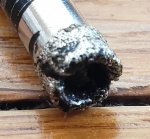
After thinking about it overnight, I decided to have go with a diamond tipped masonry drill I had in the garage ( the house is built of granite, so I have various diamond tipped drill around). The drill has 7mm OD and around 4mm ID.

Diamond tipped drill.jpg
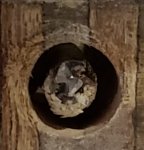
And it cored the broken drill out, no problem, I needed to take it slowly , it tended to get very hot, it's normally used with water as a lubricant.

broken drill cored.jpg

The broken drill acted as a guide, I now have to fill the hole with micro fibre thickened epoxy, and re-drill it very carefully.
 
If you still need to get it out rather than sealing it in to go rusty, use an EASY OUT it is the most professional way.
 
View attachment 89143

If you make the teeth as shown, and run your drill in reverse (slowly), it will extract the plug with the remains of the screw in it.
ps and keep withdrawing the tool and blow out the hole to clear the dust, otherwise it will overheat and ruin the temper.

I've had to do dozens of these on my boat where bronze woodscrews have corroded and broken when trying to unscrew them.

I fill the hole with a fluted dowel, glued in and then screw into that.

It seems to work OK.

I used to use epoxy as a glue until I discovered moisture activated Gorilla glue. (£3.99 for 60ml from Aldi)
 
Top