
DavidJ
Well-Known Member
I wonder if a bit of weight distribution would help.
Is there anything you could transfer to the front (sorry bow)?
Is there anything you could transfer to the front (sorry bow)?


 even at cruising speed of 8km/h a gust of wind will blow the bow off the heading, there is no keel on our little flat bottomed boat, the only thing it has is the Volvo Penta S drive and rudder, making turning to starboard at anything less than cruising speed an exercise in futility, it is easier and quicker to turn to port to go to starboard at slow speed.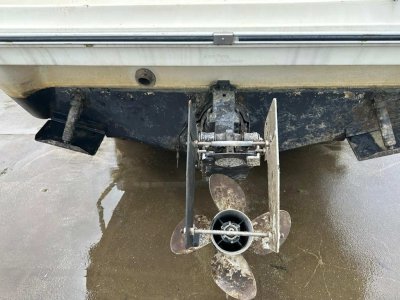
I have about half a cubic meter of gravel in the bow of mine and it still blows around! the ballast is sitting about where the round fender is.I wonder if a bit of weight distribution would help.
Is there anything you could transfer to the front (sorry bow)?
Marketed in the early 80s as AddarudderMy 7.5m river boat wanders like a leaf on the wind.
It is a real pain at slow speed, trying to manoeuvre on to a dock is a case of trial and error... with more error than trial
I'm getting used to it, but still if someone walks from one side to the other I have to counter steer to keep the boat on heading.
Those parallel plates on the outdrive/outboard are very popular in Holland, the boat I looked at before buying this one had one fitted to the sterndrive, the boat was a Searay 220DA with a Toyota diesel engine
at displacement speed the plates are in the water like a rudder, at planing speed the plates lift out the water with the hydrodynamic force. The boat has been re-engined as it is on an Mercruiser Alfa one leg with the marinised Toyota 4.2 turbo diesel 170hp engine as fitted to a Landcruiser.
View attachment 167744
I think you'll find that the one in the picture is the Ruddersafe. The Addarudder was a single plate aluminium moulding that I had fitted on my Enfield legs on the Senior 31. I must admit they helped a bit but not nearly as much as the fixed skeg.Marketed in the early 80s as Addarudder
I think you are correct!I think you'll find that the one in the picture is the Ruddersafe. The Addarudder was a single plate aluminium moulding that I had fitted on my Enfield legs on the Senior 31. I must admit they helped a bit but not nearly as much as the fixed skeg.


Enfield leg! That brings back memories! Wound the handle and the thing swung up?I think you'll find that the one in the picture is the Ruddersafe. The Addarudder was a single plate aluminium moulding that I had fitted on my Enfield legs on the Senior 31. I must admit they helped a bit but not nearly as much as the fixed skeg.

I think it’s just a feature of V planing hulls, not volume. The single drive at low speed sucks water from random sides of the centreline I was always told. Which is why my twin engine Ring rib didn’t wander, and my neighbour’s identical single engine version did. The skeg helps because it acts like s fence as well as a rudderVery common on boats like this. Made worse on this particular boat and other US generic makes similar. Just because they are built in a way that is designed to favour internal space and arrangement in the cabin…great, but also means that they are notoriously biased to stern in terms of their weight. Literally all machinery and a large fuel tank is all installed far to the stern as possible. Add in some crew sat aft…the pointy end at the bow, finds an impossible job of being able to track a steady course through the water. Instead you are trying to push a very flat and shallow area of hull through the water, with no real centre line to track straight. Worsened by the skipper unfamiliar, over compensating at the helm each way.
That’s the case most often. But if it helps, you could check for any slack and play in the steering bush on the outdrive. Any play in the power steering arm, pin and linkage too perhaps. But generally, it’s just a trait of a planing hull with that shape, 400kgs of big v8 and another 250-300kgs of fuel and water back there too.
Is that a Buckingham 20?I have about half a cubic meter of gravel in the bow of mine and it still blows around! the ballast is sitting about where the round fender is.
View attachment 167745
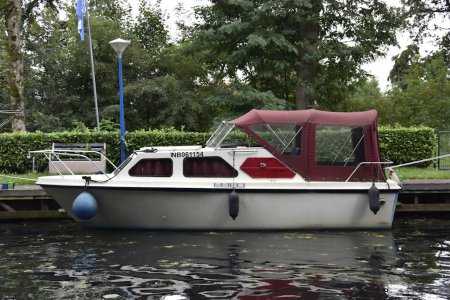
It's a Falcon 750 as far as I know, it's a little over 7.5m or 25ft and 2.5m in beam, I still have no idea as to what the underwater profile is, there is a brace coming from the bottom of the rudder underneath the propellor to something on the hull, I have a waterproof camera but not had the opportunity to use it yet - waiting for more of the weed to clear, we will be lifting the boat out next year to clean and paint her.Is that a Buckingham 20?
That's what my parents had - and that is the boat Dad fitted with the twin rudders (two rudders mounted either side of the cavitation plate. They were deep (down to the skeg) and allowed the thrust from the prop through the centre almost like a tunnel creating almost a jet of water. It had the additional advantage of still working (albeit less well of course) if the thrust was off but the boat was still moving - which could also be a pain as if you turned the steering to apply some reverse thrust the boat would still turn because of the rudder even though no thrust was on - you got used to it and it certainly tracked massively better.
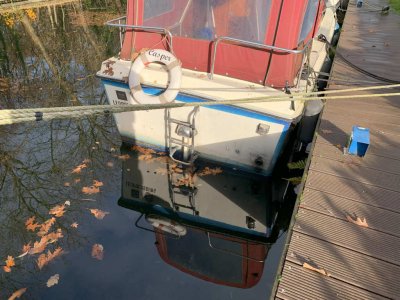
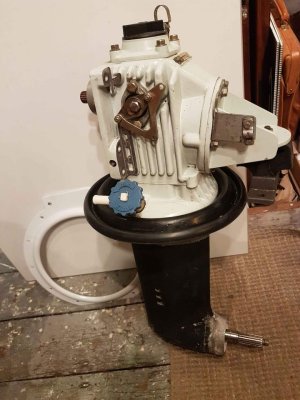
Sort of yes, it's a 1980 Volvo Penta MD7A with saildrive and a 3 blade fixed propellor.That looks like one of these
Saildrive Solutions - Marine Propulsion Engines Beta Marine
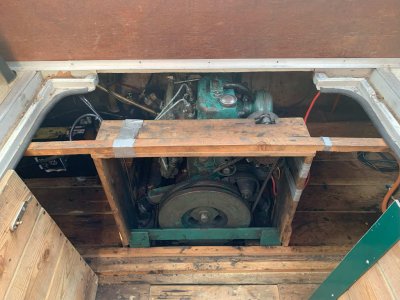
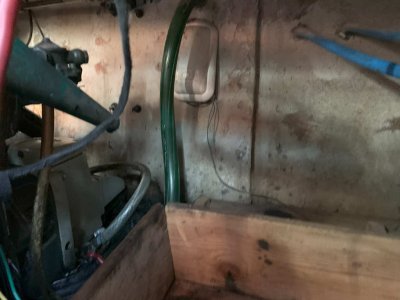

Hello Josh, I've fitted one of these on all my previous boats, displacement and planing. In fact I'll shortly be making one for my latest rebuild! It transforms the straight line running at slow speeds especially when on autopilot. All it needs is a simple 6 or 8mm steel plate welded onto a mounting pad that bolts through the hull onto an internal backing plate of the same metal. If you can weld it'll take you about an hour to make and another hour to fit. If not then any fabricators will make it for a few quid or if you are anywhere near J27 M5 I'll make you one.
Hi Pcuk sorry for not responding to you first chance I’ve had to get online.Hello Josh, I've fitted one of these on all my previous boats, displacement and planing. In fact I'll shortly be making one for my latest rebuild! It transforms the straight line running at slow speeds especially when on autopilot. All it needs is a simple 6 or 8mm steel plate welded onto a mounting pad that bolts through the hull onto an internal backing plate of the same metal. If you can weld it'll take you about an hour to make and another hour to fit. If not then any fabricators will make it for a few quid or if you are anywhere near J27 M5 I'll make you one.
