Boat vibrating in high winds??

DangerousPirate

Well-Known Member
Joined
24 Feb 2020
Messages
981
Location
N. Ireland
Visit site
I have noticed this before on my Maxi 95 (Sloop rigged, 32 ft).
When the wind picks up, the whole boat vibrates. That certainly wasn't a thing on my other boats before. I am not sure about tensions in the rig, but I haven't noticed anything really slack recently. This vibrating happens in harbour, not under sail. We currently have like 20-25 knots or thereabouts, with wind from aft.

Is it because something is looser than it should, or perhaps the opposite and too tight, is that normal with certain boats, or where should I turn to make it stop?

It isn't alarming me, but it's a little annoying. Honestly thought crawling out from my comfy, warm cabin into the cold night with two wrenches to tighten the backstay a little more would solve the problem. Alas, here I am writing you.


Edit: This is the first boat with a radar, which is halfway up the mast on this one. Is that the culprit?
 
Last edited:
I have noticed a rig vibration at times on my 23 foot yacht.
I have studied the rigging several times at night with a torch and rearranged all of the halyards etc to avoid touching the rigging.
My conclusion is that it is the the topping lift vibrating in the breeze.
To stop this at night I drop the boom down onto the cabin top.
I might try a boom strut some day.
 
On my boat with a dyneema backstay, it use to resonates in high winds. The quick solution is the slacken the back stay.
An alternative, which might work is to wrap a rope around the backstay to form a spiral.
The vibration is know as Vortex Induced Vibration (VIV). It's caused by a vortex tripping on one side of the wire, causing a low pressure area on one side, which moves the wire sideways. The movement detached the vortex. Then a vortex is generated on the otherside. This pattern is repeated causing the wire to vibrate.
If the frequency of the VIV matches a natural frequency of the wire, it can "lock-in" or resonate, causing the amplitude to increase.
This a well known phenomenon and occurs in water as will as air.
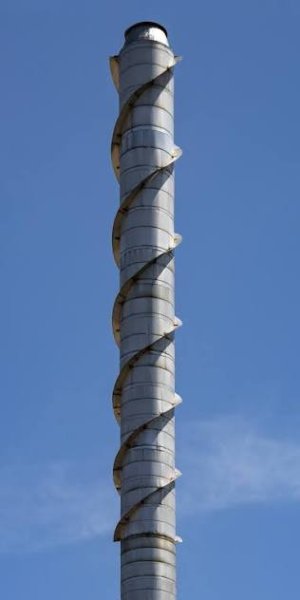
You'll often see spirals of tabs welded to tall narrow chimneys to stop VIV, could cause sever fatigue and failure of the chimney.

1763064403546.jpeg
Wrapping rope main halyard or similar around the backstay could have a similar effect.
However, I know from experience this is difficult to do in a gale, in the middle of a cold night.
I cured the problem by wrapping a 3mm cord around the dyneema backstay with a pitch of about 50cm. A long task achieved over winter evenings sitting by a long fire, with a glass of something warming.
Just like I'm doing now!
 
On my boat with a dyneema backstay, it use to resonates in high winds. The quick solution is the slacken the back stay.
An alternative, which might work is to wrap a rope around the backstay to form a spiral.
The vibration is know as Vortex Induced Vibration (VIV). It's caused by a vortex tripping on one side of the wire, causing a low pressure area on one side, which moves the wire sideways. The movement detached the vortex. Then a vortex is generated on the otherside. This pattern is repeated causing the wire to vibrate.
If the frequency of the VIV matches a natural frequency of the wire, it can "lock-in" or resonate, causing the amplitude to increase.
This a well known phenomenon and occurs in water as will as air.
You'll often see spirals of tabs welded to tall narrow chimneys to stop VIV, could cause sever fatigue and failure of the chimney.

View attachment 202093
Wrapping rope main halyard or similar around the backstay could have a similar effect.
However, I know from experience this is difficult to do in a gale, in the middle of a cold night.
I cured the problem by wrapping a 3mm cord around the dyneema backstay with a pitch of about 50cm. A long task achieved over winter evenings sitting by a long fire, with a glass of something warming.
Just like I'm doing now!
Hm. I can try with the main halyard and see if that changes anything. Although my backstay is split halfway down as I have a center gate on the aft. like in this picture (don't have pics of that of my own handy right now, but just so you get the idea):R0025826.jpg

I hope it helps. Thanks for the tip!
 
Possibly only one stay or rope causing the vibrations. Looking closey at each in turn you can quite often see the offender.
On my boat it was the topping lift. Easing the mainsheet stopped it but allowed the boom to swing around. Then had to sort the boom out ....
 
Possibly only one stay or rope causing the vibrations. Looking closey at each in turn you can quite often see the offender.
On my boat it was the topping lift. Easing the mainsheet stopped it but allowed the boom to swing around. Then had to sort the boom out ....
One of the first things I tried. I eased the topping lift but it didn't help.

I have wrapped the main around the backstay now as good as I could. Can't see much at night, but gave a good amount of twists. It's vibrating less, I think. It's not gone entirely, but shorter intervals and less noticeable.
 
I get this in certain conditions, not necessarily very strong winds.
I try various tricks, loosen or tighten topping lift with main sheet, tie topping lift to backstay, tie a towel around topping lift etc. One thing sometimes helps, hoist a thick warp and wrap around mast for vortex shredding.
No one thing works every time.
 
The mast on my Sadler 34 is prone to panting, a strong vibration at about 1 or 2 cycles per second, shaking the whole boat. Probably more likely in a marina where the wind may not be from ahead. It may be that slackening the backstay, reducing compression, could alleviate it. It seems that wrapping the main halyard in a spiral below the spreaders reduced it.
 
A lower frequency vibration could be the mast pumping due to the VIV described above. My Snapdragon used to do this, but I never did find a solution.
I just got up and decided to take a look at it during light, and I was convinced it was the topping lift again (slapping on the side of the mast), but not sure.
The mast on my Sadler 34 is prone to panting, a strong vibration at about 1 or 2 cycles per second, shaking the whole boat. Probably more likely in a marina where the wind may not be from ahead. It may be that slackening the backstay, reducing compression, could alleviate it. It seems that wrapping the main halyard in a spiral below the spreaders reduced it.
Guess I was lucky with my other boats. I just simply never experienced it. It's comforting to know that it's not unique to me and that there is seemingly little that can be done about it.
 
Mast tramping can be very annoying. With us it seemed to happen with a beam-on wind, often not very strong. I have tried to suppress it by attaching the spinnaker uphaul somewhere near the bow and tightening it, and I think this had some effect, though this was many years ago now.
 
Top