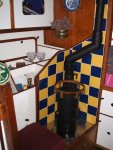
boat heater... charcoal?

stu9000

Well-Known Member
Joined
8 Mar 2008
Messages
930
Location
near kingston upon thames, surrey
Visit site
Hi

I am keen to get some dry heat on my jaguar 27.
This would allow me to keep the family cosy an extend the season. Oil or gas would throw out too much water and condensation, but charcoal burns clean and dry, not to mention it is quiet and no leccy needed.

But, ye gads, they dont come cheap.
£600 for one of these.
http://www.charcoalheater.com
They look great and burn slow and clean all night but I can't afford it.

I have been playing about with materials for a diy option. Currently there is a cement prototype curing in my shed! But I suspect it won't work as well as I would like. And one has to be careful not to risk carbon monoxide poisoning.
We shall see.

I was thinking of borrowing a mig welder and making one out of sheet steel. But i am not sure ijj have the skills. Or I might draw up plans and ask a local welder to make it up. If I can bring it in for under £200 for a proper job I'd be happy.

Ive scoured the web and seen gypsy wood burneers and the like but nothing that quite fits my needs.

Any suggestions?
Has anyone here used a charcoal burner?

Thanks
S
 
Charcoal burns no drier than any other fuel, be it gas, paraffin, diesel, or whatever. The key is to have an exhaust for the combustion products, which can be arranged for any type of fuel.

Charcoal's advantage is that it has little or no smell, and the flue can be very small (about an inch diameter). I briefly had a Pansy which I got off eBay and fitted to my previous boat. It was OK, but a bit of a faff and very prone to downdrafts until I extended the flue to more than 2ft above the coachroof.

If you have the space to fit a 4" flue then you could get a small coal burner off eBay for about £100.
 
Interesting coal burner suggestion. I will look into it, but the 4" flu may well be a deal breaker.
I liked the sound of the 1" flu on the pansy and would not mind fitting an extension.
I think I read that gas and paraffin had significantly more water, but fair point about the exhaust gas being removed via the flu. Perhaps I should give them another look.
 
Hi

I am keen to get some dry heat on my jaguar 27.
This would allow me to keep the family cosy an extend the season. Oil or gas would throw out too much water and condensation, but charcoal burns clean and dry, not to mention it is quiet and no leccy needed.

But, ye gads, they dont come cheap.
£600 for one of these.
http://www.charcoalheater.com
They look great and burn slow and clean all night but I can't afford it.

I have been playing about with materials for a diy option. Currently there is a cement prototype curing in my shed! But I suspect it won't work as well as I would like. And one has to be careful not to risk carbon monoxide poisoning.
We shall see.

I was thinking of borrowing a mig welder and making one out of sheet steel. But i am not sure ijj have the skills. Or I might draw up plans and ask a local welder to make it up. If I can bring it in for under £200 for a proper job I'd be happy.

Ive scoured the web and seen gypsy wood burneers and the like but nothing that quite fits my needs.

Any suggestions?
Has anyone here used a charcoal burner?

Thanks
S

You are right that charcoal produces very little if any water vapour when it burns but you must not burn any carbonaceous or hydrocarbon fuel in the confines of a boat cabin without an efficient flue to exhaust all the products of combustion to the outside or without an adequate supply of air to ensure complete and efficient combustion

Hydrocarbon fuels, and coal to a lesser extent, will produce water vapour but they all, coke and charcooal included, have the potential to produce deadly carbon monoxide especially if the supply of fresh air is restricted.
 
Pansies are rubbish, solid fuel is too much for a 27 footer, you must spend money on a paraffin or diesel heater, flue isn't too bad. Speaking from experience, Jerry
 
I would not risk having anything that produced carbon monoxide burning all night, and definitely not anything that is not a room sealed appliance (balanced flue type), and even then there are risks. There are just too many cases of people not waking up the next day. My solution is pretty basic. When I turn in I turn out my heat source, I close the hatch ventilation (still have a trickle vent) and have a hot water bottle with a nice knitted jacket that helps retain its warmth longer. It gets me off to sleep and as long as the sleeping bag or whatever is fine I can shut up shop without worry and sleep like a log.

Yes I am a registered gas engineer and have seen just enough close shaves with Carbon Monoxide not to want to take any risks whatsoever in that direction.

Anything that combusts creates carbon dioxode and water, and oddly enough, so do you, awake or asleep, so condensation is going to be a problem anyway in any environment with cold surfaces and water vapour.

Tim
 
I've had a Pansy charcoal heater in my Nic 32 for some years and as a liveaboard have wintered in the UK. Quite honestly, when the weather is really cold the Pansy struggles to heat the boat comfortably. I use a dehumidifier when I can get shorepower and the drier air in the boat warms quicker than without the dehumidifier, but even then if there's frost on deck it's not toasty warm aboard. Fine for chilly evenings but that's about it.
The other problem with charcoal heaters is, when you need the charcoal to heat the boat...it's out of season in the easy places to buy it, ie: Garden Centres etc: Ok if you can find a local supply but 'hand made' charcoal is expensive and some of the brickette types are rubbish and will fill the heater with unburned ash/residue.
If I was going to install another heater aboard I think I would look at one of the smaller gravity fed diesel type heaters.
 
Charcoal burns no drier than any other fuel, be it gas, paraffin, diesel, or whatever.

Charcoal is almost pure carbon and therefore burns to give only carbon dioxide (if you're lucky) and carbon monoxide (if you aren't).

Gas, paraffin and diesel are all hydrocarbons which burn to give carbon di-/monoxide and water. Lots of water.
 
Charcoal is almost pure carbon and therefore burns to give only carbon dioxide (if you're lucky) and carbon monoxide (if you aren't).

Gas, paraffin and diesel are all hydrocarbons which burn to give carbon di-/monoxide and water. Lots of water.

I stand corrected, thank you!
Not that it makes any difference in practise- it all goes up the chimney anyway.
 
Charcoal is almost pure carbon and therefore burns to give only carbon dioxide (if you're lucky) and carbon monoxide (if you aren't).

Gas, paraffin and diesel are all hydrocarbons which burn to give carbon di-/monoxide and water. Lots of water.

Even the most modern well set up gas burner with electronic control shows anything from 80 to approaching 200 parts per million CO on full whack on my flue gas analyser.You can therefore be sure that even when supplied with plenty of air there is a CO element given off by charcoal. Most boilers have an 'action' level of 200 ppm beyond which we can't leave them running unless we can either adjust it down or clean and retest.

Tim
 
I put in a home-made charcoal burner in my previous 30' boat. Bought from a forumite it was plate stainless steel properly welded with a 22mm flue.
It kept the boat habitable a couple of Scottish winters although when it got seriously cold it needed an eco fan to circulate the heat to floor level. Silent and no power draw... but -
There are downsides.
As others have said, buying lumpwood charcoal in the winter when the sheds don't stock barbecue fuel is a struggle. Storing bags of charcoal on board for any length of time is not practical as it absorbs moisture. My solution was to pack brown paper bags with charcoal at home. the bags were small enough for dinghy transport and to drop into the heater without getting charcoal all over the saloon.
As all the moisture and gasses went up the flue it was messy with carbon specks and, sometimes, tar on the deck.
I abandoned the idea of burning peat as it produced too much tar.
Driftwood did not burn well. Unseasoned pine especially is full of pitch.
I didn't leave it burning after lights-out but there was enough residual heat in the fire-brick liner to give warmth off for a few hours.
New boat has a Taylors drip-feed heater which is temperamental and doesn't give as good a heat as the charcoal burner but is cleaner.
When mankind can put probes onto comets you would think someone could come up with a decent small boat heater!
 
I'm currently using an old defunct Refleks whose innards had rusted out. I've installed a pressurised liquid fuel camping stove inside it, and I run it on central heating oil. The camping stove is a Chinese rip-off of the MSR type of stove.
It throws out a decent bit of heat but it's pretty noisy. Anyone who uses a Taylors cooker will recognise the roar, as it uses the same basic principle. It's probably a bit louder than a Taylors, although the sound is dampened down by the heater's casing.
 
I have a Newport charcoal heater and I like it. No battery drain. No drippy smelly diesel. If you burn proper charcoal it is clean, not much ash and the ash is inoffensive. Avoid bbq briquettes as they make loads of weirdly horrid ash. Good flue is ESSENTIAL. Sometimes you see Pansy heaters on eBay and I think they are ok too. On mine you can open a little grating and see the fire glowing! My boat is well insulated but the heat is perfectly adequate.
All that said if you have mains power get an oil filled radiator. Cheap and safe and lovely
 
Thanks for the comments. All very useful.
Propex comes in at £600 plus so not within budget . I am interested in the welded plate burner and might well go down that route. A co alarm is essential. I will keep my eyes open for paraffin options but charcoal seems good. Small paper bags prepacked and in a damp proof container seems like. A great way to reload.
Ive not given up on my cement project yet. Will post pictures when I get time. But I like the idea of that residual heat radiating out all night even after the fire has gone out. Might take a while to heat up in the mornings though. Sounds like a 1 inch copper flu is possible. Initially I plan to route it through a fore hatch with blanking plate. Once the project is proven I am willing to drill the deck, but I would need to be sure it worked. The steel charcoal burners on the web look fantastic. I'm sure that with small volumes and many man hours to build the price is cost plus a bit, but it is a shame there isn't something in the £200 ish bracket. I am not hell bent on the diy option and would happily spend money , just not £600!
Cheers
S
 
Burning charcoal (or other fossil fuel) inside a reasonably enclosed space may lead to the production of carbon monoxide , if incomplete combustion occurs.
Do not take my word for it - Please do read up on the subject .
.
 
I had a charcoal heater on my 28' boat for years. It put out a lot of heat and wasn't expensive to run in the evenings.

It was a home made one of 3/16" s/s plate. It was a bit messy and when the top flap was opened for refueling a fair bit of smoke came out so we developed a technique of filling brown paper bags (scrounged from a greengrocer) with charcoal. One of us would open the flap for a few seconds (wearing a leather gauntlet because it was b----y hot!) and the other hurled in a bag of charcoal!

I sold it to a Scotsman who installed it in an old wooden boat and burned peat in it. He told me his dog liked it. It must have been a very fragrant atmosphere on board - peat smoke, the odour of dog and , I assume, the pleasant smell of whisky!

As far as I remember, the flue was about 1-1/8" diameter.
 
Seen some woodburners made from old gas cannisters (careful!). My boat in Greece has a lovely woodburner made from an old scuba tank. Could also burn charcoal in them...

0017-boat_196.jpg
 
Isn't the CO risk highest when the fire goes out, leaving smouldering bits of charcoal?
There are two decent options, Webasto and Eberspacher.
This will do the job properly and add value to your boat.

Only option with less capital cost is shore power and fan heaters.
 
Top