BNC connectors

Just call the guys at Nevada Radio. They'll fix you up.
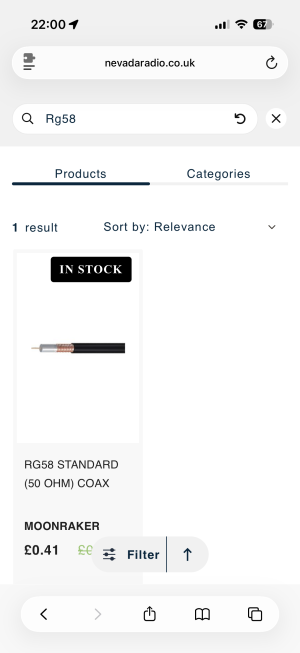
Theirs could very well be the worst site I’ve seen. They don’t even allow filtering by RG58 let alone specifying the sub type. They aren’t even documenting whether cable is tinned or not.
 
A simple search for RG58 yields one product. It says the cable is stranded and tinned.
Actually they sell three so you proved my point of how shite their website is.
I searched RG58, if this is tinned cable then it’s not tinned very well at all.
Some of us are a bit more thorough, and don’t deal with such organisations. I have neither the time nor patience to be sold the wrong thing.
IMG_0817.png
 
Nevada used to be based in Portsmouth harbour and was great, then got bought by Moonraker and moved to Hertfordshire. They know their stuff but aren't amazing at website design.

Martin Lynch and Sons in West London also good, especially the M&P cables they sell.
 
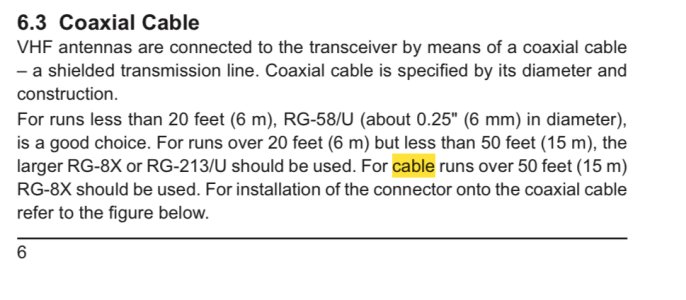
I had my lengths muddled but I knew I'd seen it somewhere. This is from the manual for my standard Horizon VHF/DSC/AIS. I used Glomex RG8x as the end fittings are pre fitted so no need to crimp/solder. The old RG58 I removed had been joined with domestic TV aerial adapters 🤦‍♂️
I now have a single run from masthead to VHF and the difference is astounding.

IMG_6098.JPEG
 
Weird that Shakespear supply 20m of RG58/u with their antennas and don’t mention this.

RG8X is twice as thick and feeding connectors down a mast rarely works.
 
Weird that Shakespear supply 20m of RG58/u with their antennas and don’t mention this.

RG8X is twice as thick and feeding connectors down a mast rarely works.
I think mine was about 10mm diameter. I quite enjoyed the process; I did all the mast electrics at once. I used the old tricolour wiring to pull through a mousing line and used the old tri/anchor to pull through a secondary mouse as reserve. I then more or less just pulled the new cables through. I was fairly surprised it went without a hitch :LOL:
 
I think mine was about 10mm diameter. I quite enjoyed the process; I did all the mast electrics at once. I used the old tricolour wiring to pull through a mousing line and used the old tri/anchor to pull through a secondary mouse as reserve. I then more or less just pulled the new cables through. I was fairly surprised it went without a hitch :LOL:
You got lucky. The hole at my masthead is 7mm and I fitted the cable while the mast was up. The hole could be drilled out if I take the masthead apart and remove other cables but that would require removing the mast.
 
I was lucky indeed to be able to do it with the mast down. I think doing it in situ in a bosuns chair would be fairly challenging!
 
In case anyone is interested (which I seriously doubt :D )
Attenuation Chart - 50 Ohm Coaxial Cable
This is their 5mm cable. As a radio ham, I know the guys at ML&S very well and they recommend Extraflex Bury 7mm for boat use due to it's better durability, UV protection etc.

EXTRAFLEX BURY 7 /.300

The EF Bury 7 @ 144MHz (closest to marine freq) spec shows a cable loss of 6.9db/100m vs 9.6db/100m for the Hyperflex 5.

I've previously recommended this cable in these similar threads ..


At £2.60/m the average yottie would need say 25m so £65 worth vs £1.50/m (£37.50) for the single core crap sold by the chandlers. That extra £27 spend would be well worth considering on a "mission critical" item such as this. (I hate that phrase as much as you do).
 
Last edited:
as an ex radio engineer
Hello Wonkywinch,
if I may ask your opinion, could any ballpark figures be approximated about this:
with my portable vhf radio at 5/6W and its tiny 20cm antenna (gain is unknown, surely not much), if I climb to my mast top (18m above seal level) and transmit I am ''loud and clear'' with shore stations about 20-25nm away ( I haven t tried more than that distance). I should not declare it as awfully illegal but the same happens if I test transmit from the top of an island say 30-50m asl. Of course totally free line of sight in both cases. Same results with the fixed set and its masthead antenna.
So at the same height asl, on one side a 5W transmitter with a poor antenna, on the other a 25W fixed set with transmission line attenuation from connectors, cables etc so X remaining watts at masthead, but a better antenna --> both seem to have similar actual minimum range.
In a new installation I agree to try and provide the best one can do (in particular cable choice), but to what extent is this fight against the marginal dB loss worthwhile? Difference in attenuation in a 10m tx line from rg58 to rg8 at marine vhf is about 1-1.5dB...
Just trying to figure out where theory and practice match :)
regards r.
 
Hello Wonkywinch,
if I may ask your opinion, could any ballpark figures be approximated about this:
with my portable vhf radio at 5/6W and its tiny 20cm antenna (gain is unknown, surely not much), if I climb to my mast top (18m above seal level) and transmit I am ''loud and clear'' with shore stations about 20-25nm away ( I haven t tried more than that distance). I should not declare it as awfully illegal but the same happens if I test transmit from the top of an island say 30-50m asl. Of course totally free line of sight in both cases. Same results with the fixed set and its masthead antenna.
So at the same height asl, on one side a 5W transmitter with a poor antenna, on the other a 25W fixed set with transmission line attenuation from connectors, cables etc so X remaining watts at masthead, but a better antenna --> both seem to have similar actual minimum range.
In a new installation I agree to try and provide the best one can do (in particular cable choice), but to what extent is this fight against the marginal dB loss worthwhile? Difference in attenuation in a 10m tx line from rg58 to rg8 at marine vhf is about 1-1.5dB...
Just trying to figure out where theory and practice match :)
regards r.
Don't read too much into your interactions with shore stations. I once got a "weak but readable" signal report from about the entrance to Cherbourg harbour, from Solent Coast Guard, broadcasting at -- 1 watt. 60 miles.

They have giant antennae, and high. You don't design your radio installation to be able to successfully communicate with the Coast Guard. You design it to communicate with an average installation in another vessel.

You want the best reasonably feasible antenna (e.g. an internal dipole like the lovely silver-plated Shakespeare Galaxy), with the best reasonably feasible feedline (RG-214 in my case, with silver plated conductor), and as few and as good connectors (Type N when you can) as possible.

In 99% of cases, the lesser attenuation won't make a difference, and you shouldn't break the bank or undertake some ridiculously difficult installation, chasing perfection. But you do it well, as well as reasonably possible, for that 1% of cases. 1.5dB will make a difference only in exceptional cases -- that's why our fixed stations have 25 watts. But you should still do it as well as reasonably possible.
 
Hello Wonkywinch,
if I may ask your opinion, could any ballpark figures be approximated about this:
with my portable vhf radio at 5/6W and its tiny 20cm antenna (gain is unknown, surely not much), if I climb to my mast top (18m above seal level) and transmit I am ''loud and clear'' with shore stations about 20-25nm away ( I haven t tried more than that distance). I should not declare it as awfully illegal but the same happens if I test transmit from the top of an island say 30-50m asl. Of course totally free line of sight in both cases. Same results with the fixed set and its masthead antenna.
So at the same height asl, on one side a 5W transmitter with a poor antenna, on the other a 25W fixed set with transmission line attenuation from connectors, cables etc so X remaining watts at masthead, but a better antenna --> both seem to have similar actual minimum range.
In a new installation I agree to try and provide the best one can do (in particular cable choice), but to what extent is this fight against the marginal dB loss worthwhile? Difference in attenuation in a 10m tx line from rg58 to rg8 at marine vhf is about 1-1.5dB...
Just trying to figure out where theory and practice match :)
regards r.
You might not notice the difference in transmitting unless the SWR was poor and I certainly wouldn't be rewiring for the gain benefit alone. If there is work to do and I had a choice of cable and connectors, I'd always do a cost/benefit calculation.

Lower losses mean better reception so you might be an extra mile away and not hear CG replying to you if you chose the lossier cable just to save a few bob when the labour cost and install hassle was identical whichever piece of wire you used.

Musicians strive for perfection an amateur can't hear, I spend days balancing my central heating and tuning the ASHP weather compensation. Sometimes people just like doing the best they can for a given situation.
 
Top