
Plevier
Well-Known Member
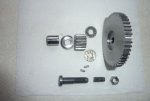
Dismantled this windlass (Pro 1000) expecting to find a stripped gear. Instead it's the spindle of a compound gear that has sheared. If you look at the pic from left to right, the pieces that stack on the spindle are:
first there is a plain hardened bush that runs in a needle roller bearing in the casing
then a hardened thrust washer
then the small gear is internally threaded and screws onto the spindle
then there is a needle roller thrust washer sandwiched between two washers
then the large gear, which is locked to the spindle by two dowels (used as keys not as pins)
then a nut (that goes inside a boss on the right of the large gear that runs in a needle roller bearing in the casing)
So why is it made like this? The small gear can only move on the spindle by however much slack there is in initial assembly. In the driving direction it screws down onto the plain thrust washer and locks solid; if torque was applied in the reverse direction it would screw up against the needle roller thrust washer to the large gear and lock solid.
I thought at first this was a slipping drive for if you are winding the windlass up with a ratchet spanner if the motor has failed but it isn't, it can't slip.
Can anyone see a purpose in this complex and vulnerable assembly? Why isn't it made as a one piece compound gear, like the other one in the drive train?
Now I have to try and get a spare - wonder if Lewmar will supply the spindle or only sell the whole assembled gear?
first there is a plain hardened bush that runs in a needle roller bearing in the casing
then a hardened thrust washer
then the small gear is internally threaded and screws onto the spindle
then there is a needle roller thrust washer sandwiched between two washers
then the large gear, which is locked to the spindle by two dowels (used as keys not as pins)
then a nut (that goes inside a boss on the right of the large gear that runs in a needle roller bearing in the casing)
So why is it made like this? The small gear can only move on the spindle by however much slack there is in initial assembly. In the driving direction it screws down onto the plain thrust washer and locks solid; if torque was applied in the reverse direction it would screw up against the needle roller thrust washer to the large gear and lock solid.
I thought at first this was a slipping drive for if you are winding the windlass up with a ratchet spanner if the motor has failed but it isn't, it can't slip.
Can anyone see a purpose in this complex and vulnerable assembly? Why isn't it made as a one piece compound gear, like the other one in the drive train?
Now I have to try and get a spare - wonder if Lewmar will supply the spindle or only sell the whole assembled gear?
Last edited:

