Beta Marine 30 engine not passing enough seawater through the Raw water cooling

Somewhat academic as you've bought a new one but you can test a thermostat by heating it in a pan of water and observing what temperature it opens at, or whether it opens at all.

 
Somewhat academic as you've bought a new one but you can test a thermostat by heating it in a pan of water and observing what temperature it opens at, or whether it opens at all.
Yes I learnt that in my 1st year of my motor vehicle mechanics apprenticeship in Henley. I think a mini 1000 thermostat was used but thank for tip, you weren't to know I am an ex car mechanic. Changed to computers in the 90s.
 
OK. Assuming the buzzer only sounds when the engine is properly hot and that the cooling water volume is not less than the Beta specification, then it has to be something covered in this thread. I see the possible link to the mud bank incident but that could be coincidence or some effect from full throttle running. These engines are simple and well made and you seem to have checked most things. Monitoring the temperature with an engine thermometer might shed some light on whether the problem happens at all throttle positions - test run in gear on the pontoon.
Just arrived on the boat. The first thing I did was switch on the ignition which is down in my cabin next to the battery switches and the engine battery is behind that panel panel.

I checked the box in the cockpit where the starter buttons are and the tacho.

Not a single light was on so that needs to be investigated too.
 
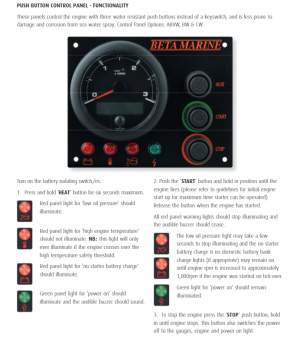
If you have a push button only panel then nothing comes on until you press the top heat button which energises the panel (explained in the handbook). all the lights should come on and the buzzer sounds. Mine is wired direct to the engine start battery with no separate "ignition" switch as it is not needed.

I looked at a photo of the original Volvo installation in a 1090 and it had a Vetus strainer on the bulkhead to the right of the engine well above the waterline. This is a very common method and would be fine for the Beta engine. If yours is like that, easy to check the inlet is clear by detaching the input hose from the strainer, lowering it below the waterline and opening the seacock. You should get a flood of water so shut the seacock and reconnect.
 
If you have a push button only panel then nothing comes on until you press the top heat button which energises the panel (explained in the handbook). all the lights should come on and the buzzer sounds. Mine is wired direct to the engine start battery with no separate "ignition" switch as it is not needed.
The green ight, the no charge warning light, the low oil pressure warning light and the buzzer but not the over-heating warning light
 

Attachments

  • 1690630601653.png
    1690630601653.png
    273.9 KB · Views: 19
If you have a push button only panel then nothing comes on until you press the top heat button which energises the panel (explained in the handbook). all the lights should come on and the buzzer sounds.
Or you can skip the pre-heating (I usually do in summer) and press the start button, and this will also energize the panel.
 
Re cleaning out the stacks - in my case the oil cooler but more usually the HE's, I was advised not to use wire coat hangers as they could damage the stacks, but soak over night in white wine vinegar, then use thin wire brushes - you can get different thickness sets very cheaply off Amazon.

Interesting thread and I will also be interested to learn the outcome.

Regarding cleaning out the tube stacks in the heat exchanger (Beta 28 in my case), I found that bamboo BBQ skewers made good non-scatching rodding tools, in combination with an acid descaler mix.

I was also surprised by the amount of scaling in the raw water cooling pipe, albeit it was not as severe as that shown on @ianc1200 's photos in post #33.
 
Interesting thread and I will also be interested to learn the outcome.

Regarding cleaning out the tube stacks in the heat exchanger (Beta 28 in my case), I found that bamboo BBQ skewers made good non-scatching rodding tools, in combination with an acid descaler mix.

I was also surprised by the amount of scaling in the raw water cooling pipe, albeit it was not as severe as that shown on @ianc1200 's photos in post #33.
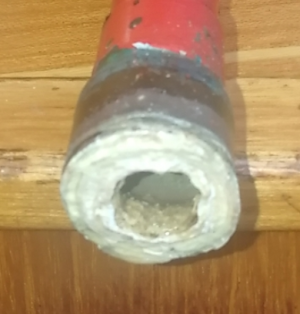
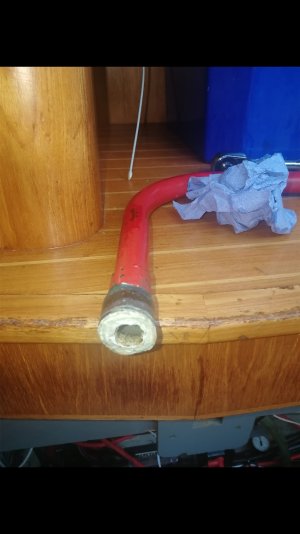
I just removed my raw water cooling pipe. I hadn't bothered as the heat exchanger end was clear. This was at the pump end, only for the first few cms and had built up in 250 hours. Screenshot_20230801_112938_com.android.gallery3d.jpg
 
Poor 2nd photo but the junction immediately on top of the raw water pump, on mine this goes across the top of the engine to an oil cooler, more standard would go to the HE. Equally poor 1st is partially cleared.

I just removed my raw water cooling pipe. I hadn't bothered as the heat exchanger end was clear. This was at the pump end, only for the first few cms and had built up in 250 hours.
I wonder what is causing this. Earlier I speculated that it could be heat from the engine when first shut down but its far two localised for that.
The pipe is presumably copper but what material is the water pump ?
 

Attachments

  • 1690893644009.png
    1690893644009.png
    348.1 KB · Views: 8
  • 1690893690231.png
    1690893690231.png
    223.1 KB · Views: 11
I wonder what is causing this. Earlier I speculated that it could be heat from the engine when first shut down but its far two localised for that.
The pipe is presumably copper but what material is the water pump ?
Pump internals are bronze I think, and clean. I thought it could be the heat at the start of the copper pipe but not convinced. It surprised me as it seems to need more attention than the impellor or heat exchanger.
 
Supertramp I saw your post on the Beta FB group earlier, this pipe/junction must be the first (& easiest) check for anybody to start with.
Agree, not hard to check. Unless, like me, you didn't realise it could build up at the "cool" end. Now I know I will be checking every 50 hours or so.
 
Is the pipe always full of water (I expect it is)? Or is it that when the engine is stopped for a while, the rest of the pipe is empty of water leaving just that bit with water round it such that only that bit gets the deposit??
No idea myself but if it is not heat related and not dependent on the permanent presence of water compared to other areas, what causes it? Is it the presence of air and there is an air leak/perished rubber pipe at that point? We have hard water and the WC gets limescale deposit at the water/air interface mainly.
 
I don't think it is full of water when been standing idle for a bit, but suspect the inch above the pump junction has water in it & hence why the limescale builds up there as it cools.
 
That makes sense, and would explain the variation between similar engines run in similar conditions, but set at different heights in the boat. Mine is fully below the waterline.

Best explanation yet.

Poecheng is right about the toilet too.
 
The green ight, the no charge warning light, the low oil pressure warning light and the buzzer but not the over-heating warning light
Mine is different.
Switch on the ignition next to the engine battery switch below. Start the engine and the green light comes on to show that the alternator is charging, which it is.

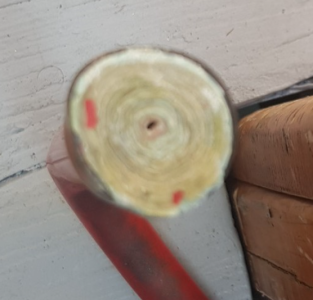
We have cured the sea water throughput. Changed the hoses from the seacock to the strainer and from the strainer to the impellor pump. Replaced the impellor, Unblocked the metal pipe that goes from the the output of the impellor over the top of the engine to the heat exchanger. That was blocked just like the photo of the calcium blockage with rings like a cut tree. Only a tiny hole for water to get through. Now it is chucking loads of water out the exhaust and no more white smoke (Steam).

Curiously when I first started it after the repair, the oil pressure warning light flickered briefly and has never come on again since. I no longer have to rev it to stop the buzzer as the buzzer does not come on when first started on tick over. However while we were steaming gently down the river, I heard an odd noise, this turned out to be the buzzer sounding like twittering, it comes and goes and twitters randomly. The oil level was checked and it was at maximum on the dipstick and the oil is still nice and viscous. Because the oil pressure light flickered for an instant and then the twittering sound began, we believe the oil pressure sensor may be faulty due to engine getting so hot before. That's a theory?

I also bought a thermostat & gasket and 2 new O rings for the heat exchanger cap ends. Because the repair on the sea water side was a success, the fresh water coolant side was only checked and topped up. When we returned after 3 days sailing and having used the engine for 90 minutes all together, When I removed the steps and exposed the front of the engine to turn off the seacock, the engine was still too hot and the separate engine bilge compartment was full of water. I think we should have replaced the thermostat and checked the heat exchanger again for alignment and replace the the 2 O rings and of course look through the tubes in the heat exchanger next to check that they were still clear after we had cleaned it out the weekend before.

So seawater side is good now but its still running too hot and boiling coolant I think so it is coming out of the over flow pipe?
 
Top