Beta Marine 30 engine not passing enough seawater through the Raw water cooling

Have you taken the pipe off from the pump to the HE? The system IS self priming provided the seawater pump is in good order. As a number of us have said you need to open the system up at every joint to see where the blockage is. You won't get airlocks because there is nowhere for air to get in.

Would help if you posted some photos rather than long explanations that don't help visualise your exact setup.

My guess from what you have written is that you have a ball valve inlet with an external grill then a strainer (attached to the top?) then a hose to the inlet of the seawater pump, then the long pipe that goes over the top of the engine to the HE. The outlet from the HE then goes up to an antisyphon and down to the injection point in the exhaust outlet.

You need to check that you are getting good flow at all of those points. So detach the hose into the pump with the seacock open. There should be a rush of water. Shut the seacock, reconnect the hose start the engine and disconnect the hose from the outlet to the pump. You should get a good flow of water. Shut down the engine. Reconnect the outlet, start engine and raise the revs a bit and disconnect the inlet to the HE. you should get a good flow of water there. If not the blockage is in the pipe. If good flow there then the blockage is in the HE or the outlet to the antisyphon and exhaust.

Following this kind of process is the only way.

The engine is overheating because there is insufficient seawater flow to cool the the engine coolant.
 
Just a brief note, I've been told it's better to fill some circuits from the bottom up to help avoid airlocks, which may apply to yours.
 
Have you taken the pipe off from the pump to the HE? The system IS self priming provided the seawater pump is in good order. As a number of us have said you need to open the system up at every joint to see where the blockage is. You won't get airlocks because there is nowhere for air to get in.

Would help if you posted some photos rather than long explanations that don't help visualise your exact setup.

My guess from what you have written is that you have a ball valve inlet with an external grill then a strainer (attached to the top?) then a hose to the inlet of the seawater pump, then the long pipe that goes over the top of the engine to the HE. The outlet from the HE then goes up to an antisyphon and down to the injection point in the exhaust outlet.

You need to check that you are getting good flow at all of those points. So detach the hose into the pump with the seacock open. There should be a rush of water. Shut the seacock, reconnect the hose start the engine and disconnect the hose from the outlet to the pump. You should get a good flow of water. Shut down the engine. Reconnect the outlet, start engine and raise the revs a bit and disconnect the inlet to the HE. you should get a good flow of water there. If not the blockage is in the pipe. If good flow there then the blockage is in the HE or the outlet to the antisyphon and exhaust.

Following this kind of process is the only way.

The engine is overheating because there is insufficient seawater flow to cool the the engine coolant.
Tranona,
Sorry about the lack of photos. I am 70 miles away from my boat and trying to get as much advice as I can, in order to resolve this problem on Friday so that we can go sailing on Saturday & Sunday.
You have described my setup exactly so I think my (maybe a bit long but that's the only way that I can thoroughly give you and others a description of it all without the photos.)

Your process is extremely helpful as I have been taking everybody's advice on board but have been unable to visualise the process from start to finish but you have now given me that visual process so I must thank you very much.

One issue and worry that I have is, what if the blockage is between the the sea water uptake grill and the sea cock or if it is the seacock ball valve that is partially blocked.

I have only just had a lift out and relaunch, plus 2 hours crane time to fit a new Mast head Wind transducer and I have a £500 bill to pay the boat yard.
I don't suppose anybody knows how I can address those issues (if that is what it is) with the boat still afloat....
 
One issue and worry that I have is, what if the blockage is between the the sea water uptake grill and the sea cock or if it is the seacock ball valve that is partially blocked.

I have only just had a lift out and relaunch, plus 2 hours crane time to fit a new Mast head Wind transducer and I have a £500 bill to pay the boat yard.
I don't suppose anybody knows how I can address those issues (if that is what it is) with the boat still afloat....
Unlikely to have a blockage there given your previous activities; if removing the hose to the seawater pump shows slow flow or a trickle then shut the seacock, remove the hose from it and check that hose and the hose from strainer to seawater pump is clear. Then with a piece of welding rod open the seacock and repeatedly poke outwards while enjoying the healthful effects of salt water bathing.
 
Unlikely to have a blockage there given your previous activities; if removing the hose to the seawater pump shows slow flow or a trickle then shut the seacock, remove the hose from it and check that hose and the hose from strainer to seawater pump is clear. Then with a piece of welding rod open the seacock and repeatedly poke outwards while enjoying the healthful effects of salt water bathing.
Thanks, Whilst We will have a 10 L bucket on standby I can imagine that my bone dry bilge is going to get a wash and the bilge pump will getting a workout after not being used for a long time 👍
 
Have you taken the pipe off from the pump to the HE? The system IS self priming provided the seawater pump is in good order. As a number of us have said you need to open the system up at every joint to see where the blockage is. You won't get airlocks because there is nowhere for air to get in.

Would help if you posted some photos rather than long explanations that don't help visualise your exact setup.

My guess from what you have written is that you have a ball valve inlet with an external grill then a strainer (attached to the top?) then a hose to the inlet of the seawater pump, then the long pipe that goes over the top of the engine to the HE. The outlet from the HE then goes up to an antisyphon and down to the injection point in the exhaust outlet.

You need to check that you are getting good flow at all of those points. So detach the hose into the pump with the seacock open. There should be a rush of water. Shut the seacock, reconnect the hose start the engine and disconnect the hose from the outlet to the pump. You should get a good flow of water. Shut down the engine. Reconnect the outlet, start engine and raise the revs a bit and disconnect the inlet to the HE. you should get a good flow of water there. If not the blockage is in the pipe. If good flow there then the blockage is in the HE or the outlet to the antisyphon and exhaust.

Following this kind of process is the only way.

The engine is overheating because there is insufficient seawater flow to cool the the engine coolant.
Tranona,
By air locks I mean trapped air from when the system drained down by gravity when the boat was stood on the hard. That water would be replaced by air. Air can be compressed and will stay, unless it is bled out. I know this from my days as a car mechanic and having to bleed the air out of the cooling system after draining down the coolant. The difference is that on a car or the freshwater/coolant side of the marine engine, it is a closed system so there is nowhere for that trapped air to escape except by bleeding it out.
I know that the raw water is not a closed loop but wondered if there could be air trapped and not being pushed out because the water pressure isn't high enough. Hence a blockage somewhere so we will start at the seacock ball valve and work our way through the system section by section or pipe union by pipe (y)
 
Would it help to fill up the system via a hose pipe from the highest point, to at least fill the whole system with water again.

We are going to try and find this restricted flow obviously but if we still get this spitting and spurting after everything. Would filling the system up completely with water help get the water flowing again. Might even have to plug the exhaust out let with something.....
Dont do this . It risks flooding the exhaust system and then getting water into the cylinders... then you will be in trouble !

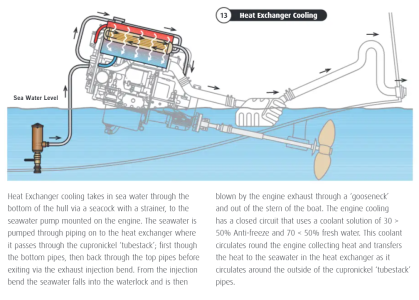
The attached diagram, copied from the Operators manual, shows and explains the flow through the raw water system from inlet to exhaust.

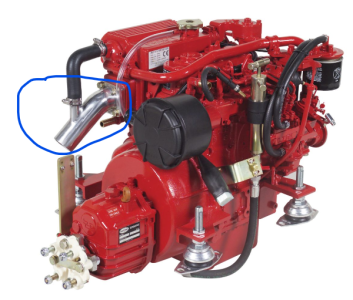
Have you checked the exhaust outlet bend and water injection point yet ? This part, ringed in blue in the second attached diagram.
 

Attachments

  • 1690294903195.png
    1690294903195.png
    399.2 KB · Views: 16
  • 1690295279584.png
    1690295279584.png
    416.4 KB · Views: 16
Dont do this . It risks flooding the exhaust system and then getting water into the cylinders... then you will be in trouble !

The attached diagram, copied from the Operators manual, shows and explains the flow through the raw water system from inlet to exhaust.

Have you checked the exhaust outlet bend and water injection point yet ? This part, ringed in blue in the second attached diagram.
VicS,

That was actually the very next thing on the list but I will check the flow of water coming in from the Seacock first and work my way hose by hose, to the exhaust elbow.
Thanks, about the previous advice, yes you are very correct the water would back up and eventually get into the cylinders through the exhaust valves. What a ridiculous idea Duhhh!!
 
Tranona,
By air locks I mean trapped air from when the system drained down by gravity when the boat was stood on the hard. That water would be replaced by air. Air can be compressed and will stay, unless it is bled out. I know this from my days as a car mechanic and having to bleed the air out of the cooling system after draining down the coolant. The difference is that on a car or the freshwater/coolant side of the marine engine, it is a closed system so there is nowhere for that trapped air to escape except by bleeding it out.
I know that the raw water is not a closed loop but wondered if there could be air trapped and not being pushed out because the water pressure isn't high enough. Hence a blockage somewhere so we will start at the seacock ball valve and work our way through the system section by section or pipe union by pipe (y)
It is quite normal for the water to drain out of the inlet when the boat is lifted or dried out. The pump is self priming and may well actually be below the waterline. As soon as the engine turns over it sucks water up through the inlet. If the strainer is on top of the inlet (as in the diagram in post#27) rather than being above the waterline as in the photo of my Beta 30 installation, take the top off and check that water is coming in through the inlet. If it above the waterline like mine make sure the hoses are properly attached because air can enter here. Also make sure the lid seals properly - silicon grease on the O ring helps. If it is this type you can always prime it by pouring some water in, but that really should not be necessary. The next cause of poor flow is the pump itself. You have checked the impeller, but it may also have wear on the face plate. Not common and usually obvious because of grooves worn in the face.

There is nowhere for air to get trapped after the pump. If flow is poor there must be an obstruction.
IMG_20220916_172758.jpg
 
It is quite normal for the water to drain out of the inlet when the boat is lifted or dried out. The pump is self priming and may well actually be below the waterline. As soon as the engine turns over it sucks water up through the inlet. If the strainer is on top of the inlet (as in the diagram in post#27) rather than being above the waterline as in the photo of my Beta 30 installation, take the top off and check that water is coming in through the inlet. If it above the waterline like mine make sure the hoses are properly attached because air can enter here. Also make sure the lid seals properly - silicon grease on the O ring helps. If it is this type you can always prime it by pouring some water in, but that really should not be necessary. The next cause of poor flow is the pump itself. You have checked the impeller, but it may also have wear on the face plate. Not common and usually obvious because of grooves worn in the face.

There is nowhere for air to get trapped after the pump. If flow is poor there must be an obstruction.
View attachment 160714
Thanks Tranoma,
My engine is mounted higher than yours. My boat has a very low profile above the water but a deep hull shape and long keel . I have to access it from the front by removing the steps or from my aft cabin by removing covers on the back.

My strainer is low fairly low and only 30 cms above the the stopcock ball valve. I was in the cockpit starting the engine and looking over the side at the exhaust for water pumping out. My friend said the strainer was not filling up very much, only about 30mm in it at anytime. Im pretty sure when I bought the boat, it was filling up a lot higher than that.

I will check all these things you mentioned, the cap, the pipe, the silicone grease. I have several types of winch grease, I think one or all of them contains silicone...


Thanks R
 
The strainer won't fill up when the engine is running if it is above the waterline like mine - just enough to cover the outlet. The inlet from the seacock is higher than the outlet so you see water coming up and spilling over the top. when you stop the engine the water level falls but leaves sufficient head to keep the hose and the pump full. The sealed top creates a vacuum so that when you start the engine again it sucks water up from the seacock. Once the water is flowing the rate of flow is governed by the speed of the pump. If it is below the waterline like the one in the Beta diagram it will fill up to the top. What sort of strainer is it?

BTW my engine is deceptive. The waterline is just below the bottom of the water strainer on the left.
 
One minor correction - from sea water inlet to exhaust. Likely you have a sail drive. Some Beta engines take their water from a hole in the saildrive leg and since you ran aground this may be part blocked. But ianc1200 is right. Follow the sythem through from sea water coming in to sea water being dumped from the exhaust.

Could be you have fried the engine and got a cylinder head gasket leak etc, but start with the simple things first. Dont get mechanical hypochondria and go for the complicated and expensive issues until all the silly minor ones have been checked out.
No, standard shaft driven engine, not a sail drive.
 
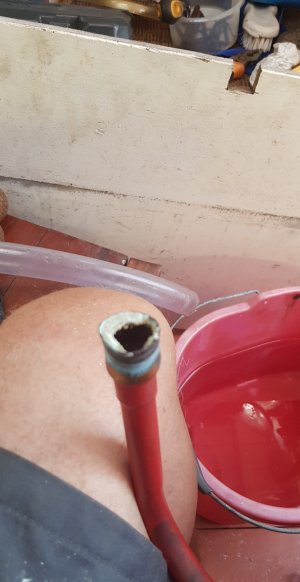
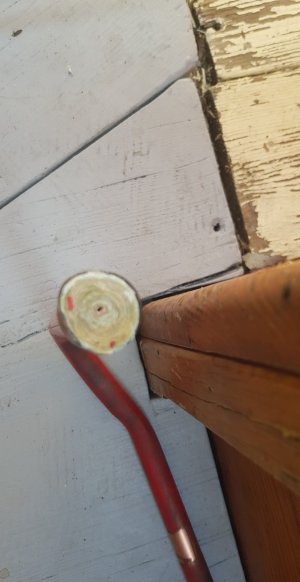
Poor 2nd photo but the junction immediately on top of the raw water pump, on mine this goes across the top of the engine to an oil cooler, more standard would go to the HE. Equally poor 1st is partially cleared.Partially cleared pipe.jpgBlocked pipe.jpg
 
Poor 2nd photo but the junction immediately on top of the raw water pump, on mine this goes across the top of the engine to an oil cooler, more standard would go to the HE. Equally poor 1st is partially cleared.
Why has the pump discharge pipework become so heavily scaled?.

.
 
Why has the pump discharge pipework become so heavily scaled?.

.
Watching this thread with interest.

If I understand this (and it's similar on my Beta engine) the raw water pump exit runs in a pipe over the engine top to the entry point on the HE. I find scale in the first (entry) chamber to the HE (the one with the anode). At least some builds on the chamber walls but I'm now thinking the pipe could also be the source.

Does anyone understand what causes scale to form? I thought it was heat driving calcium salts out of solution. But the transfer pipe only picks up radiated engine heat.
 
On my outboard I knackered the impellor and it looked perfect when taken out. New impellor and the cooling was back to normal. Spent ages comparing old with new and couldn't see any difference.
 
Watching this thread with interest.

If I understand this (and it's similar on my Beta engine) the raw water pump exit runs in a pipe over the engine top to the entry point on the HE. I find scale in the first (entry) chamber to the HE (the one with the anode). At least some builds on the chamber walls but I'm now thinking the pipe could also be the source.

Does anyone understand what causes scale to form? I thought it was heat driving calcium salts out of solution. But the transfer pipe only picks up radiated engine heat.
Heat decomposes bicarbonate ions forming carbonate ions, Calcium carbonate has a vey low solubility and is therefore deposited as scale .

I cannot believe the pipe in question becomes heated while the engine is actually running but perhaps when it is shut down heat from the engine is sufficient to cause the scaling.

.
 
A good idea indeed. I have already decided to buy a new impellor for the raw water pump and as the coolant boiled when I got stuck in the mud for 35 minutes, I'm going to be thorough and replace the thermostat also. These will be replaced after every pipe and coupling has been carefully examined for blockages. The blockage in the 2nd photograph by ianc1200 is crazy.

Oh and I have to say that I think that my strainer is just below the waterline. The stop cock ball valve is about 30cms below that
 
Heat decomposes bicarbonate ions forming carbonate ions, Calcium carbonate has a vey low solubility and is therefore deposited as scale .

I cannot believe the pipe in question becomes heated while the engine is actually running but perhaps when it is shut down heat from the engine is sufficient to cause the scaling.

.
This is essentially what the guys on the pontoon said in less technical terms, and why they said look there first. I wish I had listened, would have saved a lot of time.
 
Don't altogether discount the fact that the pressure washer just, may have, pushed a lump of mud up into the inlet. Can you disconnect the inlet hose and open the seacock to check the flow?
 
Top