penfold
Well-Known Member
Somewhat academic as you've bought a new one but you can test a thermostat by heating it in a pan of water and observing what temperature it opens at, or whether it opens at all.


Yes I learnt that in my 1st year of my motor vehicle mechanics apprenticeship in Henley. I think a mini 1000 thermostat was used but thank for tip, you weren't to know I am an ex car mechanic. Changed to computers in the 90s.Somewhat academic as you've bought a new one but you can test a thermostat by heating it in a pan of water and observing what temperature it opens at, or whether it opens at all.
Just arrived on the boat. The first thing I did was switch on the ignition which is down in my cabin next to the battery switches and the engine battery is behind that panel panel.OK. Assuming the buzzer only sounds when the engine is properly hot and that the cooling water volume is not less than the Beta specification, then it has to be something covered in this thread. I see the possible link to the mud bank incident but that could be coincidence or some effect from full throttle running. These engines are simple and well made and you seem to have checked most things. Monitoring the temperature with an engine thermometer might shed some light on whether the problem happens at all throttle positions - test run in gear on the pontoon.

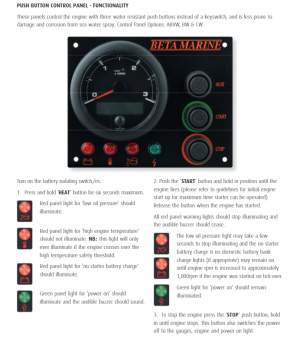
The green ight, the no charge warning light, the low oil pressure warning light and the buzzer but not the over-heating warning lightIf you have a push button only panel then nothing comes on until you press the top heat button which energises the panel (explained in the handbook). all the lights should come on and the buzzer sounds. Mine is wired direct to the engine start battery with no separate "ignition" switch as it is not needed.
Or you can skip the pre-heating (I usually do in summer) and press the start button, and this will also energize the panel.If you have a push button only panel then nothing comes on until you press the top heat button which energises the panel (explained in the handbook). all the lights should come on and the buzzer sounds.

Re cleaning out the stacks - in my case the oil cooler but more usually the HE's, I was advised not to use wire coat hangers as they could damage the stacks, but soak over night in white wine vinegar, then use thin wire brushes - you can get different thickness sets very cheaply off Amazon.

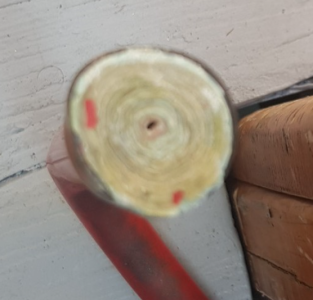
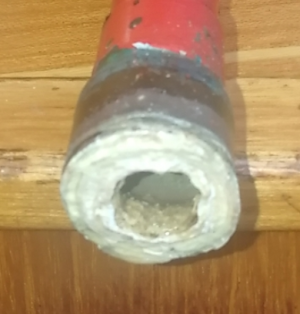
I just removed my raw water cooling pipe. I hadn't bothered as the heat exchanger end was clear. This was at the pump end, only for the first few cms and had built up in 250 hours.Interesting thread and I will also be interested to learn the outcome.
Regarding cleaning out the tube stacks in the heat exchanger (Beta 28 in my case), I found that bamboo BBQ skewers made good non-scatching rodding tools, in combination with an acid descaler mix.
I was also surprised by the amount of scaling in the raw water cooling pipe, albeit it was not as severe as that shown on @ianc1200 's photos in post #33.
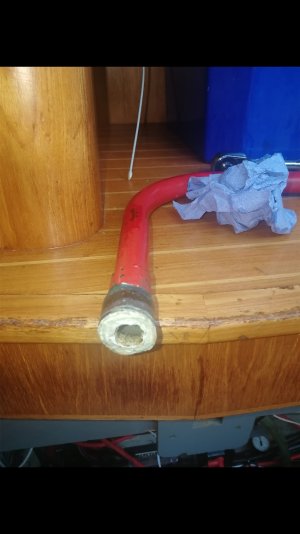
Poor 2nd photo but the junction immediately on top of the raw water pump, on mine this goes across the top of the engine to an oil cooler, more standard would go to the HE. Equally poor 1st is partially cleared.
I wonder what is causing this. Earlier I speculated that it could be heat from the engine when first shut down but its far two localised for that.I just removed my raw water cooling pipe. I hadn't bothered as the heat exchanger end was clear. This was at the pump end, only for the first few cms and had built up in 250 hours.
Pump internals are bronze I think, and clean. I thought it could be the heat at the start of the copper pipe but not convinced. It surprised me as it seems to need more attention than the impellor or heat exchanger.I wonder what is causing this. Earlier I speculated that it could be heat from the engine when first shut down but its far two localised for that.
The pipe is presumably copper but what material is the water pump ?

A short distance - less than an inch. Little adhesion to the flexible coupling pipe. I am mystified about how local it is. Rest of the pipe is clear.How far does the calcination extend along the pipe?
Agree, not hard to check. Unless, like me, you didn't realise it could build up at the "cool" end. Now I know I will be checking every 50 hours or so.Supertramp I saw your post on the Beta FB group earlier, this pipe/junction must be the first (& easiest) check for anybody to start with.

Mine is different.The green ight, the no charge warning light, the low oil pressure warning light and the buzzer but not the over-heating warning light