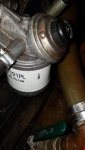
Beta engine breakdown in the clyde !

It could be an air leak on one of the unions. This happened to us years ago in Holland about 50hrs after fitting a new engine, fuel tank and pipework. Did the usual change filters etc and in desperation called the Beta agent in Ipswich who said it's an air leak - tighten all the unions - which I did and it's been fine since.

As I was reading through, checking for air leaks was my first thought before replacing filters. Open the bleed screw at the primary filter and use the manual lift pump to see if air comes out as a first check along with any evidence of diesel leaking at any joint. Failing this yes, check the filters (secondary first) trying to run it after each change.
 
Before doing this, I would first run it up, in gear, in the marina and prove to youself you can still see the fault.

When you do something (changing a filter, tightening the unions, whatever) do one at a time, and again, check for the fault.

This is the only way to be sure you have fixed it ...
 
Didn't know engine had to be to be in gear- in fact said to my girlfriend running in neutral but revved up must be the same as in gear ! Didn't try the low revs thing either- we had it full blast most of time as were desperate to get to marina.

Diesels use fuel in a very direct relationship to the amount of work they are doing. So running in neutral at any revs = low fuel consumption. Similarly, running in gear under light load = low fuel consumption. Clearly an engine with partially clogged filters may run perfectly well under light load, allowing it to tick over indefinitely or limp home at low revs. The same filter may not allow high-load running. Equally, only high-load running will confirm that a filter is delivering the amount of fuel it should.

Did i mention that ???

The issue you addressed (and quoted from) was running in gear versus in neutral. So implicitly, yes you did. You might more pertinently have addressed your point, which no-one denies has merit, directly to the OP's mention of running alongside. Polite questions, by the way, are followed by a single punctuation mark.
 
Do others panic in this sort of situation? Or just calmly sail into the marina? We wouldn't be able to do that- we're still at the 'which side of the boat do we put the jib out on again?'

Cheers

Haha, been there, done that and bought the T shirt!

It's all about experience (says he, with not that much himself in reality). First 'big' boat I bought a few years back had a duff fuel lift pump, and would conk out at annoying moments. Myself and a couple of friends found ourselves having to sail up the Clyde (the river, beyond number 1 buoy at Greenock) to get the boat back into the marina. Fortunately the wind was from the west, so it was an easy task, using just the headsail.

This summer, I had an engine overheat just as I was about to enter Pulladobhrain (sp?) up near Oban on a horrible day. My options were to abort and turn tail for Oban itself (thus losing all the Southing I had made that day) or short tack into the narrow anchorage. I chose the latter and quickly dropped anchor in the first available space.

But that slightly higher confidence in being able to do that has been through 2 things:
1) dinghy sailing for a couple of seasons I reckon made me a 50% better 'sailor'
2) just getting the sea miles piled on, and practicing as much as possible anchoring under sail, mooring under sail, sailing off the anchor, and generally trying to use the engine as little as possible.

Just build your skills and confidence i them as you go. I've realised that sailing is a long term hobby and that I'm constantly learning new things.

Good luck with getting the engine sorted btw.
 
Cheers Steve. Yeah I'd love to learn all that because at the moment we find it quite hard to enjoy the actual sailing bit because we are always waiting for something to go wrong. Love the whole boat ownership thing,sitting on our mooring at Crinan in nice weather is magic, love reading about sailing - it's just the bloody sailing that's the problem! It will come though.

I was thinking of joining the wee sailing club at loch winnoch, not sure I fancy dinghy sailing that much but everyone says it makes them much better on a bigger boat
 
Re "panicking"

Always make sure your anchor is ready to be deployed. If you really can't start the engine and can't sail, and are close to the shore, then drop the anchor. That will keep your boat safe and give you time to sort the problem without having to panic about it. It worked for us when the motor stopped 100 metrres from the harbour entrance in a F6
 
Cheers Steve. Yeah I'd love to learn all that because at the moment we find it quite hard to enjoy the actual sailing bit because we are always waiting for something to go wrong. Love the whole boat ownership thing,sitting on our mooring at Crinan in nice weather is magic, love reading about sailing - it's just the bloody sailing that's the problem! It will come though.

I was thinking of joining the wee sailing club at loch winnoch, not sure I fancy dinghy sailing that much but everyone says it makes them much better on a bigger boat

You should do it! It's great fun. I could already sail (knew the basics) but dinghy sailing is proper sailing by the seat of your pants stuff. Make an a*se of it and you go swimming! I did my sailing at Strathy loch and my level 2 dinghy cert at Bardowie. Could recommend both clubs. If I had the time, I would still do some dinghy sailing but trips on the big boat get in the way.
 
All good advice already.

If your fuel is really dirty (years of previous ownerships?), then consider having the tank drained and cleaned when boat is ashore. Else use fuel-conditioner, carry plenty of spare filters and get used to changing the primary filter perhaps twice a year as a preventative.

My boat fortunately has a drainage cock below a mini-sump at the lowest point of the tank easily accessible in the engine-bay, so draining off any crud is easy peasy at each engine service. Normally only a couple of teaspoons at most of muck comes out, then it runs clear with just red diesel.

The other thing I recently did was fit a Racor primary filter - for mess-free changing of filters.

Jon

PS Take every opportunity to sail onto and off moorings and pontoons, and also into and off anchorages. That way your luck will improve!
 
When this happened to me it was crud in the tank blocking the fuel uptake line. The filters were clean. I took off the fuel lines and renewed them and drained the tank via the sump. There was crud there. I have used Marine 16 anti bug ever since and all has been well.
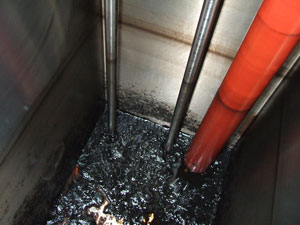
That's how my diesel bug/crud problem presented. The engine kept stopping after a sail in not very rough seas. Bimbling around in the marina or calm water wasn't a problem. Both the fuel/water separator filter and the engine filter were clean. The bottom of the tank had this:
Tank1.jpg

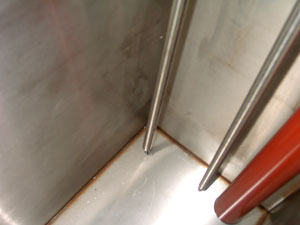
...and the engine then ran perfectly when it was like this:
Tank2.jpg

;)

Two compounding factors delaying me emptying the tank were:
- My mates helpfully topped up the tank I was running down, as a thank you for taking them sailing for a week. 50litres of diesel - numpties.:D
- Air was appearing in the engine fuel filter and I thought it was leaky joints. I tightened them all up and the engine then wouldn't run at all! Numpty.:D

In the absence of an inspection hatch you can sample the bottom of a tank very easily via the filler pipe:
If I were the OP that's what I'd do.
 
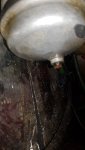
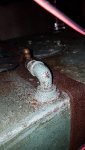
Folks see the 1st and 3rd photo
That's my primary filter
Do i turn off the fuel and undo the screw on photo 1 and see what drains out? Then take the filter off and replace it with a new one?
Thanks
 
The only thing that occurs to me that's not already been mentioned would be to check that the fuel tank breather isn't blocked or partially blocked...
 
As I was reading through, checking for air leaks was my first thought before replacing filters. Open the bleed screw at the primary filter and use the manual lift pump to see if air comes out as a first check along with any evidence of diesel leaking at any joint. Failing this yes, check the filters (secondary first) trying to run it after each change.
+1
 
I know Spyro what was I thinking!

Can someone tell me exactly where the bleed screw is on the primary filter - Is it the screw on the bottom of it? I can't see any others.thanks
 
Top... always bleed from the highest point

the bolt right on the top... loosen it off a bit, then push the big black button which is a hand pump to push out any air in the system. When no more air is coming out, tighten bolt again.
 
Last edited:
good choice not going round the Mull :)

You seem to be confusing Crinan12 with somebody else...
Think folk suggesting luck just mean lucky in terms of a good weather window to have opportunity to go.
Spyro my girlfriend is good, probably less of a whinger than me actually.
Sailing is luxurius compared with our other hobbies so the roughing it won't be an issue I don't think. It's just we've found the first 2 years of boat ownership amazing but also quite nerve wracking some of the time and that's mainly been pottering about between Crinan and Craighouse. So going round the mull would be a big deal for us.
If we don't manage to get round the mull this year I think we will do a trip to the clyde in fair weather next summer just so if we attempt the same trip later in the year to get home we've at least experienced it before

Yes engine reliable and not old.

Cheers
:D
 
Top