Best spotting scope/camera for shore-based photo/video of sailing and shipping?

I was thinking of the Mavic Pro as the item that would cost double what the Nikon would...

...but however little I know about photography, I am really in the dark on drones. So your suggestion is still very interesting, cheers.
 
Gentlemen, thank you for your responses. I should have predicted I would immediately be at sea in the turbid waters of my ignorance.

Given that for my purposes, my phone (a top Samsung from 2019) captures very fair images for almost any situation at close range, I would be shopping purely for something that can do what the phone (or the phone plus a scope) cannot.

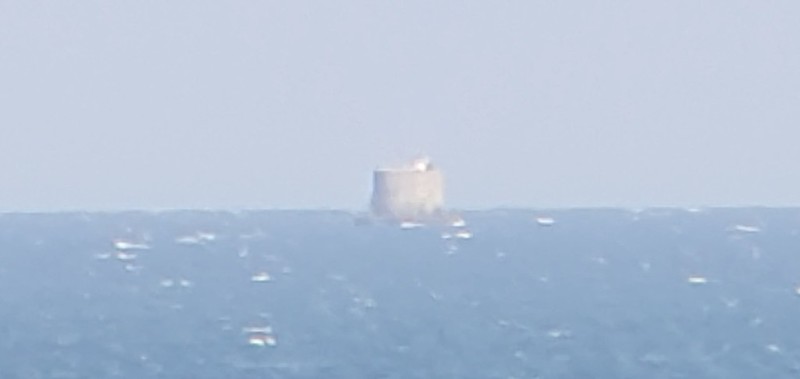
For instance, the five-mile Nab Tower pic in my opening post was caught by pointing the Samsung through my excellent but not extraordinary Bynolyt 50mm binoculars, balanced on a fence post - so, 7x optical, increased (but doubtfully enhanced) by the phone's 10x digital zoom. I realise how inferior digital enlargement of distant objects tends to be. Obviously I am hoping to gain magnification, and precision at high magnification.

Having started the thread last night, I found what seems to me to be the pleasingly single-purpose bridge Nikon P950 and P1000...and I was ready to order one, when I found a video that compared the images captured at up to three nautical miles, by the P1000 and a Samsung S23 Ultra smartphone from last year...


...and it is dazzling how competent (in fact, how superior) the phone is, up to 10x zoom. It's also staggering that any recognisable image is produced at what the phone calls '100x zoom', given that the digital enlargement must be eeking out detail captured by a tiny lens.

The wonderful precision of the Nikon's pictures at 125x zoom is undeniable and certainly does make it tempting, although I'd be in for a bigger-than-intended bill (and need a bigger than expected case) when I've acquired a good tripod. What I wonder is whether I'll need a new phone anyway by next year, and just how good a picture that Samsung S23 might take, looking through my binoculars!

I found comments made in favour of the slightly newer, significantly smaller and less costly Nikon P950 compared with the P1000. Is that likely to be a consequence of the P950's advances (it's only 18 months more recent) or is it only better if one considers that it is smaller and a lot lighter? 83x zoom seems like a lot less power than the P1000's 125x, if all I would be buying it for, is distance shots.

All your thoughts and suggestions are welcome, thank you.
.
Bit of history and an explanation .... focal length of lenses which tells you if the lens is wide-angle or telephoto is measured in mm and references the old 35mm film format from last century.

It is not the zoom factor that dictates how much magnification you get .... every camera lens has a field of view, the distance from the centre of the lens to the image focal point (which is the image sensor surface) and this is the focal length. It is expressed in millimetres (mm). A lens with a short focal length is a wide-angle lens and one with a long focal length is a telephoto lens. A 50mm lens represents a human field of view, so was always one of the prime lenses that every photographer had in their bag for street and portrait photography. The bigger the field of view value (mm), the closer you're subject will seem and the more of the frame it will cover.

Consumer camera manufacturers are a bit sneaky when it comes to marketing their cameras .... for example an equivalent 24-240mm zoom camera is a 10x zoom .... but it has only half the "reach" of a wildlife 500mm telephoto ..... so check out the "equivalent" mm value of the fully zoomed camera to find out exactly what you are getting.

I used the word "equivalent" because the sensor size also contributes, the standard mm values on all interchangeable lens cameras are referenced to old 35mm film, so a "full frame" sensor is the same size as 35mm film and will produce the same field of view as 35mm film when used with the same lens. A smaller sensor introduces a crop-factor, which is also effectively a zoom - typically in mirrorless or SLR cameras the smaller sensor is an APS-C (same size as an Advanced Photo System film negative in its C ("Classic") format) which produces an effective zoom of 1,6x compared to what a full frame sensor will see. So a 100mm lens becomes an effective 160mm on an APS-C sensor camera.

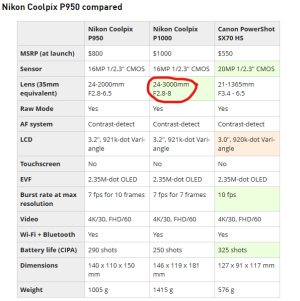
For comparison purposes, the only way to determine what the actual reach of the telephoto lens of a camera is, is to look at the highest "35mm equivalent" focal length is in mm.

1732868633899.png
Nikon Coolpix P950 review

From this table, the P1000 has a 125x zoom and the Canon a 65x zoom but because the Canon starts from a wider angle, the zoom multiplier value is misleading as the max focal length is not half of the P1000, it's only around 45% so cameras offering wider wide angle values, can quote higher zoom factors but don't necessarily have a higher reach.

Do bear in mind that the longer reach also affects the equivalent f-stop value, lower is better and effectively lets in more light, making shutter speeds faster which is important to avoid shake and movement at high zoom settings. The scale is not linear, with f2,8 letting in twice as much light as f5,6 .... modern cameras compensate with image stabilisation and some cameras are better at this than others. f-number - Wikipedia

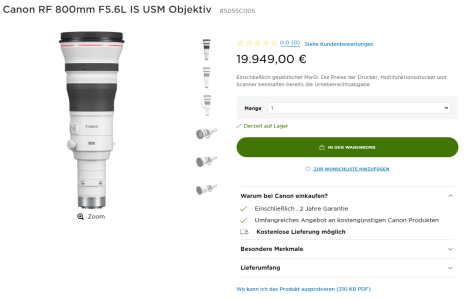
Getting a lower f-stop and higher focal length can be eye-wateringly expensive ... for a full frame sensor mirrorless camera, a 800mm, F5,6 lens is huge and costs around €20k

1732869556453.png

,,, so the P950/P1000 looks like a bit of a bargain.

Be aware that these massive zooms are best for getting really close to subjects that are relatively small or not that far away. As already pointed out, zooming over huge distances works, but creates washed-out images due to atmospheric distortion and inherent haziness, and is very susceptible to camera shake.

There is an awful lot that can be done these days if you shoot in RAW and post-process using AI tools to produce very acceptable images from mediocre photos - they can't solve the 2 most important aspects of a good photo though, subject and composition.
 
PS .... once you get bitten by the photography bug, you will appreciate a good camera over a phone .... control over depth of field, motion blur, and other creative effects is still IMO better on a dedicated camera than a mobile phone.

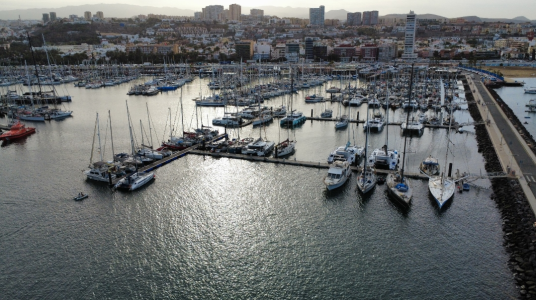
This is one of my favourite photos in my portfolio, I couldn't do it on my Samsung s22+

1732870339619.png
 
Last edited:
My wife just got a second hand panasonic lumix bridge camera from CEX. It has a big screen and a 60 times zoom. Very impressed and it comes with a 12mth warranty for under £200.
Sadly you can't get super zoom compact cameras any more. I guess they were too expensive to be profitable, and the manufacturers are doing blogging cameras instead.
 
Baggywrinkle, many thanks for those posts. What I didn't understand, I'll read again and research, to make sense of.

At present, in my simplicity, it seems that the fact that there are impressively scaled but basically unsophisticated cameras for easily-pleased customers like me who want their holiday snaps to benefit from huge reach, means those products are still very appealing.

Half the problem would appear to be finding a P1000, given that it is no longer produced.

Are the (apparently new, unpacked) marked-up examples offered on Amazon and elsewhere, likely to be just genuine items of old stock, or part of an elaborate rip-off for zoom-greedy newbies like me?
.
 
Baggywrinkle, many thanks for those posts. What I didn't understand, I'll read again and research, to make sense of.

At present, in my simplicity, it seems that the fact that there are impressively scaled but basically unsophisticated cameras for easily-pleased customers like me who want their holiday snaps to benefit from huge reach, means those products are still very appealing.

Half the problem would appear to be finding a P1000, given that it is no longer produced.

Are the (apparently new, unpacked) marked-up examples offered on Amazon and elsewhere, likely to be just genuine items of old stock, or part of an elaborate rip-off for zoom-greedy newbies like me?
.

For pleasing good-quality photos they will be fine, there is enough control to get good shallow depth of field and if you become a dedicated amateur photographer it will take a few years before you hanker for a bit more flexibility. Just be aware you won't get the same clarity at 3 km as you will at a few hundred meters - and it's go nothing to do with the camera pre-se - not even cameras costing thousands with exotic lenses can photograph with absolute clarity at long distances (looking up into a clear night sky is a different matter). Due to atmospheric haze and heat effects, you get low contrast images and heated disturbed air will distort the image too. Finally, blurring if the camera isn't rock-steady for the length of the exposure and perspective compression, although a matter of taste, also can detract from a perfect image.

You should be OK buying from Amazon as their return policy is bulletproof - and if you don't like the idea of refurbished p1000 then a p950 can be had new from the Nikon Store on Amazon. The effort required to make a fake camera close to the quality of a Nikon is technologically beyond the ability of anyone who isn't a camera manufacturer - basically, if they can make a camera of that sophistication, they might as well start a legit camera company. There are occurrences of cheap crap cameras being labelled as Canon or Nikon but they don't even resemble current models so are easy to spot.
 
Hi, I have a p900 and a p1000. Bought the p1000 specifically for long range shots and i am happy with its performance. Bought it from wex photo as a return model with a 1 year warranty still boxed, I think it may have been ex display it was cheaper than a lot of 2nd hand ones on ebay. P1000 is a lot heavier and bulkier than the p900 but the image stabilization is remarkably good as I use it hand held.
 
Seems like a decent option for casual marine photography. DJI claims it can deal with winds up to F5. I'm sort of tempted to upgrade our ancient Mavic Pro, if just for the better image quality.
...and, done. Turns out I could find one for €200 on a Black Friday sale in one of the electronics shops here.
Didn't have chance to really put it to test, but it does fly and take photos.
ffGekzV93PbmPthvM0WfPbePT0BqyudqKcl7awHH.jpg

Screenshot_20241129_232407_Photos.png
 
July 2025

In the end I waited long enough for the withdrawn Nikon P1000 to be reintroduced (almost unchanged) as the P1100.

The P1100 generates plenty of scorn among serious photographers for its low-megapixel sensor, but for use as a compact telescope that can capture distant views, it seems to have few (if any) rivals at its cost.

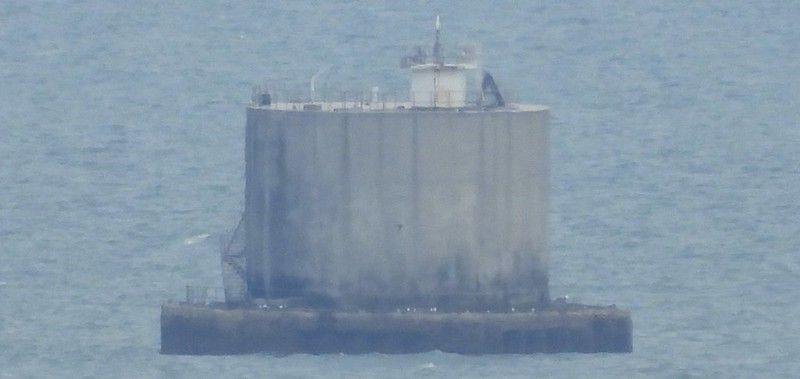
I'm still woefully inexperienced with the camera's settings and I didn't have the best luck with visibility on this year's holiday, but below is my Nikon P1100 photo of the Nab Tower, taken from Culver Down (over 5.5 nautical miles); and beneath it is my earlier, execrable smartphone-and-binoculars benchmark photo from 2024 at almost the same distance. I'm happy with the improvement. :)

54640478709_ab1437e49d_c.jpg


54167430814_b03e8ff406_c.jpg


Thanks again for the advice, here! 👍
 
We could hear the Nab at night from Seaview and even in its shrunken form is visible from the garden with unassisted eyeball. If at Culver the Haven is for island fare a worthwhile venue with a friendly staff but you tend to need to book by phone.
 
Bit of history and an explanation .... focal length of lenses which tells you if the lens is wide-angle or telephoto is measured in mm and references the old 35mm film format from last century.
I think you're misusing telephoto - that means the lens is physically shorter than it's focal length. You can have an 8mm pancake telephoto.
 
I think you're misusing telephoto - that means the lens is physically shorter than it's focal length. You can have an 8mm pancake telephoto.
As a nerdy side-note, that is factually correct, but misleading as the common understanding of "telephoto lens" in photography is that the lens magnifies distant objects.

telephoto lens

Pancake lenses are an anomaly as their extremely short physical length allows then to technically qualify as "telephoto" while having a field of view wider than the standard (50mm) lens, resulting in no magnification of the subject.

I would not expect a lens review titled "Telephoto Lenses" to include pancake lenses, would you? ;)
 
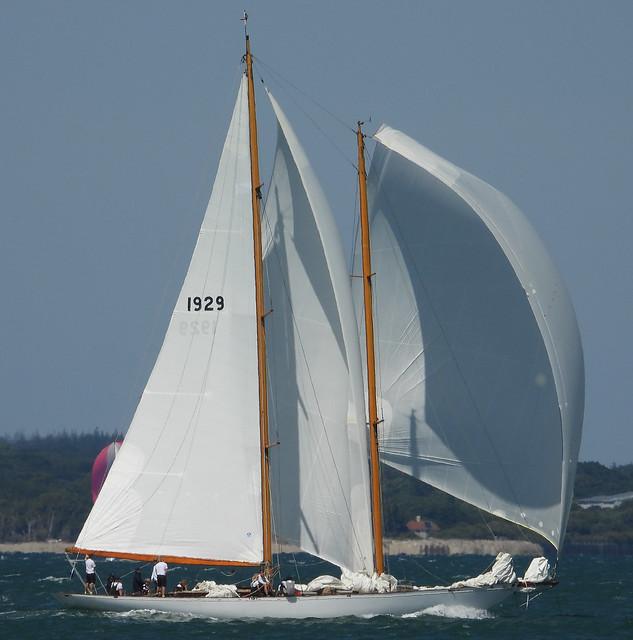
I meant to reiterate that of course, I had bought the Nikon mainly for capturing photos of distant boats. I was lucky while standing near Fort Victoria this month, to see the lovely schooner Viveka passing with a good force 5 making the most of her asymmetric kite. I estimate she was somewhat less than a mile away.

54665730037_8dfe8c8cec_z.jpg


For context, below is the photo I took in the same few minutes using my Samsung phone...

54666785623_4137e5b8b1_z.jpg


I actually took loads of photos of Viveka with the Nikon in the minutes that followed, but in the fresh breeze with no tripod (and very little experience) the photos are pretty poor. I haven't yet learned how to crop or improve photos - I don't even know whether the pics I have put on Flickr, are 'raw' or some other category of image. There's plenty to learn (I need to re-read all of this thread for a start ;)).
 
Top