Best screws for galvanised rowlocks?

I don't understand why one would object to using galvanised fastening to secure a galvanised fitting.

Innumerable small craft (barges, fishing boats, workboats, pleasure boats, etc.) and wooden marine structures (pontoons, piers, landing stages, light towers, groynes, dolphins, etc.) have been put together using galvanised fittings and fastenings, and many have lasted decades.
 
From the days when I worked on the old clinker rowing dinghies that I had I used galvanized sockets for the rowlocks and secured them with 1 × 8 galvanized screws. Before each screw was inserted it was dipped into anhydrous lanolin and the surplus that squeezed out when it was screwed in was rubbed over the head using a finger.
I still use the lanolin with all types of screw. I'm running a bit short now, I bought 2 cans from Thomas Foulkes in the 1960s and have started on the second can as the first is only half full and it is hard to get the whole shaft of a screw covered.
 
I don't understand why one would object to using galvanised fastening to secure a galvanised fitting.

Innumerable small craft (barges, fishing boats, workboats, pleasure boats, etc.) and wooden marine structures (pontoons, piers, landing stages, light towers, groynes, dolphins, etc.) have been put together using galvanised fittings and fastenings, and many have lasted decades.
Don't think there is any objection to using good galvanised screws - just that they are not as readily available as stainless which you can get in small quantities at any chandlers.
 
Don't think there is any objection to using good galvanised screws - just that they are not as readily available as stainless which you can get in small quantities at any chandlers.
Exactly. Galvanised screws and bolts available nowadays from vast numbers of outlets are not produced by immersion in molten zinc, they are electroplated. Their finish is bright, so they look better, but the zinc thickness is very small indeed and alloying with the steel substrate does not take place. Corrosion resistance is minimal.

Same applies to C-links by Crosby. They are not intended for marine use and need extra protection.
 
Last edited:
Versus £22.95 plus £3.95 postage for a tube of Duralac. :ROFLMAO:
Duralac Anti Corrosive Jointing Compound | Force 4 Chandlery

If I had a classic boat with galvanised fittings I would pay to have galvanised fastenings, since the sight of s/s or bronze screws securing them would annoy me.
You don't need Duralac. Just squirt sealant (I used white CT1) in the pilot hole and under the head. After a few weeks in you can't tell the screw heads are any different from the surrounding metal.. All the fairleads on my "classic" boat are galvanised and fastened with stainless from new in 1979.

1" No8 would be OK for rowlocks. Used 3" No14 for fairlead at just under £1 each.
 
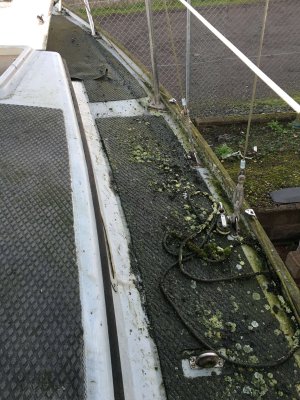
Somewhat embarrassingly, looking at a picture taken during the initial cleanup of the deck, it appears I do have mixed galvanized (turnbuckles) and SS (wire and other fittings) in my standing rigging.

Have to look at it more carefully when I get back there, since I havn;t done anything to the rigging yet apart from remove some halyards, but I dont remember the turnbuckles looking like they had suffered galvanic corrosion. Dont think the boat has been in the sea for a few years, though, which might have helped
 

Attachments

  • StbdSdeckCut60.jpg
    StbdSdeckCut60.jpg
    1.9 MB · Views: 4
Somewhat embarrassingly, looking at a picture taken during the initial cleanup of the deck, it appears I do have mixed galvanized (turnbuckles) and SS (wire and other fittings) in my standing rigging.

Have to look at it more carefully when I get back there, since I havn;t done anything to the rigging yet apart from remove some halyards, but I dont remember the turnbuckles looking like they had suffered galvanic corrosion. Dont think the boat has been in the sea for a few years, though, which might have helped
Good old hot dip galvanised steel had a very generous amount of zinc. Galvanised buckets used to last for years. Galvanic corrosion is not common on kit such as rigging, where water drains away very quickly.
 
I could maybe apply some isolating plastic, but a full wrap of the pin probably wouldnt be appropriate since it might exclude oxygen (possible crevice corrosion of the stainless steel) and trap water.

Maybe just a wax or silicone spray? Or perhaps just wash it and then leave it alone?

It seems to be accepted to goop up galvanised rigging with lanolin or vegetable oil, and maybe wrap the turnbuckes with denzler tape, etc, I dont want to do that here since it;d inhibit inspection, especially important due ti the proximity of stainless steel, but a protective coating of veg oil might be OK

Probably appropriate to lubricate the turnbuckle threads, and I might try my semi-standard polythene/PTFE/grease treatment there, but thats a mechanical need, largely separate from attempting to prevent corrosion, especially galvanic corrosion at the SS pin/galvanized turnbuckle eye interface
 
Last edited:
Top