Berthing Suggestions

Snowgoose-1

Well-Known Member
Joined
2 Jun 2015
Messages
1,569
Visit site
I have a marina berth where the finger is much smaller than the length of my boat.

This prevents me from picking up a spring where I leave the engine on tickover motoring forward on the spring and tie up at leisure. There is know where to site a pole on the finger. I am single handed.

Depending on conditions, I'm considering going in reverse. I can then pick up a spring and motor aft on tickover.

Anyone do this ? Or perhaps a different idea ?
 
Depends on you boat/engine setup a lot. Put a big dock fender on the pontoon at the bow. Run the boat slowly onto it. Engine in tickover ahead. Put the tiller across a little to push the boat in against the finger. This replaces the need for the spring. Give it a short while to make sure the boat is settled. Then attend to your ropes to secure your boat.
 
When we got less agile we found that a 'granny pole' at the end of the finger made things much easier. Little more than a rowlock on a plastic pole, it meant that one could pick up a loop and secure it much faster. I would combine this with fenders as described.
 
Depends on you boat/engine setup a lot. Put a big dock fender on the pontoon at the bow. Run the boat slowly onto it. Engine in tickover ahead. Put the tiller across a little to push the boat in against the finger. This replaces the need for the spring. Give it a short while to make sure the boat is settled. Then attend to your ropes to secure your boat.
That technique works perfectly although I had a bow fender so I could do it anywhere.

The only difficulty was well-meaning helpers rushing up and trying to push the bow off while shouting 'stop' 😄
 
I use a loop on a pole to catch the end cleat of my finger pontoon. It is tied off to a midships cleat and stops the boat hitting the end of the berth. I can lasso, and then gently motor forward as described. If the finger was too short, I might tie the lasso rope to the bow. But never tried that.

In practice I can usually step off and secure bow and stern without motoring against the midships lasso.

My finger is 2/3 length of the boat. One benefit of the lasso pole is I can use it in marinas when cruising.
 
Depending on conditions, I'm considering going in reverse. I can then pick up a spring and motor aft on tickover.

That would swing the bows out. When reversing in try a brest line from the stern to the main pontoon of start of the finger berth. You could motor forwards against it to hold the boat in.

Or get a midships line to the end of the finger when going in forwards or astern and adjust as needed.
 
This is a very useful thread for me, trying to berth stern on has been quite a trial. I have nobody who can handle lines for me most of the time and even then it can be an "adventure" in itself, so thanks all.
 
I have a long keel, high windage and am usually singlehanded. Going in astern is never an option. Going slowly and using wind and current to best effect is my usual strategy along with securing to the midships cleat asap. Be prepared to secure to your neighbour (with fenders in place) if it goes wrong. I keep a midships line ready on that side in case.

Anchoring is so much simpler!
 
I have a long keel, high windage and am usually singlehanded. Going in astern is never an option. Going slowly and using wind and current to best effect is my usual strategy along with securing to the midships cleat asap. Be prepared to secure to your neighbour (with fenders in place) if it goes wrong. I keep a midships line ready on that side in case.

Anchoring is so much simpler!

I wouldn't necessarily have to, but I have a friend with poor mobility who even struggles with getting onto the swim platform in a straight line. I could manage it sideways but that is irrelevant.

I find that I can get in OK and then I lose the bow to port before I can deal with it. With an expensive boat alongside, that worries me. I am going to experiment with a boat hook and a loop next time, once I have replaced the broken impeller.
 
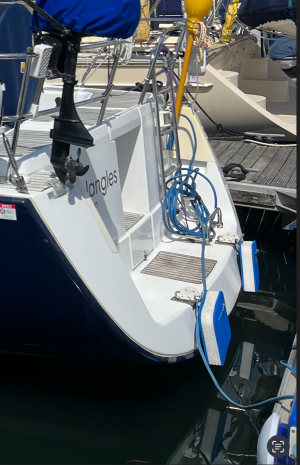
I have a sugar scoop stern, so quite wide & flat, I always reverse in single handed, I have two flat fenders hung off the stern, once I have arrived and am against the main walkway pontoon I go to half revs astern and that locks the boat in position, a side wind won't budge her, if it was very windy I would put on more revs, then just step off & pick up the already prepared bow line to secure the pointed end, great thing is it works anywhere.
 

Attachments

  • Screenshot 2026-03-24 at 20.46.16.png
    Screenshot 2026-03-24 at 20.46.16.png
    1.4 MB · Views: 14
I have a sugar scoop stern, so quite wide & flat, I always reverse in single handed, I have two flat fenders hung off the stern, once I have arrived and am against the main walkway pontoon I go to half revs astern and that locks the boat in position, a side wind won't budge her, if it was very windy I would put on more revs, then just step off & pick up the already prepared bow line to secure the pointed end, great thing is it works anywhere.
Neat reversing in technique. But why “step off” to get the ropes. Always worries me slightly a solo person stepping off a boat with engine running in gear, lots of potential failure scenarios.
If on home berth, we leave loops on the ends of the ropes and just lift up with boathook whilst remaining on board. For an away berth, lassoing the bow cleat should work?
 
Neat reversing in technique. But why “step off” to get the ropes. Always worries me slightly a solo person stepping off a boat with engine running in gear, lots of potential failure scenarios.
If on home berth, we leave loops on the ends of the ropes and just lift up with boathook whilst remaining on board. For an away berth, lassoing the bow cleat should work?
I know what you mean about stepping off a boat whilst the engine is running in gear, the first few times I was certainly ‘focused’, but I’ve been doing it for 10 years now, no mishaps so far 😬. I like having the same routine home & away so it’s grooved, I think I am quicker & safer stepping off the back & walking briskly along the finger pontoon than getting out of the cockpit & along the side deck. In my mind is the failure mode of the bows blowing off, I prepare the bow line to be picked up from the guard wires quite close to the stern, so it’s quickly in hand. This gives more flexibility to secure a blowing off bow quickly than getting all the way to the bow on the side deck & attempting to lasso a disappearing pontoon.
 
We (my wife) always lasoos a cleat on the end of the finger with a rope on our mid ships cleat. That way I can then motor ahead, lock the wheel and sort out the other lines. It works really well except in France where there is nothing to lasso. After 20 odd years of practice she rarely misses.
 
I have a marina berth where the finger is much smaller than the length of my boat.

This prevents me from picking up a spring where I leave the engine on tickover motoring forward on the spring and tie up at leisure. There is know where to site a pole on the finger. I am single handed.

Depending on conditions, I'm considering going in reverse. I can then pick up a spring and motor aft on tickover.

Anyone do this ? Or perhaps a different idea ?
If your boat is manoeuvrable astern I think this is the way to do it.

Always worked for me, singlehanded. Secure one line from the safety of the cockpit and then you can do everything else safely and in your own time.

If your boat is not manoeuvrable astern, however…
 
I know what you mean about stepping off a boat whilst the engine is running in gear, the first few times I was certainly ‘focused’, but I’ve been doing it for 10 years now, no mishaps so far 😬. I like having the same routine home & away so it’s grooved, I think I am quicker & safer stepping off the back & walking briskly along the finger pontoon than getting out of the cockpit & along the side deck. In my mind is the failure mode of the bows blowing off, I prepare the bow line to be picked up from the guard wires quite close to the stern, so it’s quickly in hand. This gives more flexibility to secure a blowing off bow quickly than getting all the way to the bow on the side deck & attempting to lasso a disappearing pontoon.
We now have a solution to that problem of bow blowing off as walk forward. Have bow thruster but only control was by the helm. Now have a wireless remote so as walk forward can just nip the bows in if needed :-)
 
We (my wife) always lasoos a cleat on the end of the finger with a rope on our mid ships cleat. That way I can then motor ahead, lock the wheel and sort out the other lines. It works really well except in France where there is nothing to lasso. After 20 odd years of practice she rarely misses.
We do that too - with the end led back to genoa winch so can quickly spin in the slack and set a precise length.
But the OP said their pontoon was too short for this to work.
 
I have a mooring rope with a bight at the end held open by having the rope run through an length of engine coolant hose. In other words a decent sized fixed open loop. I run the tail end through the midships cleat and then to the port sheet winch so I can drop the l;oop over the pontoon cleat and then ni back and winch the boat to the pontoon. I use a bow fender so I can keep the boat in slow ahead whilst this goes on.

I tried the rowlock on a pole system but sometimes I blew off before I could grab the rope.
 
It does depend to a degree on how much shorter than the boat the finger is.

I was previously in a similar position (though with a long-keeler to add a little spice to the proceedings!), and often single-handed. My 'patent' technique involved a 'special' temporary line taken from the centre cleat (or via an opening in a stantion base on a previous boat without centre cleats)

I would have a fairly lightweight and stretchy (nylon, IIRC) 'temporary' docking line, with a fixed wide loop in the end held open by a flexible plastic tube (the rope in the loop running through it). On approach the line would be set up with the loop in the cockpit, and the line running from it running over the guard wires at the side of the cockpit, then along outside the guard wires, through a fairlead on the toe rail, round the forward side of the centre cleat on the side deck inboard the fairlead, then back along the side deck, once loosely round the genoa winch on the cockpit coaming, and the tail and rest of the line loosely laid on the cockpit seat. A boathook would also be to hand in the cockpit.

Arriving at the berth I would be as far forward in the cockpit as possible and lean over to hook the loop over the cleat at the end of the finger (using the boathook if need be) as it came past, then quickly pull the line round the winch in tight, using this line to (hopefully!) stop the boat before the bow reached the main pontoon ahead. The stretchiness of the line reduced the strain on the fairlead of this part of the operation, given there wasn't usually the time/distance to surge the rope round the winch. The line could then be temporarily held by taking another turn round the genoa winch and cleating off in the jamming cleat.

The proximity and angle of the finger end cleat to the fairlead meant that this line was not good as a semi-permanent mooring line, but it did mean that the boat wasn't now going anywhere, and I could confidently step ashore to rig up my proper mooring lines. If I needed to have the engine in forward to keep the temporary line taut while I did this, it did tend to push the bow in and stern out, but I could quickly correct this with by starting with the stern line (which on one boat/berth combination was taken from a loop over the genoa winch, rather than the stern cleat, which was too far back and inboard (on transom behind cockpit coaming), for a good breast line to the finger end cleat.).

Once the boat was settled and mooring lines sorted, the temporary line was slackened off and removed.

p.s. beaten to it by barca nova!
 
Top