Belts on marine engines

Some are :p

Anyway, there are no longer any engines being designed for yacht use (Bukh are the only dedicated small marine diesels I can think of, but the intended application is ships' lifeboats). My Volvo was designed for generators and refrigeration plant, I believe, neither of which need an alternator hung off the side.

They are all adaptations, even when brand new out of the factory, and a belt is a much easier adaptation than some kind of gear-train to the crankshaft.

Pete

Lots of variations in the way pumps (and alternators) are driven. Volvo raw water pumps are gear driven , but freshwater pumps by belt. Alternators are belt driven almost universally to give the flexibility of different sizes, types etc on the range of applications of the base engine.

With motorcycle engines as mentioned earlier, they are single application engines and packaging to achieve compactness makes integrated gear driven alternators a good solution.
 
I have a home-made alternator installation and for various reasons too tedious to explain, the belt gets a really hard time. 6" pulley on the engine, 1.25" pulley on the alternator. There was no way a V belt was going to work, so I tried a Poly V. That was better, but I still suffered high wear rates and loads of rubber dust. Now I have a timing belt doing the job and it has been fine ever since.

Are you using a timing belt with proper toothed pulleys (sprockets may be a better term?) or still using the polyvee pulleys?

I like the idea of a direct toothed drive between crankshaft, alternator and waterpump as it sounds like a more positive system although I don't recall ever seeing that in an auto or marine application. Presumably there is a disadvantage?

Richard
 
I like the idea of a direct toothed drive between crankshaft, alternator and waterpump as it sounds like a more positive system although I don't recall ever seeing that in an auto or marine application. Presumably there is a disadvantage?

The ultimate would probably by 'high torque' drive belts, which have roughly semi-circular lateral ribs engaging in depressions on the pulleys. Commonly installed as as a more robust primary drive on classic competition motorcycles, and even quite small ones can easily tolerate 50bhp. The pulleys are quite cheap, but it would inevitably require a bit of machining to mate them to a marine engine. Total overkill, but if starting from scratch, there's no reason I know of not to do it.
 
I think people tend to overtighten vee belts. This results in rapid wear and, on some Yanmars, premature failure of water pumps. The grip of a vee taper is amazing - just try pulling it round ( dont get fingers anywhere near if its running !!!) . The centrepetal acceleration required when running at speed does act against the belt grip but I dont think slippage is the problem in most cases.
Try running slacker than you think and see if it cures the problem like it has for me.
 
A lot of the problem is the alternator generating a lot of power at low rpm immediately after starting.
Modern alternators will generate a lot of current at low RPM. Often 80% of rating at tickover. Cars need this these days.
The alternator will initially be current limited if the batteries are not fully charged.
So it is generating high power.
High power at low rpm means high torque.
So possibly more than the belt can cope with.
It may help a lot to increase the idle speed ASAP after starting.

But you may wish to let the oil get around first.
A smart alternator which does not put out much current for the first minute or so is one option.

I found Gates branded cogged belts better than some others.
 
I think people tend to overtighten vee belts. This results in rapid wear and, on some Yanmars, premature failure of water pumps. The grip of a vee taper is amazing - just try pulling it round ( dont get fingers anywhere near if its running !!!) . The centrepetal acceleration required when running at speed does act against the belt grip but I dont think slippage is the problem in most cases.
Try running slacker than you think and see if it cures the problem like it has for me.

That contradicts what the marine/ auto electrician who serviced my alternator told me; after refitting, the alternator warning light was flashing intermittently accompanied by a 'tick' in the rev. counter needle though the voltmeter was still showing a 14+v charge, this happened at below 1500 revs. He suggested that the twin belts were probably not tight enough and had become polished and were slipping at low revs, I am hoping new belts and more tension will cure it. Not a Yanmar though, a green lump.
 
That contradicts what the marine/ auto electrician who serviced my alternator told me; after refitting, the alternator warning light was flashing intermittently accompanied by a 'tick' in the rev. counter needle though the voltmeter was still showing a 14+v charge, this happened at below 1500 revs. He suggested that the twin belts were probably not tight enough and had become polished and were slipping at low revs, I am hoping new belts and more tension will cure it. Not a Yanmar though, a green lump.

Another ham fisted mechanic.

Belt tension chart

TM-5-3805-258-24-1_408_1.jpg


PEN1.jpg


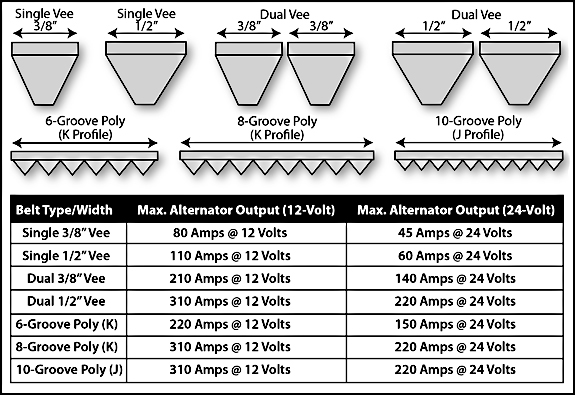
This is and interesting chart showing what size Vee belts ans polyvee belts(serpentine) are needed for various alternator outputs.

beltsxc.jpg
 
I think people tend to overtighten vee belts. This results in rapid wear and, on some Yanmars, premature failure of water pumps. The grip of a vee taper is amazing - just try pulling it round ( dont get fingers anywhere near if its running !!!) . The centrepetal acceleration required when running at speed does act against the belt grip but I dont think slippage is the problem in most cases.
Try running slacker than you think and see if it cures the problem like it has for me.

This is certainly the case on Yanmar raw water pumps which have relatively little resistance to rotation but a relatively small section shaft. The small belt does not have to be tight at all in order to spin the water pump ..... but overtightening it will certainly wear out the shaft, bearings and seals too quickly.

Opinions differ with regard to the alternator belt. This does have to transmit a lot of power if the batteries are low and needs to be tight enough to do its job. I am one of those who tends to err on the slack side because I would rather replace belts than bearings ..... but running slack only works if the belt is in tip-top condition. An old belt which is already polished will simply slip and polish even more.

Richard
 
If you can read the guide RogerShaw posted, the point about belts resonating/whipping is worth thinking about sometimes.
 
Are you using a timing belt with proper toothed pulleys (sprockets may be a better term?) or still using the polyvee pulleys?

I like the idea of a direct toothed drive between crankshaft, alternator and waterpump as it sounds like a more positive system although I don't recall ever seeing that in an auto or marine application. Presumably there is a disadvantage?

Richard

Yes, it's a proper timing belt and sprockets. I ought to explain that mine is an odd engine though. Originally it had a 20 Amp (yes, 20 Amp!) contactless alternator built into the flywheel (like some outboards with charging loops). They were pretty rubbish, by all accounts, even when working properly and we bought Avocet after she'd been sunk, so the alternator didn't work at all. As I had a 60 Amp car alternator lying round, I made a bracket to sling it under the engine. There was another snag though - it has no bottom pulley. The raw water pump is driven off the nose of the crank. I therefore put a big sprocket on the end of the camshaft (6" diameter was the biggest I could get and not foul anything). The next problem that presented itself was that the gits who designed Avocet's engine, ran the cam at 1/4 of crank speed, rather than the more common 1/2 engine speed! They did this (I think!) because it's possible (in theory at least!) to hand start the engine and to get the crank speed up, the starting handle goes into the end of the camshaft. That means that I had to use an absolutely tiny pulley on the alternator and even then, it would never be running anywhere NEAR its optimum speeed! The engine redlines at about 3600 RPM. If we cruise at 2500, the cam is only doing 625 RPM, so the alternator will barely manage 3500 RPM a lot of the time. However, as has been said, they generate a fair bit at low revs these days. Also, it's a small boat, daysailed, and our electrical demands are modest. We only have the one battery for starting and domestics, but in the 20 years or so that we've run this system, it seems to have coped without any additional inputs. It's not a full-sized timing belt as you'd find on a car. it's mroe like one of those electric lanmower belts with a finer pitch. Initially, I had a 25mm pulley on the alternator but the belts kept snapping. I now have a 32mm pulley on and that seems fine. Current belt has been on for a good 12 years (but the boat was laid up for 8 of those)!

Advantages:
No belt dust and small losses (you'd have huge losses trying to get a V belt round a 32mm pulley!).
Changing a belt is a doddle (tension doesn't need to be great and isn't critical).
Low belt tension means the alternator bearings have an easier time.

Disadvantages:
The belt almost certainly sees vicious crank speed fluctuations as it's only a signle cylinder engine - especially at idle.
The alternator armature tends to see much of those fluctuations (less whatever the stretch in the belt can damp out)
When the engine stops and "bounces" back from TDC on a compression stroke, the alternator gets accelerated backwards qquite quickly.

Also (but this is just my installation) if the raw water pump seals fail, it drips water on to the alternator.

adv
 
Disadvantages:
The belt almost certainly sees vicious crank speed fluctuations as it's only a signle cylinder engine - especially at idle.
The alternator armature tends to see much of those fluctuations (less whatever the stretch in the belt can damp out)
When the engine stops and "bounces" back from TDC on a compression stroke, the alternator gets accelerated backwards qquite quickly.

Interesting story. Thanks.

All the advantages would surely apply to any auto or marine installation ..... and probably none of those disadvantages.

I've often thought about this over the years and wondered why toothed belts and sprockets are not used more generally. I wonder if cost is the explanation although I don't see why it would be more expensive than a polyvee installation. There must be an explanation but it's beyond me.

Richard
 
If my alternator seizes, it will make a mess of the belt! I think in a lot of engines, more than one ancillary is driven by the same belt, so if anything went wrong with one component, you might lose another one, but it's hard to see how that would be any better with a conventional V belt. I guess it might scream for a few seconds to warn you? I suppose if the water in the water pump froze and you tried to start the engine, you'd know about it (but you might have other problems then too)! I think conventional V belts are more forgiving of misalignment between the two axes of rotation (a toothed belt will just slip off if they're not perfect), but other than that, I can't see a downside.

Modern car engines with more powerful alternators have a uni-directional clutch in them to reduce belt flutter. Alas, I wouldn't get one in my alternator pulley, but I wonder if high-output marine alternators would benefit? This video is an advert, but it shows the diference, nevertheless:

https://www.youtube.com/watch?v=4EXYP1CmL9Q
 
Top