Battery monitor recommendations

…plus there’s always jumper cables if you get caught out
That would not have helped with my Bavaria as the start battery was buried in a cockpit locker and the house bank under the saloon settee. Better to think it through from the start if you can and build in a means of paralleling. Never needed it myself in the nigh on 30 years of having two separated banks.
 
I think I only needed it once in 18 years, when the starter battery died over a couple of weeks on the mooring, but I was glad to have it then.

Mostly, I used the 12b switch as a battery isolator for the starter system, which meant the engine couldn't be started without access to the cabin. (The domestic battery had its own isolator)
 
Hi all, my family had an Achilles 24 in old days and I'm trying to buy a boat in these days, so I'm not an expert.
Have a portable jump starter like the one I have for my car, it is a bad idea/solution?
 
Hi all, my family had an Achilles 24 in old days and I'm trying to buy a boat in these days, so I'm not an expert.
Have a portable jump starter like the one I have for my car, it is a bad idea/solution?
Long thread recently on just this subject. As usual some for having one, some think it unnecessary and others agnostic. My view is that if you have a well designed battery system then it is unnecessary as it is very rare for a start battery to suddenly fail and even rarer for for the house bank to fail at the same time.
 
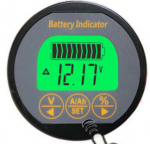
I have one like this:Battery monitor
1653645023024.png
It was only about £35 a couple of years ago and seems to have got a lot more expensive. It comes with 50A, 100A or 350A shunts.
I've no idea of the accuracy of the % charge as I've only run it down to about 80%. I think this applies to most battery monitors as there is no easy way to check the readings and errors will accumulate over time and it can't account for self discharge of the battery. Probably best to reset it regularly when you know the battery is fully charged to 100%.
The only downside is that it is always on and the LED backlight is rather bright and needs covering at night to avoid losing night vision.
 
We have become obsessed with amps in, amps out, total amps, state of charge, etc. which add n o real value to a weekend or two / three week leisure yotty.

When it comes down to it, a simple accurate digital volt meter is all you really need to keep up to date with your batteries.

Good marketing to seel you expensive kit you don't really need in 99% of situations. A multimeter will cover the other 1%.
 
Long thread recently on just this subject. As usual some for having one, some think it unnecessary and others agnostic. My view is that if you have a well designed battery system then it is unnecessary as it is very rare for a start battery to suddenly fail and even rarer for for the house bank to fail at the same time.
Just wondering whether, with a decent house bank (4 x 110 Gel) there is a need for a separate starter battery at all?
I know this is heresy and hasn't been my plan (I have prepared to put a Red Flash in as engine start) but on our weekend usage and with quite a lot of solar and wind gen (non functioning at the moment), I cannot imagine the house bank ever being in a state that it cannot start a 40hp Yanmar.
On the current battery set up (3 x 110 FLA and 1 x 110 FLA for engine - all of them a little aged), with evening lights, fridge on overnight and anchor light etc, we don't get down much below 90% of nominal 300ah capacity. Looking at the consumptions, it wouldn't take much more if we were sailing overnight with AP.
Separate isolators for house, engine, emergency parallel and windlass/thruster. INverter has separate isolator which remains off as we don't use it.
I wondered what you thought.
 
Just wondering whether, with a decent house bank (4 x 110 Gel) there is a need for a separate starter battery at all?
I know this is heresy and hasn't been my plan (I have prepared to put a Red Flash in as engine start) but on our weekend usage and with quite a lot of solar and wind gen (non functioning at the moment), I cannot imagine the house bank ever being in a state that it cannot start a 40hp Yanmar.
On the current battery set up (3 x 110 FLA and 1 x 110 FLA for engine - all of them a little aged), with evening lights, fridge on overnight and anchor light etc, we don't get down much below 90% of nominal 300ah capacity. Looking at the consumptions, it wouldn't take much more if we were sailing overnight with AP.
Separate isolators for house, engine, emergency parallel and windlass/thruster. INverter has separate isolator which remains off as we don't use it.
I wondered what you thought.
I like duplicate and even triplicate systems so for me having two separate battery systems to cover engine starting is a must. An engine (that starts) is a fundamental piece of safety kit. My engine start battery died last year, but the service battery started it and allowed me to continue cruising without panic. I fully agree about isolation switches - they provide peace of mind and a great aid to diagnosing problems.

If I was to rely on one battery bank I would replace after a fixed number of years rather than my lead acid policy of waiting til it fails.
 
First observation is why do you have so much capacity if you don't use it? 440Ah is an awful lot for a weekend sailor - but maybe you aren't! Fundamentally the requirements for a start battery are very different from a house battery, so apart from the security of having an independent battery, why would you use a large deep cycle battery to start your engine? Useful to look at the evolution of electrics on boats from, say 1960s on. Then you did not really need much in the way of battery capacity and many boats had just one as the "house" use was relatively low and engines small. As things move on, the typical 80Ah battery becomes inadequate so a second battery to double capacity gets added and some bright spark comes up with the idea of giving choice of which battery to use to avoid running one down. Hence the manual choice 1,2,both switch. Things move on and the demands of "house" grow and dominate the capacity requirement, plus charging capacity needs to increase and focus more on charging the heavy usage house. Alongside this are developments in batteries mean that those designed for house become very different from those for the sole job of starting an engine.

That is really where we are now although with developments in lithium there is further to go for house requirements. On the other hand engine start is essentially unchanged. Modern engines start instantly so all you need is high cranking amps - capacity is not an issue. On my last old boat with a Nanni 14 I fitted a 45ah FLA battery normally used for small diesels like Citroens which gave space to fit a 95Ah house. Bit cheapskate as I was selling the boat which previously had a Red Flash and a Lifeline 110Ah AGM.

For me a dedicated start battery is a given, and if I had room in my GH I would have gone for another small car battery, but that would have limited the house capacity, so bit the bullet and have an Odyssey - same size as the Red Flash which means I can fit 2*95Ah AGMs all in a 50*50cm box.
 
Great, thanks to both of you for your answers.
Tranona - very interesting that you answered it by considering the development of usage as it was really with that in mind that I asked the question - had we reached a new stage where we don't need the separate engine battery depending on the size of the house bank. I will do as you both suggest and as per my original plan.
THanks again
 
Last edited:
This, though I'd keep the 1-2-both to allow starting from the domestic bank in an emergency. Common to the starter, engine battery to 1 and domestic to 2, VSR to link 1 & 2.

If the budget really is tight, use a cheap headlamp relay - this sort of thing:

SW02649-40.jpg

I had one on Jissel for years and it worked fine. Feed it from the alternator warning light terminal and link 1&2 on the 12B switch

I use such a relay to control my Coldbox ..... engine starts - alternator kicks in - box starts. Engine stops - box stops.

As to Battery monitor for OP ..... if its just a simple What is state of battery A ... B .... and no need to control charge etc. - then I have a simple Battery A - B small panel with 3 position switch and volt meter. Flick switch loeft - displays Battery A .. centre OFF .. switch right displays Battery B.

But I'm a cheapskate ...

While moored - I have two little trickle charger boxes mains powered .. .... one for each battery - I have two 90 A/hr ... they just sit there keeping my batts topped up .....

Car Battery Charger Maintainer Auto 12V Trickle RV for Truck Motorcycle | eBay

I have these for maintaining my garden tractors through winter as well .... marvelous little boxes ...

OK - not exactly what OP is after ... but WTH !!
 
Top