Battery gassing

Ammonite

Well-Known Member
Joined
7 Feb 2007
Messages
1,195
Visit site
I've just installed a Victron Blue Smart 12/30 (3-outlet) charger and my CO alarm triggered after 30 minutes. The batteries are 110Ah SLAs which were at 12.5V initially. It was set to the default 14.4v lead acid profile, and was initially delivering 14.65V due to temperature compensation.

The battery box lid was off at the time, and the CO monitor is 3m away and 1.2m above the sole. The batteries did not feel warm. I understand SLAs can vent via the valve, and that CO monitors can be triggered by hydrogen but is 14.65V high enough to cause this?
 
The cabin is closed up because it is winter? Yes.

I guess a better question is were there any other possible source of gases.
  • Fired-heater running.
  • Working with solvents, paint, or adhesives.
  • Smoking (probably not, but had to ask).
You can Google CO meter interference.

---

I don't understand why the voltage was higher in the winter due to temperature compensation. In the winter voltages run considerably lower to full charge. Depending on how cold the battery is, 14.65 is pretty high. At 12.5V at 15C (they are probably colder than that) they are fully charged, so you are just making hydrogen.

battery+charge.jpg
 
Last edited:
A few seconds use of a butane Dremel every now and again to apply heat shrink but I was doing this yesterday and no alarm. Today was the first time I switched the charger on.
 
I've just installed a Victron Blue Smart 12/30 (3-outlet) charger and my CO alarm triggered after 30 minutes. The batteries are 110Ah SLAs which were at 12.5V initially. It was set to the default 14.4v lead acid profile, and was initially delivering 14.65V due to temperature compensation.

The battery box lid was off at the time, and the CO monitor is 3m away and 1.2m above the sole. The batteries did not feel warm. I understand SLAs can vent via the valve, and that CO monitors can be triggered by hydrogen but is 14.65V high enough to cause this?
I have had my CO alarm activate when charging my lead/acid batteries but that was with an old charger. Ever since I replaced with a smart charger CTEK M200 I have never had the problem and like your charger, increases the charging voltage in cold weather to 14.65v
 
I think it is more likely to be H2S from a failing cell than H2. Any whiff of bad eggs?
I don't think so. H2S has a low interference ratio for CO sensors, and H2S smell so bad you would be chased out of the boat before it registered on a CO meter.

Sensor Type

Carbon monoxide

Gas / Correction factor(%)

Carbon monoxide 100

Carbon dioxide 0

Hydrogen sulfide 10

Sulfur dioxide 0

Nitrogen dioxide -5 to -20

Chlorine -10

Chlorine dioxide 0

Hydrogen cyanide 15

Hydrogen chloride 3

Hydrogen 25 to 60

Ammonia 0

Acetylene 150 to 200

Alcohols 50 to 120

Water condensation large

Freon 75-200

Methane <15
 
Question to "Ammonite" ....

You say SLA battery .... a SEALED Lead Acid battery gassing ? The whole design point of the SLA is that nothing escapes from it ... any gassing would be reconstituted internally ... if excessive - the case swells and battery fails.

Do you mean Maintenance Free Lead Acid ? Which are standard Lead Acid, without top up plugs - but with similar action of gassing reconstituting internally unless the amount is such that the 'valve' opens ?

But both types will show you by case temperature if being pushed over charged ...
 
Question to "Ammonite" ....

You say SLA battery .... a SEALED Lead Acid battery gassing ? The whole design point of the SLA is that nothing escapes from it ... any gassing would be reconstituted internally ... if excessive - the case swells and battery fails.

Do you mean Maintenance Free Lead Acid ? Which are standard Lead Acid, without top up plugs - but with similar action of gassing reconstituting internally unless the amount is such that the 'valve' opens ?

But both types will show you by case temperature if being pushed over charged ...
I was under the impression that SLA in the context of automotive batteries was a marketing term and that there is no such thing as they are valve regulated, but maintenance free, but yes, this is what I have. With the lid in place any hydrogen will disperse via the vent pipe to the outside, rather than into the cabin, but I was surprised it was being produced at 14.65v. There was no egg smell and none of the batteries were even slightly warm. I think I'll try switching off the temperature compensation and run another test.
 
Last edited:
SLA usually relates to the sealed case batterys used in Domestic Alarms ... old fashioned emergency start packs etc ... you could turn an SLA upside down and it would still stay sealed etc ...
I have not come across an SLA with any valve .......

But Maintenance Free - yes some have a valve to release gas if the reconstitution cycle gets overwhelmed. But many just have a vent pipe at one end of the battery case top ...

Being in an industry that H2S is a serious matter .... I have never noted H2S gas from a battery (rotten eggs) ..... Hydrogen gas yes (that sharp aroma) .... Sulphur vapours yes (sickly smell) ...
 
SLA usually relates to the sealed case batterys used in Domestic Alarms ... old fashioned emergency start packs etc ... you could turn an SLA upside down and it would still stay sealed etc ...
I have not come across an SLA with any valve .......

But Maintenance Free - yes some have a valve to release gas if the reconstitution cycle gets overwhelmed. But many just have a vent pipe at one end of the battery case top ...

Being in an industry that H2S is a serious matter .... I have never noted H2S gas from a battery (rotten eggs) ..... Hydrogen gas yes (that sharp aroma) .... Sulphur vapours yes (sickly smell) ...
Excess voltage, typically caused by shorted cells, will give of a rotten eggs smell.
 
I was under the impression that SLA in the context of automotive batteries was a marketing term and that there is no such thing as they are valve regulated, but maintenance free, but yes, this is what I have. With the lid in place any hydrogen will disperse via the vent pipe to the outside, rather than into the cabin, but I was surprised it was being produced at 14.65v. There was no egg smell and none of the batteries were even slightly warm. I think I'll try switching off the temperature compensation and run another test.

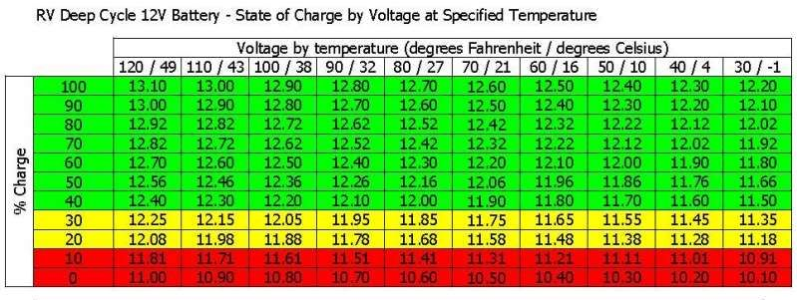
Remember, that in cold weather voltages go down (in use and charging), which means that at 40 F you will generate gas at 12.6 V the way you would at 13.0 V in the summer. 12.6 is WAY too high if the battery is cold. I'm not surprised.

I keep a copy of this chart next to the panel in the boat. These voltages are at no charging (plus enough time since charging to distribute the surface charge--maybe 5 minutes) and no load (resting).

1768865061879.png
 
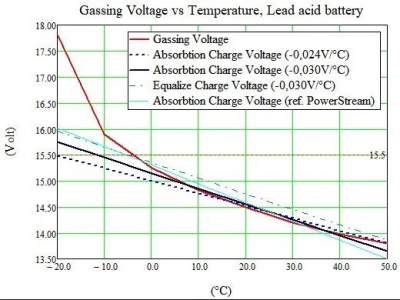
I understand that state of charge is temperature dependent, but the propensity to gas falls as temperature drops, which is why all modern multi-stage chargers like my victron ramp up the absorption voltage to 14.7v as it gets colder, but in theory are smart enough to know when the battery is fully charged so its not held at this voltage unnecessarily. My batteries are probably getting a little tired but the charger was doing exactly what Victron have designed it to do. Either that or the AGM for the thruster was fully charged before the two similarly sized domestic SLAs which meant the absorption phase for the AGM was longer than it should be, given the charger treats this as one bank. The more I think about this, it sounds like restricting the absorption voltage to 14.4v regardless of temperature is the safest way forward. If I still have a problem it then has to be a failing battery.
 
Last edited:
I understand that state of charge is temperature dependent, but the propensity to gas falls as temperature drops, which is why all modern multi-stage chargers like my victron ramp up the absorption voltage to 14.7v as it gets colder, but in theory are smart enough to know when the battery is fully charged so its not held at this voltage unnecessarily....
I learn something new every day! Part of this is likely because gas solubility goes up in cold water and down in hot water (same with other fluids), and this shifts the equilibrium.

As you pointed out, the battery is still full when it is full (the table I posted), so charging at much higher voltage seems tricky, because the charger can only guess battery SOC from amps and not so much voltage rise. If there is a defect that allows it to keep taking amps (internal short or bridging) any controller can get confused. I see the advantage of higher voltage, but I see risk.


1768928458929.png
P
 
I don't think so. H2S has a low interference ratio for CO sensors, and H2S smell so bad you would be chased out of the boat before it registered on a CO meter.
In practice I have on a couple of occasions notified boat owner that their co alarm is sounding and it has always been a bad battery. In one case there was a very bad smell but in another there was no smell that I noticed.
 
Offshore, we were regularly briefed on H2S, and its dangers and so on, but of course the most dangerous thing about it is perhaps when you no longer smell it, which could mean that it's dispersed, or that it's more concentrated and killed your sense of smell.
It's worth googling it, and developing a sense of fear. I've no idea of the effect from a battery(s), but on a rig, for obvious reasons considering the volumes involved, it was an extremely serious risk; colourless, odourless, heavier than air, explosive and corrosive. On a couple of rigs that I was on, facial hair was outlawed as it might interfere with the fitting of the BA set that one had to carry at all times.
Bundle of laughs it ain't. :eek:
 
On a couple of rigs that I was on, facial hair was outlawed as it might interfere with the fitting of the BA set that one had to carry at all times.
That used to be the case in the army (apart from, IIRC, Pipe Majors and some Pioneer Corps ranks, apparently especially expendable in an NBC context) but a recruiting poster on the bus shelters here in Edinburgh shows beardies and women in a tent fiddling with laptops, so I suppose its changed.
 
Offshore, we were regularly briefed on H2S, and its dangers and so on, but of course the most dangerous thing about it is perhaps when you no longer smell it, which could mean that it's dispersed, or that it's more concentrated and killed your sense of smell.
It's worth googling it, and developing a sense of fear. I've no idea of the effect from a battery(s), but on a rig, for obvious reasons considering the volumes involved, it was an extremely serious risk; colourless, odourless, heavier than air, explosive and corrosive. On a couple of rigs that I was on, facial hair was outlawed as it might interfere with the fitting of the BA set that one had to carry at all times.
Bundle of laughs it ain't. :eek:

If you can smell H2S .. its already well over the threshold limit .... quickly it will deaden the sense of smell and you can suffer a false sense of all-clear ... but very quickly after loss of smell - you can be overcome with possibility of fatal consequences if not pulled from that to clear air.

We too whilst I was with Chevron - were not allowed facial hair for same reason.
 
Top