Battery connector question

For me, leaving the DC switched on whilst we are away from the boat is a No No No No
If you must have a fridge on whilst you are away, why not arrange for it to be powered by the shore supply.
All mine are.

Waeco supply fridge power unit that will power a DC fridge from both 240v and DC (12v / 24v).
It automatically switches from DC to 240v whenever the 240v is connected.
Use one of these and SWITCH THE DC OFF when you are away.
Then, if someone disconnects your shore supply whilst you are away, your batteries won't discharge.
When you are on board (with your DC systems on), the Waeco power unit will automatically switch from 240v to DC when you go cruising.
And then switch back to 240v whenever you are plugged back into shore supply or running off generator.
These Waeco supplies are used everywhere - they are designed for the job.
They have a few different models, depending on the size of your fridge.

Why are you against leaving the DC system on?
 
I had one like that on my motor home....in fact it was three ways...gas, 12v and 220v...all seamless transitions.
So you saying that an existing fridge can be converted ?
I think that your motor home would have had it all integrated into the fridge (gas etc).
But these Waeco units are available for all DC fridges.
Check them out.
 
I rather like having my DC automatic bilge pump still powered up, even when the shore power is disconnected.
 
A little background
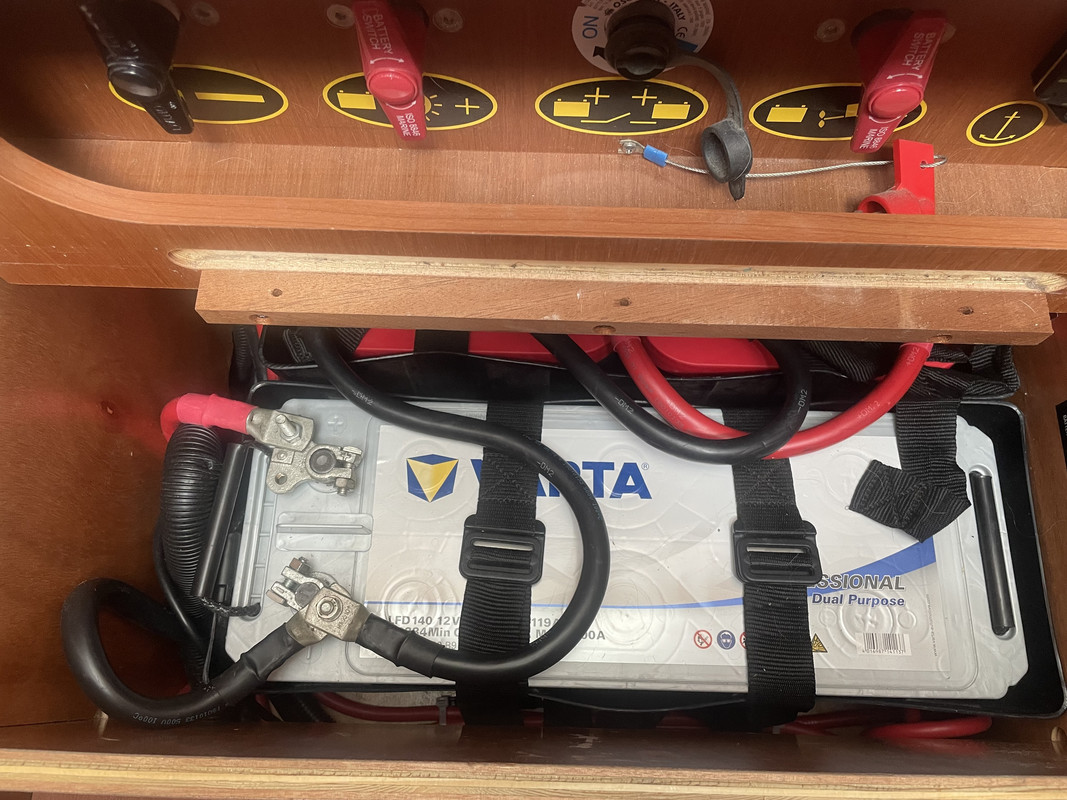
The existing battery has failed. I’ve decided that I can no longer lift this 140 Ah 30 kg battery…two 80 Ah batteries will fit in the same battery box. Just wondering what size cable should I fit for the parallel connection ?
On my last boat I did the same -I know others here suggested same dimensions between the batteries, but I did use smaller diameter cables for the short distance between the batteries. That boat hat all 140 AH batteries, which were changed to 2x100 each block. This way the capacity was also increased.

Since 1,5 years I have another boat, now slowly working my way from the Adria back home (Baltic) - we do spent lots of time at anchor meaning at least two hour generator use in the morning (we have one Fridge/Freezer plus another Fridge). The consumers were just 2x180 ah, and we added one more so nnow have 3x180 for consume. There is no space for further.

As the charger for the 24V starter batteries were broken I bought a Victron IP722 - only much later I realized having bought a 12V/20A suitable for 3 batteries. Therefore locally a new 24V charger was arranged. Now I have the "Smart Victron" here and the present old charger is 40A, but first of all I have to go into the engineroom to read how much its charging, and I have never seen it charge with more than 20-25A - Question to the experts: would it be better to install the new Victron although its only 20A ??? it would be connected to consumers, Bowthruster batteries, and the Generator starter battery. ???
 
'but I did use smaller diameter cables for the short distance between the batteries'
can't see an issue with that, its all about voltage drop, which is related to length of cable, so shorter can be smaller diameter
It's not just about voltage drop, it's also about current rating. We don't know what those 95mm cables are powering, there's a reason the builders used those sizes of cable. With the pair of batteries correctly wired, but using smaller cable for the parallel connection potentially means an under rated section of cable in the middle of the circuit. The difference between a metre of 95mm cable and one of 50mm cable is about £8, why bother ?
 
It's not just about voltage drop, it's also about current rating. We don't know what those 95mm cables are powering, there's a reason the builders used those sizes of cable. With the pair of batteries correctly wired, but using smaller cable for the parallel connection potentially means an under rated section of cable in the middle of the circuit. The difference between a metre of 95mm cable and one of 50mm cable is about £8, why bother ?
The other thing I wondered about was the flexibility of thick cables of short length....turns out the 95mm2 cable is quite soft and malleable.
The only other problem was that thinner cables in different lengths and with various connectors were available off the shelf...but when I found a supplier who would make the thicker cables to my specs, the delivery time was extremely rapid and the cost, I thought, was reasonable
 
Top