Battery boxes lids

ridgy

Well-Known Member
Joined
26 Jan 2003
Messages
1,707
Location
North West
Visit site
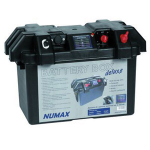
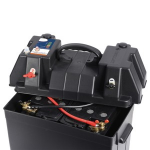
Thought I might do the decent thing and add some battery boxes to the setup but then I started wondering how you put the lids on since the cables would be in the way?

The lids seem to have areas that look like they should be cut out but even then how do you attach the cables which are now under the lid?
 
They should really be vented to atmosphere...

In that case, I understand you make a cutout for the cable exit around half way up the height of the box. Logic being, gas rises and vents out before it collects enough to escape through the cable entry. But you don't want the hole too low, in case the battery spews acid!
 
Unbeknownst to me - my previous gardener disconnected my power to boat few winters back ... one battery discharged - temps dropped and battery case cracked ..... what a mess -

Luckily my battery box is a ply built in affair with thick epoxy paint on inside - base and sides, so it was all contained.
 
How do you intend to secure wobbly plastic battery box down, so it doesn't go flying in a knock down?

You might also search e bay for GRP battery boxes which tend to be used by the off-road and performance hill climbing lads. Fitted one to a previous boat with bolts and metal plates. Price was quite reasonable at the time and compared to wobbly boxes.


Pete
 
How do you intend to secure wobbly plastic battery box down, so it doesn't go flying in a knock down?

You might also search e bay for GRP battery boxes which tend to be used by the off-road and performance hill climbing lads. Fitted one to a previous boat with bolts and metal plates. Price was quite reasonable at the time and compared to wobbly boxes.


Pete

Most boxes I see have straps over back to fixings .... simple to glass a webbing end and buckle to secure box.
 
How do you intend to secure wobbly plastic battery box down, so it doesn't go flying in a knock down?

You might also search e bay for GRP battery boxes which tend to be used by the off-road and performance hill climbing lads. Fitted one to a previous boat with bolts and metal plates. Price was quite reasonable at the time and compared to wobbly boxes.


Pete
Personally I never intend to put myself in a situation were I would risk a 'knock down'.
No movement of boxes in regular use although I haven't tried turning boat upside down :D (yet).
There are so many variables and differences in our sailing endeavours and I sail coastal solo with care and attention to
the risks of extreme weather.
I am more concerned with metal objects (tools etc) hitting the contacts on the 3 batteries that have to share the same locker.
Although I am a fairly tidy person I always fear dropping stuff or catching a watch strap on an exposed powerful battery.
 
I made a box for my engine starter battery with plywood, screwed to engine bearers with a hinged lid secured with ss overcentre clips, ventilation around the top and a central spacer strip so that when closed the battery was firmly located. Slots for the cables and varnished. Works for me, no problems after several years. The original battery box now has two house batteries strapped down.
 
Personally I never intend to put myself in a situation were I would risk a 'knock down'.
No movement of boxes in regular use although I haven't tried turning boat upside down :D (yet).
There are so many variables and differences in our sailing endeavours and I sail coastal solo with care and attention to
the risks of extreme weather.
I am more concerned with metal objects (tools etc) hitting the contacts on the 3 batteries that have to share the same locker.
Although I am a fairly tidy person I always fear dropping stuff or catching a watch strap on an exposed powerful battery.

Having seen the consequences of short on a battery ... its something I do not care to see again.
The battery literally split and guys hand was permanently disfigured / damaged .. he was lucky the acid didn't hit his face ..

I hop that you at least cover the terminals to prevent any change of a short ... even it only covers for each terminal ... or a shallow ply lid fixed over top ....
 
Having seen the consequences of short on a battery ... its something I do not care to see again.
The battery literally split and guys hand was permanently disfigured / damaged .. he was lucky the acid didn't hit his face ..

I hop that you at least cover the terminals to prevent any change of a short ... even it only covers for each terminal ... or a shallow ply lid fixed over top ....
Whenever I am working on or around the batteries I lay a plastic bag(s) over anything that might short.
 
Whenever I am working on or around the batteries I lay a plastic bag(s) over anything that might short.

You'd think I would be more careful having witnessed an 'event ' ........

I was fiddling with one of my garden tractors ... small Lead Acid 30 A/hr battery .... I was using a large screwdriver ... I mean a big screwdriver ... about 15" long .... ZAP .... in the short time it 'welded' itself to the battery post - it had burnt away half the shaft diameter ........

Simply put - the amount of energy that can be put out is astounding. Even a small AAA rechargeable ... I had in pocket left a scar on my leg ...
 
Might not agree with some peoples ideas ... but I am against boxes that seal or near enough seal ...

The chances of a plastic battery box and its lid sealing hydrogen gas inside, or anything near it, are zero. Hydrogen is one of the hardest gases to contain because of its small molecule size, beaten only by helium. It's also pretty good at diffusing rapidly (the molecule's temperature induced velocity at the top of the atmosphere is so high it exceeds the gravitational escape velocity there and escapes into space, which is why there's almost none in the atmosphere). And it can work its way into and through solids. The equipment needed to contain it both safely and without it escaping is expensive and complex, which is one of the many reasons why hydrogen powered cars are not coming any time soon. An approximately fitting lid on a plastic battery box retaining any significant amount is a non-issue.
 
Simply put - the amount of energy that can be put out is astounding. Even a small AAA rechargeable ... I had in pocket left a scar on my leg ...

The amount of power that can be put out is high, especially for lead acid batteries that have a very low internal resistance, hence heating a screwdriver shaft to red hot in seconds or turning over a big cold diesel engine. However, the amount of energy? Meh. Batteries are useless at that, especially the specific energy value compared to mass for lead acids. The theoretical total energy stored in a 100 Ah 12V lead acid battery is about the same as a third of a mug full of petrol; the useful energy is half that.
 
Last edited:
The amount of power that can be put out is high, especially for lead acid batteries that have a very low internal resistance, hence heating a screwdriver shaft to red hot in seconds or turning over a big cold diesel engine. However, the amount of energy? Meh. Batteries are useless at that, especially the specific energy value compared to mass for lead acids. The theoretical total energy stored in a 100 Ah 12V lead acid battery is about the same as a third of a mug full of petrol; the useful energy is half that.

You should see what you can do with a Lithium battery .... especially some of the LiPo's we use with 100C rating !!

Its not the total amount of 'energy' - its the rate at which it can be discharged ..... Lead Acid are way behind LiPo as example ... but still not to be ignored.
 
The chances of a plastic battery box and its lid sealing hydrogen gas inside, or anything near it, are zero. Hydrogen is one of the hardest gases to contain because of its small molecule size, beaten only by helium. It's also pretty good at diffusing rapidly (the molecule's temperature induced velocity at the top of the atmosphere is so high it exceeds the gravitational escape velocity there and escapes into space, which is why there's almost none in the atmosphere). And it can work its way into and through solids. The equipment needed to contain it both safely and without it escaping is expensive and complex, which is one of the many reasons why hydrogen powered cars are not coming any time soon. An approximately fitting lid on a plastic battery box retaining any significant amount is a non-issue.

I prefer NOT to take the chance ...

Having a nose that has on many occasions got a 'whiff' of the H put out by charging batts ... especially strong when in a confined space ... whether its enough to ignite or not - I prefer not to chance.

My work involves Tanker Ships and that instills a strong wish to avoid even the slightest risk of any flammable gas ....

I am aware of the problems to create H cell powered vehicles - but its far more than just containment ...
 
Having a nose that has on many occasions got a 'whiff' of the H put out by charging batts ... especially strong when in a confined space ... whether its enough to ignite or not - I prefer not to chance.
If you can smell it, it isn't hydrogen. The nasty smell that (usually knackered) batteries can give off is hydrogen sulphide, which is a lot nastier than H2, as it's a bit heavier than air and is flammable enough to be explosive in the wrong conditions.
 
Top