Battery advice?

Ok people I have to again repat that I am several disablaed in the cognitve function and certain words and phrases come out , left field, please clam down to some thing that are said its ok
my meanig t this is that the wire can demand more or less pwer due to the fault, i.e a light blowing or two wires connecting , will each have a diffrence of pwer asked for.
Now as the argument went on I was 3 hours of my meds and my anxiety kicked in therefore writng like a mad mad man but not knowing what I was writting
I also have taken certain comments out of context my apooligies if that offended anyone
but my intial claim which I was lamblasted for was if you add 2 batteries in parrelel then just check the wire can handle the extra thats all . simply really
I ahve added a lovely website that tells you this to just incase you think im having a funny turn
he other type of connection is parallel. Parallel connections will increase your current rating, but the voltage will stay the same. In the “Parallel” diagram, we're back to 6 volts, but the amps increase to 20 AH. It's important to note that because the amperage of the batteries increased, you may need a heavier-duty cable to keep the cables from burning out.
https://www.batterystuff.com/kb/articles/battery-articles/battery-bank-tutorial.html

Oh Paul I appreciate your knowledge on these forums s I alway like them
but my brother in a Naval Artichtuce and my brother for the lat 20 years is an ROV piolt and technician which runs all electrical , so I can and do knw somthing , just get confused ,
Yes, paralleling the batteries gives you the option of running heavier loads, hence the need for heavier cables. But this is not the case with the OP's boat. The load from the batteries will remain the same because he isn't changing or adding anything that will consume more power. If the maximum draw from his domestic battery was say 40 amps with one battery it is still going to be 40 amps with two batteries. He is just adding another battery to increase capacity.
 
Please Paul, you're making my head hurt almost as much as Moomba. There is no such thing as a 600amp battery. It may be rated as 600 CCA - Cold Cranking Amps are the numbers of amperes a lead-acid battery at 32 degrees F (0 degrees C) can deliver for 30 seconds and maintain at least 1.2 volts per cell (7.2 volts for a 12 volt battery). Amp.hours are the measure of charge, easier to handle than the Coulomb, a basic SI unit - 1Ah = 3.6kC

Despite the "pedant" comment in my original post, there had to be one :)

Forgive me for sticcking my head above the parapet and trying to give a simplified explanation of how things work. Perhaps i should stick to the day job of wiring boats up :)
 
You may think it's keeping it simple - to me it is just wrong. I don't think it's pedantry to object to palpably incorrect information e.g. "So a 600 amp battery can deliver 600 amps, maximum." So we have Moomba pushing 100A down a wire because it's a 100Ah battery, and Paul conflating CCA and Ah.

Despite the "pedant" comment in my original post, there had to be one :)

I absolutely agree with you Paul. :)

If Awol thinks that "So a 600 amp battery can deliver 600 amps, maximum." is you "conflating CCA and Ah" then he really needs to read your simplified explanation a lot more thoroughly himself because he's way behind the curve. :ambivalence:

Richard
 
As the OP I am fairly sure I understand what was meant so no need for further argument. Having slept on it I have decided to proceed so here is what I plan to do.
Remove the positive connections from the existing engine battery. (OE+)
Route those cables into a new battery box in a locker beside the existing, connecting them to a megafuse terminal on the bulkhead.
Extend a very short new positive cable from the new fuse to the new engine battery. (NE+) The lighter cable connections need only reach the fuse?
Run a new negative cable from this new engine battery (NE-) to the negative bar in the engine bay.
I will retain the old engine bat. (OE-) negative which runs from it to the same bar, this becomes the domestic negative ?
I will make up a link between the domestic positive (D+) and the old engine positive (OE+), the main bat. terminal (D+) will be fitted with a fancy ceramic ring fuse.
I will shorten the old domestic (D-) negative and connect it to the old engine bat neg. terminal (OE-.)

Couple of questions
What size fuse to protect 50mm. cable?
Are flooded batteries on sailboats best aligned fore and aft or does it matter?

I would welcome any comments, don't want to name from whom, I respect you all and some have helped a lot.
Believe it or not the above is what I intended to do in the first place, except that I did not intend to add fuses at the batteries but it makes sense now as the switches and panel fuses are quite a long way off in this boat.
 
Last edited:
Yes, paralleling the batteries gives you the option of running heavier loads, hence the need for heavier cables. But this is not the case with the OP's boat. The load from the batteries will remain the same because he isn't changing or adding anything that will consume more power. If the maximum draw from his domestic battery was say 40 amps with one battery it is still going to be 40 amps with two batteries. He is just adding another battery to increase capacity.

Correct. And moomba's quote from batterystuff.com failed to mention that the start of the article said "When you need more power, instead of getting yourself a massive super tanker of an RV battery for example, you can construct a battery bank." As you said, it's not the case for the OP here.
 
I’m pleased to hear that the OP is going ahead – it should not be that difficult. Good luck.

My original battery compartment is L-shaped, and I have not had a leak problem with either (flooded) battery.

I fitted simple and accessible 60amp automotive glass fuses to the two switch panel feeds from the domestic batteries as that was large enough for my modest set-up (no windlass).

At the time I did a similar change, there was IIRC some debate here about whether or not to fit a fuse to the engine start battery (assurance of starting in emergency versus electrical safety). I suspect that may have been resolved in favour of one, and I should perhaps now fit something like pvb’s 250A Megafuse - I presume that making any such fuse and a spare immediately accessible is accepted to cover the assurance of starting in emergency?
 
At the time I did a similar change, there was IIRC some debate here about whether or not to fit a fuse to the engine start battery (assurance of starting in emergency versus electrical safety). I suspect that may have been resolved in favour of one, and I should perhaps now fit something like pvb’s 250A Megafuse - I presume that making any such fuse and a spare immediately accessible is accepted to cover the assurance of starting in emergency?

Yes, it's always worth having spares of any fuses on the boat. The MegaFuse fits in a bolted carrier, so you'd need to keep a spanner handy too!

In practice, MegaFuses have a fairly slow-blow characteristic (depending on the current) and are unlikely to blow without some provocation.

mega_link_holder_1[2].jpg
 
Yes, it's always worth having spares of any fuses on the boat. The MegaFuse fits in a bolted carrier, so you'd need to keep a spanner handy too!

In practice, MegaFuses have a fairly slow-blow characteristic (depending on the current) and are unlikely to blow without some provocation. …

Sure, I carry spares of all fuses. I take your point about unlikelihood, but I might prefer if possible a more easily replaced start battery fuse. But I haven’t yet found one even for my small (18hp) engine.
 
Sure, I carry spares of all fuses. I take your point about unlikelihood, but I might prefer if possible a more easily replaced start battery fuse. But I haven’t yet found one even for my small (18hp) engine.

If the fuse blows, it will be because of a wiring fault and this wouldn't necessarily be a quick thing to fix. So easy replacement of the fuse isn't crucial, but you might look at ANL fuses, which only require the fixing nuts to be loosened to change the fuse (rather than removed completely).

ANL-Fuses.png
 
"Are flooded batteries on sailboats best aligned fore and aft or does it matter?"

Doesn't really matter.
Not according to Nigel Calder. He recommends the plates aligned fore/aft so that healing doesn't expose a lot of any plate out of the acid. I'm inclined to agree that it's a secondary consideration though.

Derek
 
Not according to Nigel Calder. He recommends the plates aligned fore/aft so that healing doesn't expose a lot of any plate out of the acid. I'm inclined to agree that it's a secondary consideration though.

Don't assume Mr Calder is always right; he'll have read that somewhere. Most batteries have a good reserve of electrolyte and can cope with heeling easily. AGM and gel batteries are, of course, totally unaffected.
 
Correct. And moomba's quote from batterystuff.com failed to mention that the start of the article said "When you need more power, instead of getting yourself a massive super tanker of an RV battery for example, you can construct a battery bank." As you said, it's not the case for the OP here.

No never failed to mention anything again I said check that you wires are correct , I appreciate when reading forums words can skip as we read quickly , have done it many times, check means to look at and make sure its ok , this is sound advice in which I was giving ,the OP also said he would run the fridge harder (my mistake) and I also clearly stated that if he was to add more load in the future,then the wire upgrade would have already been done for the battries, plesae stop picking holes.
t
 
If the fuse blows, it will be because of a wiring fault and this wouldn't necessarily be a quick thing to fix. So easy replacement of the fuse isn't crucial, but you might look at ANL fuses, which only require the fixing nuts to be loosened to change the fuse (rather than removed completely). ...

Point taken. I had looked at ANL fuses, but had hoped in vain for a cylindrical push-in cartridge type. At least one would be at less risk of losing the ANL holder nuts – and I suspect one might even be able to fit wing/knurled-nuts in one, if really fussed.

BTW, I see that EN ISO 10133:2000 was quoted here back in 2013 as making (subject to conditions) the power to starter motor feed an exception to its overcurrent protection requirements: http://www.ybw.com/forums/showthread.php?300182-How-big-should-my-starter-motor-fuse-be/page6. But ISO 10133:2012 seems to be the current version and I wonder what that says - though I accept of course that you and others would not wish to make such an exception, anyway.

Thanks.
 
Point taken. I had looked at ANL fuses, but had hoped in vain for a cylindrical push-in cartridge type. At least one would be at less risk of losing the ANL holder nuts – and I suspect one might even be able to fit wing/knurled-nuts in one, if really fussed.

BTW, I see that EN ISO 10133:2000 was quoted here back in 2013 as making (subject to conditions) the power to starter motor feed an exception to its overcurrent protection requirements: http://www.ybw.com/forums/showthread.php?300182-How-big-should-my-starter-motor-fuse-be/page6. But ISO 10133:2012 seems to be the current version and I wonder what that says - though I accept of course that you and others would not wish to make such an exception, anyway.

Thanks.

The latest edition is in fact ISO 10133.2017. I do not have a copy but I have I have ISO 10133. 2012. It says

2qbhude.jpg
 
If the fuse blows, it will be because of a wiring fault and this wouldn't necessarily be a quick thing to fix. So easy replacement of the fuse isn't crucial, but you might look at ANL fuses, which only require the fixing nuts to be loosened to change the fuse (rather than removed completely).

ANL-Fuses.png

Not true if a fuse blows it could simply be down to a blown element in a lightbulb and changing the light bulb and the fuse will correct this, it will not be a wire fault and is easily corrected,
The could be the same for a main fuse on the battery as a piece of equipment could be faulty and overload the symptom again this not a wire fault , but an equipment fault. and is easily rectified.
There is a process of fault finding. The fuse is there to protect the wire
 
The latest edition is in fact ISO 10133.2017. I do not have a copy but I have I have ISO 10133. 2012. It says ...

Thanks, Vic – so the 2012 edition wording seems to have essentially the same effect as that in the 2000 edition, but we don't know if it's unchanged in the 2017 one.

(I got my reference to the 2012 edition from the ISO 10133 page, but see that the 2017 revision is on the BSI site.)
 
Point taken. I had looked at ANL fuses, but had hoped in vain for a cylindrical push-in cartridge type. At least one would be at less risk of losing the ANL holder nuts – and I suspect one might even be able to fit wing/knurled-nuts in one, if really fussed.

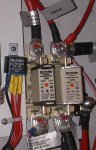
OK, have a look for HRC fuses. These are less common, but are high current devices with a big pin each end and they simply plug in to a holder. I have them on my boat for the main fuses (fitted as standard by Bavaria). If you Google, you should find them easily, here are a couple of links to the fuses and holders...

https://www.eibabo.uk/search?sSearch=hrc+fuse
https://www.eibabo.uk/search?sSearch=hrc+holder

HRCfuse.jpg
 
Top