Basic Q - where to clip on connectors to get power in engine bay

stuartwineberg

Well-Known Member
Joined
24 Oct 2007
Messages
1,813
Location
Romsey, Hants
Visit site
I have a 12v oil extractor pump with croc clips and to date have been taking the power directly from the batteries. Where do I put the clips if I want to pick up 12v on the engine itself? A very basic question but I don’t want to blow anything. Volvo D2-40. I have a meter.
 
I don't know your engine, but I'd think that clipping onto the 12VDC power line of the alternator or starter motor would be good. Obviously, huge care when clipping on in not also touching the surrounding 'metal' at the same time, as well as having no bare wire or cable after the clip, all of the way through.
This will probably require you to have the engine switched on, but not running (of course!)!
 
What's wrong with continuing clipping to the battery as its only a once a year thing ?
 
I have a 12v oil extractor pump with croc clips and to date have been taking the power directly from the batteries. Where do I put the clips if I want to pick up 12v on the engine itself? A very basic question but I don’t want to blow anything. Volvo D2-40. I have a meter.
The positive on to the same starter solenoid terminal as the main heavy battery positive cable ( and probably the alternator output)
BUT, BUT, BUT be very careful not to short it to anything else !

The negative to the same point on the engine block as the main heavy battery negative cable ( assuming your engine does not have an isolated electrical system) .

It would be so easy to short the positive to something else I reckon a direct connection to the battery is probably the safer option provided you ventilate the battery compartment first especially if the pump has no switch of its own.
 
....It would be so easy to short the positive to something else I reckon a direct connection to the battery is probably the safer option provided you ventilate the battery compartment first especially if the pump has no switch of its own.

Very good advice. Instead of messing about with croc clips I'd fit a suitable socket. Then it's safe and easy to plug in a pump, inspection lamp or whatever.
 
Very good advice. Instead of messing about with croc clips I'd fit a suitable socket. Then it's safe and easy to plug in a pump, inspection lamp or whatever.
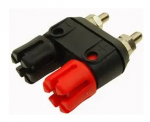
I find it very useful to have one of these on the boat. Binding posts
1667948140125.png
You can use standard 4mm plugs for up to 30A although you would need quite thick cables for that. Alternatively, if you need to power up a new bit of equipment or test something just strip the insulation with your teeth and put the wires under the screw terminals. Good for emergencies when you don't have the correct plug to hand.
 
Many older boats ... batterys power went to the starter solenoid. From there a lot had domestic connection to power rest of boat. Why ?

The power leads from battery to solenoid are substantial and able to carry the load.

It would be simple matter to create a connection point from that solenoid - ready for such pump or other ... plug and socket ?

Because my solenoid already has such domestic tapped off it ... when I needed more - I installed a line from the battery bay itself ......
 
A 12v socket in the engine bay would find all sorts of uses, including a clip-on light to illuminate just where you need it.

If you've got a spare fuse, that would be the ideal place to take it from, if not, I'd run it from the switched side of the domestic battery isolator and fit an in line fuse sized for the wire. That way, it'll still work with the engine battery isolated, which might be useful one day.
 
As Stemar suggests, why not fit a 12v socket in a convenient place, connected directly to the battery suitably fused. Then have a lead with a plug and away you go. Also convenient for other 12v gadgets, I have a 12v vacuum cleaner. I have 12v sockets in the saloon and rear cabin all switched from the main control panel.
 
Top