Balsa Core Decks.

Jim@sea

Well-Known Member
Joined
12 Feb 2010
Messages
4,578
Location
Glasson Dock
Visit site
I may be moving back from Power Boats to Sail and due to budget I am looking at boats of 35 years of age.

OK I can understand osmosis as I once bought a 1973 yacht in 1982 and the hull had already been treated (33ft Ketch. Finland)

And the boat magazines are full of adverts for Osmosis Specialists.

But the boat I looked at last week had a slightly flexible deck, presumably balsa core, and I wondered how it is treated.

Can you drill small holes in the deck and pour in fibreglass resin.

What is the treatment. ? Or do boats reach a "sell by date"

I looked at a boat last week (1978) where in a force 8 the deck started splitting because the "Chain Plates" started pulling through and the boat broker showed me the bills which cost over £12,000. ( so that boat is not for me) but the surveyors report says that the wood underneath was "rotten" Is that what you can expect for a 35 year old boat.

Over to you.

Ps In 1978 I bought a New Moody 30. So its not as if sailing is new to me.
 
It is certainly repairable, but it is a lot more complex than drilling holes and pouring in resin. You need to cut out the entire skin over the failed core from one side or the other, remove the rotted coring, replace it with more balsa or modern foam packing, then replace the skin and glass it back in. It scares the hell out of me and I wish the manufacturers would use solid GRP but they don't. It's reportedly not particularly difficult and there are plenty of articles on the web explaining it in more detail. If you like the boat, just make sure you get a low enough price to cover the cost of the repair.
 
It is certainly repairable, but it is a lot more complex than drilling holes and pouring in resin. You need to cut out the entire skin over the failed core from one side or the other, remove the rotted coring, replace it with more balsa or modern foam packing, then replace the skin and glass it back in. It scares the hell out of me and I wish the manufacturers would use solid GRP but they don't. It's reportedly not particularly difficult and there are plenty of articles on the web explaining it in more detail. If you like the boat, just make sure you get a low enough price to cover the cost of the repair.

Thank you, I have gone through every single Practical Boat Owner Magazine which I have (5 years) and have not found an article on it. Perhaps I may have missed a month.
 
Nearly all boats since the 80s have balsa or foam cored decks. The reason is because a cored deck is far more rigid than plain GRP could be without the GRP being too heavy for the location on a boat. Basically only the top and bottom surface of a structural element like a deck are taking any load; the space between them is merely keeping the top and bottom surfaces apart! So there is no need for a strong core, just something that will support local compressive loads between the inner and outer skin. The long spans of a coach-roof or deck require rigidity, and the relatively high location in the structure means you don't want too much weight. It is perfectly fine as long as water does not penetrate the core. As others have said it is repairable if water does penetrate the core; how cosmetically good the repair is will depend on the location and on the design of the boat.
 
I have had some problems with balsa core detailed here http://www.ybw.com/forums/showthread.php?316619-Deck-Shroud-Fixing-Fibreglass-repair&highlight=

If the balsa has come unstuck from the outer fiberglass that may in some circumstances be able to be repaired by drilling and injecting.

If the core is rotted it has to be removed and may be best done from underneath to avoid damaging the visible fiberglass.

The grain of the balsa is usually vertical between the two layers of fiberglass and it is usually in sections with fiberglass ridges forming barriers between each section so damp/rot may not have spread everywhere. On my small boat, around the shrouds the section was about 18" by 12"

Getting the right thickness of balsa was impossible for me and for the small area I had to replace I used marine ply.

I used a 25mm core drill with a cut off mandrill pilot drill to remove fiberglass plugs to investigate the extent of the rot.

The problem with cored decks is any sort of penetration. If they have simple cut a hole for a fitting then relied on bedding the fitting on sealant to keep water out, that eventually fails water gets in and rots the core. I had that around water filler inlets for that I scraped the balsa out around the hole and filled the resulting gap with epoxy mixed with something, maybe microfibers.

Repairing balsa cores is not easy.
 
The big thing is to make sure you oversize drill any holes in the cored deck and fill with thickened epoxy to seal the core form water ingress then redrill to your required size making sure that you don't expose the core again. A worthwhile winter job is to remove deck fittings like mushroom vents and cleats, infact everything on a new to you boat ,then seal the exposed core which probably wasn't done previously. I have a big patch around one of the forward vents which will need recored as it was rotten:-(
 
There were some spongy areas on my deck. They drilled holes, removed as much material as possible and injected with epoxy.

Its ROCK solid now.

This wasn't anywhere structural mind you.
 
Injecting resin is a bit hit and miss and the core must be tinder dry for this to work. Replacing water soaked core is best done from inside thus preserving the original deck finish.

Closed Cell Foam core is a lot easier to work with and will last a lifetime. Be advised, this is no small project if it is to done properly, working overhead with epoxy resins and fillers like Micro fibers can get a bit messy so cover everything.

You will find lots of articles on this forum, but use Google, not the site search. Type in something like

YBW Balsa deck repair

Good luck and fair winds. :)
 
A balsa cored deck with an extensive problem can be a real pain to repair, but the reality is that very few such boats have that scale of problem. Many (most?) will have no problems at all, and for those that do have a problem it will most often affect a small area and simply repaired.

You need to identify the extent of the problem (if there is one!) before deciding whether an injection of epoxy or whatever is a suitable repair - it may or may not be, depending on the scale and situation.
 
A balsa cored deck with an extensive problem can be a real pain to repair, but the reality is that very few such boats have that scale of problem. Many (most?) will have no problems at all, and for those that do have a problem it will most often affect a small area and simply repaired.

You need to identify the extent of the problem (if there is one!) before deciding whether an injection of epoxy or whatever is a suitable repair - it may or may not be, depending on the scale and situation.

Yes agreed and buyers should take a look at older balsa cored decked boats carefully if they have teak decks that are screwed down everywhere.

A disaster if the screws have let water in as that could mean a widespread problem.

Hatches that are bolted or screwed down can often allow water to ingress to the balsa core as well as the obvious deck fittings such as stanchion mounts.

I caught the problem on my boat in time. Stripped every fitting from the deck before taking all the teak off, put 5 new hatches in that were bigger than the

original enabling me to take out any suspicious looking balsa around the perimeter of each hole. Once I had taken the teak deck off I epoxied the lot and

added another thick layer of strand matt and epoxy before gel and an epoxy based non slip.
 
Last edited:
I'd like to suggest a different approach.

Previously I would have agreed with all of the foregoing.

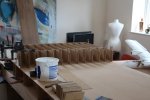
The pic is a small part of a current project (a 17' x 10' x 40" raised floor, stressed for 3 Tons distributed load, from hardboard). Apart from the need for the mezzanine, I decided to write a fairly big equation that ,when input with the desired strength and then properties of various materials, quickly showed the cheapest. I was secretly disappointed that corrugated cardboard was nearly twice as expensive. Total cost £150, including glue.

In short, a study in using the least material to perform to a certain level.

My new thinking is that it would be far easier to router some, say, 3mm wide grooves in a lattice of, say, 70mm squares, through the top skin down to the bottom skin, encapsulate in a bag, dehumidify then fill with epoxy/microfibre filler. Now you have a very strong grid structure. Stronger than original. Gravity on your side too.

I'd like to have oldsalt's thoughts.
 

Attachments

  • IMG_3623.jpg
    IMG_3623.jpg
    87.9 KB · Views: 11
My new thinking is that it would be far easier to router some, say, 3mm wide grooves in a lattice of, say, 70mm squares, through the top skin down to the bottom skin, encapsulate in a bag, dehumidify then fill with epoxy/microfibre filler. Now you have a very strong grid structure. Stronger than original. Gravity on your side too.
.

I like the theory, not sure I'd risk buying a boat with a serious problem just to find out. :o

If the deck to under layer of grp should vary across the deck how do you control the depth of the rout?
 
I like the theory, not sure I'd risk buying a boat with a serious problem just to find out. :o

If the deck to under layer of grp should vary across the deck how do you control the depth of the rout?

The top layer will almost certainly be of uniform thickness, and the thickness of core will not vary.

Done Naval Arch and worked in yacht building. I have never seen a lay-up spec that called for a change over a cored area.

Regardless, I'd do a heap of test drillings of the laminate. Even then, just piercing the top skin and then an end mill until resistance (bottom skin) felt. The tests will show the limits of the core layout ( where the planform ends).
 
My new thinking is that it would be far easier to router some, say, 3mm wide grooves in a lattice of, say, 70mm squares, through the top skin down to the bottom skin, encapsulate in a bag, dehumidify then fill with epoxy/microfibre filler. Now you have a very strong grid structure. Stronger than original. Gravity on your side too.

Neat. I like it!
 
(1)
I am looking at boats of 35 years of age.

Our boat is 34 years old, has a balsa cored deck with no significant problems. Our 'new' project boat is 37 years old, also has balsa cored decks, and has just one small 'springy' area in the cockpit sole. So, in my experience, a 35 year old balsa core is not of itself a problem. You just need to be aware that there are potential failures to watch out for.

For example, a friend who has a sister boat to those above had problems where a previous owner had put dozens of screws (presumably without sealant) through the top of the cockpit seats to face them with teak slats. The leaks from these over many years had rotted much of the balsa core in each seat. Not a major problem, but one better discovered and allowed for before you buy the boat - repair was simple but tedious and messy.

(2) I think someone above said the core needed just to be strong enough to deal with compression loads through the deck. I think that could be misleading, or at least misunderstood. There should be solid timber (or some other stronger material) instead of balsa in those areas under cleats, hatches, genoa tracks, etc. precisely to take and spread the loads in these areas.
 
Your proposed alternative could work, but you would have to improve the joint by routing out a support under the deck because the I suspect the resulting Micro-fibers rod would want to pop out with such a small contact area with the deck, rather than a ledge that would provide Better support.

How would know the existing balsa was dry? any left over moisture could contaminate the epoxy. I have yet to see a balsa repair that was done above deck that looked like anything but a patch up because it not original.

Seeing a brand new deck on an older boat would make me think twice anyway.

Having said that the idea has merit and could be adapted, but (there is always a but) Joining the deck at rightangles to a rod of Micro-fibers is not a good practice.

Only my opinion, perhaps I should make up a dummy and test it to destruction.

Good luck and fair winds. :)
 
Seeing a brand new deck on an older boat would make me think twice anyway.
:)

I agree.......

I bought my boat at a very low price knowing its history and then kept a photo and video diary of each problem when found and the processes that took place to get to the finish, so that in years to come a potential buyer could know the original problem and the work done.

So far after two years all still looks perfect and I have left all the headlinings out for the last 3000nm so that I could keep a good check all round.

In my case the problem was not only many leaks to solve, but the 'shot' teak deck, (without the serious problem that the Op has talked of in his potential purchase.)

Before I bought my boat and knowing that people run a mile from buying a boat with a teak deck in that state, I researched ways I could solve my problem.

A new teak deck would cost nearly as much as I paid for the boat, so I looked at alternatives and the resulting job is imho the very best result and best value for money that I could have hoped for.

I suggest to the OP that looking for an older boat with a 'shot' teak deck, with or without a balsa cored deck, maybe one way of finding a basically very good boat.

I personally would run a mile from a boat that had seriously bad water penetration into a balsa cored deck.
 
Top