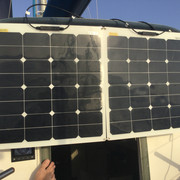
Backing and supporting 'hanging' semiflexible solar panels

pcatterall

Well-Known Member
Joined
2 Aug 2004
Messages
5,507
Location
Home East Lancashire boat Spain
Visit site
We want to boost our solar capacity using moveable solar panels, we have two fixed rigid ones on the pushpit and no space for any more and we don't want arches etc. we have purchased 4 semiflexible panels of around 50 watts each. We have fitted port and starboard deck sockets out of harms way to keep the cables tidy. We plan to store the panels below deck ( there is a handy space) and bring them out while anchored or in suitable sailing conditions.
The panels could be hung with little carabiner clips on the side wires and I would like to be able to prop them out at an angle to get the best performance. other positions could be hanging on the mizzen boom or flat on the after deck.
It would be great to know what others have been doing in similar situations. ??
The panels we obtained are around 50x60 cms and rated at 50 watts. they have holes at each corner suitable for hanging. Just tested them and got almost 2 amps from each in a low watery sun so hoping for 3 back in Spain ( ?) Adding 12 ah over 6 hours to our batteries sounds great!
 
Semi flexible panels won't last long if just suspended as the motion of the boat will cause them to hit against the lower guard wires or the toe rail. I suggest sticking them to a rigid panel of some sort. Most people I have seen with panels hinged at the guard wires are using rigid panels.
 
they have holes at each corner suitable for hanging

The holes in the corners of (some) semi-flexible solar panels are for fixing them down. They may or may not be suitable for hanging, largely dependent on how well supported the panel is across its extent.

Most semi-flexible (as opposed to 'flexible') solar panels can tolerate only very limited bending (e.g. max a couple of cm in a metre), and then only in one direction). Carrying the panels by their ends is sometimes specificalIy warned against in the fitting instructions. I suspect at least some of the reported failures of semi-flexible panels is due to them having been fixed to excessively curved surfaces, or not handled with sufficient care before fitting or when being stored.

The maximum tolerable bend is stated in the specs of the better quality panels, but not always in others.
 
The holes in the corners of (some) semi-flexible solar panels are for fixing them down. They may or may not be suitable for hanging, largely dependent on how well supported the panel is across its extent.

Most semi-flexible (as opposed to 'flexible') solar panels can tolerate only very limited bending (e.g. max a couple of cm in a metre), and then only in one direction). Carrying the panels by their ends is sometimes specificalIy warned against in the fitting instructions. I suspect at least some of the reported failures of semi-flexible panels is due to them having been fixed to excessively curved surfaces, or not handled with sufficient care before fitting or when being stored.

The maximum tolerable bend is stated in the specs of the better quality panels, but not always in others.

Direction of bend can be a big issue as LittleSister mentioned. They will be concave if you hang them from the corners and this usually results in micro-fractures and a big drop in output 80%-100%. The surface of the cells will take a little stretch, not much. Unfortunately, they aren't nearly as good in compression and cracks tend to form fairly easily. Bouncing them around makes it a lot worse. It might not be a problem for all semi-flexibles but certainly affects some types.
 
Direction of bend can be a big issue as LittleSister mentioned. They will be concave if you hang them from the corners and this usually results in micro-fractures and a big drop in output 80%-100%. The surface of the cells will take a little stretch, not much. Unfortunately, they aren't nearly as good in compression and cracks tend to form fairly easily. Bouncing them around makes it a lot worse. It might not be a problem for all semi-flexibles but certainly affects some types.
^^ This.

The instructions will probably tell you that they cannot flex more than a certain arc, that they cannot flex repeatable, and to never, never install them over a hard spot, like a railing or bimini bow. They will only last if secured against flexing and supported against sharp bends.

The wafers are like glass. Obvious, no?

So many stories of short life with semi-flexible panels, nearly always the result of an installation error, which is kind of the fault of marketing that shows some chick holding them in the air bent at an unhealthy angle. But there's no free lunch. Without glass and a frame, the installer is responcible for suport and gentle treatment.
 
^^ This.

The instructions will probably tell you that they cannot flex more than a certain arc, that they cannot flex repeatable, and to never, never install them over a hard spot, like a railing or bimini bow. They will only last if secured against flexing and supported against sharp bends.

The wafers are like glass. Obvious, no?

So many stories of short life with semi-flexible panels, nearly always the result of an installation error, which is kind of the fault of marketing that shows some chick holding them in the air bent at an unhealthy angle. But there's no free lunch. Without glass and a frame, the installer is responcible for suport and gentle treatment.
Absolutely, I had confirmation regarding mounting on a bimini and even sent pictures. The supplier said they'd be perfect in that situation and the literature showed similar installations. It lasted about 5 weeks before output dropped to almost zero. At least they were good enough to send a replacement very quickly.

I realised that even slight movement was an issue and retained the panel as a spare to be laid on deck when required. It actually worked quite well as it was light and easy to handle. However, it also died after about 5 years. I noticed that their installation instructions changed after a few months and they specifically mentioned unsuitability for concave mounting.

I've never had a problem with the rigid panels which are 2, 8 and 9 years old from eBay.
 
You could mount the panels on polycarbonate double or triple sheet. This has the advantage of providing air flow to the back of the panel so they don't over heat, which is a problem for mounted flat to a deck.

Wickes 16mm Triplewall Polycarbonate Sheet - 900 x 3000mm | Wickes.co.uk

You could then thread lengths of stainless steel tube along the top guard wire say 3/4" thickness.

https://www.baselinemarine.com/shopexd.asp?id=1740

Finally fit panels to to tube with something like this:

Single Port Pipe Clamps Stainless Steel Aluminum Brass
 
IMG-0141.jpg


Mine get hung wherever is optimal. 3 years and no problems so far.
 
As I said on a previous thread, I made a 10x10mm aluminium box section frame and pop riveted it to my panels. I stiffened up the corners using 3mm aluminium triangular plates.
Don't rely on the corner eyes, they rust and bend the corner if any pressure is put on them.
If you are going to mount them on the guard wires and remove them, I would make a hardwood frame.
 
In spite of all the doom mongers, we have used Photonics Universe semi flexible 50W panels satisfactorily for 4 or 5 years.
None have any extra backing.
Two have lived on the sprayhood 24x365 all these years, and been through many winter storms. Attached by industrial Velcro to the canvas sprayhood. All fine so far, indeed outlived the spray-hood.

The third is a floating panel, which is only used during the summer months, and then spends most of its time inside the dinghy on the stern davits. When the dinghy gets used it gets heaved out and placed somewhere convenient to get sun when we are ashore. Often leaning against the mainsheet winch or tied to the wheel. It has not objected at all to this rough treatment.
They are so cheap, in boat terms, we assumed would be a disposable item but been pleasantly surprised by lifespan. Extra weight / clutter of a frame would be a major disadvantage in my view (unless going for full hog with cockpit arch).

PS. We simply drilled 4 holes in the corners, being careful to only be on the white bit not the black bit ;-). Nothing to rust
 
Thanks all. As my storage space is limited we have had to go for the none framed type. Interesting to read quite different views about them. I will find my own way to support them bearing in mind the various advice and hope for the best! If they fail I will revert to framed ones. I note that Ladyinbed used 10mm frames and possibly my storage space will cope with that.
 
We have two narrow 50w semi flexible panels which we move about as necessary, sometimes tied on top of the the boom, sometimes on deck & sometimes hanging from the guardrails. They are mounted on 1mm aluminium sheet (stuck with CT1) cut slightly larger than the panels & drilled at the corners to take shackles. Still in perfect condition after five years.
 
I forgot that OP was using 50W panels and should have mentioned that the spare panel I had was 100W and therefore quite long. I don't imagine that 30W-50W panels would suffer as much as they are a lot shorter. I also got some stiffeners for the replacement but only used them once or twice. They did work but I found it easier to stow the panel in a gap against a bulkhead without the additional frame. I only used it flat on deck outside peak months when my 345W rigid panels weren't quite enough.
 
Personally I would sell them and buy rigid ones...
Doesn't seem to make any sense to buy delicate semi-flex panels and then add stiffening to them. You'd be better getting cheap-as-chips rigid panels and cutting the aluminium framing off if you need to (I guess you're going to be storing these under a berth cushion or similar so need them to be slim?).
 
Personally I would sell them and buy rigid ones...
Doesn't seem to make any sense to buy delicate semi-flex panels and then add stiffening to them. You'd be better getting cheap-as-chips rigid panels and cutting the aluminium framing off if you need to (I guess you're going to be storing these under a berth cushion or similar so need them to be slim?).
I don't think the rigid panels would last long under a berth cushion. Once the frame was removed they would probably have a shorter life than a semi-flexible .

I dispensed with stiffening for a semi-flexible as it made storage more difficult and I didn't gain much when it was just lying on deck.. However, I have seen semi-flexible fitted on a thin rigid bimini. It had a slight curve and looked very tidy but rigid would have been a lot cheaper.
 
My 'planned' storage space is under the slightly raised dinette floor and is around 700x700 x 10 cm Solid framed would be too high. I am considering either no frame or a thin frame. I may be able to 'stagger' the frame sizes
so that they pack better. With rigid sides I may be able to design simple props to hold the panels with a leg to the lower guard wire.
As my panels will only be used say 30 days a year I hope for some longevity provided I can afford damage.
 
I have 2 80W PU semi flexible panels which I use as roving panels when at anchor or when the sun is at a suitable angle when sailing. To prevent them flexing, I have attached them to 6mm marine plywood. It does make them a bit heavy. And I wonder if I should just get rigid ones next time?
Angus
 
I have 2 80W PU semi flexible panels which I use as roving panels when at anchor or when the sun is at a suitable angle when sailing. To prevent them flexing, I have attached them to 6mm marine plywood. It does make them a bit heavy. And I wonder if I should just get rigid ones next time?
Angus
Why rigid? The aluminium frames are sharp and can damage the GRP. Our semi flexible are fine with no extra frame, much lighter and the panels won’t damage the boat, or the rubber dinghy ours often sits in. My view is keep simple and no frame.
 
Top