Attaching semi-flexible solar panels

JumbleDuck

Well-Known Member
Joined
8 Aug 2013
Messages
24,165
Location
SW Scotland
Visit site
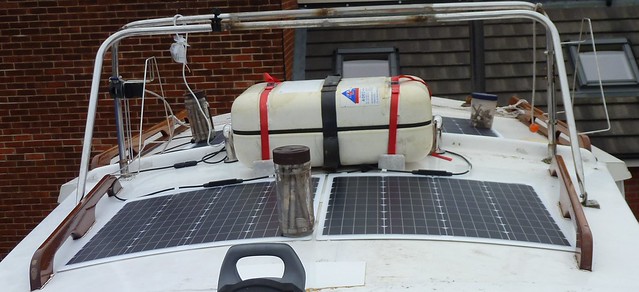
I have a couple of very nice and very expensive German panels waiting to go on my boat, replacing a couple of cheapies of which one died after a year and one is so clouded that it barely runs at half its original output.

When I installed the current ones I didn't expect them to last long but I was skint. They are held down with velcro, which has worked well but has its disadvantages. I'd like to attach the new ones a bit more firmly, but still removably so Sikaflex is out. So is velcro, because the new panels, though still flexible, are thicker and stiffer than the old ones.

What would the panel recommend? My thoughts at the moment are running towards teak strips an inch wide with a rebate machined along them so that when screwed to the coachroof they provide a slot into which the edge of the panel fits. There are eyelets at the corners of the panels so I want the fixing to be continuous along the length, and I don't want to drill through them.

Bright ideas and suggestions welcome.
 
Mine are bolted through eyelets. Easy to remove if necessary. Cheap panels which I bought on limited budget expecting to replace after a few years. One is totally misted (bought at different times) but I still saw 74W out of the 2x40W panels the other day!
 
I fixed my semi-flexible panels with self-tappers through the corner eyelets. Why does the fixing have to be continuous?
Because there is a respectable, but not excessive, curve and if I only hold them down at the corners the middle of the sides lift up, which is inviting fluttering and fatigue problems.
 
Wanting to be able to shift my hole-free german panel from time to time (it normally lies over the focsle hatch because in the berth that is due south and unimpeded) and having read the delamination warnings about drilling the margins ,I glued on some neat 4/5mm plastic tabs using sikaflex.This bonds well to the back of the panel but less well to the tabs allowing creep of the unset adhesive. This was overcome by perforating the tab overall with 6mm holes so the sika 'hardens' through and there is a mechanical bond.The tabs allow the panel to be tied or held with elastics.
Jumble Duck's panels sound less rigid than mine so can't see anything against the rebated teak except its another maintenance item and perhpas neater sections may be found ? The instructions may well say something about leaving a gap behind the panel ,against overheating, but then it needs to be clear of footfall.
 
Last edited:
I asked a similar question a while back and will try to find the link to share the suggestions received then. [p.s. it's here (note I've since abandoned the idea on bedding on butyl) Fixing semi-flexible solar panel]

None of those suggestions were entirely to my liking for my particular purposes.

I am mindful that the life of the boat will be longer than that of the panel; that water and air needs to be able to drain from underneath to avoid blisters in the GRP underneath or the panel bubbling up in heat (one panel manufacturer recommends narrow parallel strips of adhesive for this reason); the GRP underneath is too thin for self-tappers and would risk leaks, and because of what's inside I don't want to bolt through; and that solutions such as battens or velcro will not allow me to walk or kneel on the panel as I will sometimes need to do as this would flex the panel.
 
Last edited:
Mine are bolted through eyelets. Easy to remove if necessary. Cheap panels which I bought on limited budget expecting to replace after a few years. One is totally misted (bought at different times) but I still saw 74W out of the 2x40W panels the other day!
One of my existing ones, on the hatch garage, is a Photonic Universe back-contact one which was great when installed but is now very misted indeed. Still, six years isn't too bad. The other is an eBay cheapie (fifty quid) which was all I could find to fit 50W into a rather narrow space on the coachroof and died completely in its second year.

That narrow space was the killer, as lots of places could sell a 30W panel to fit but nowhere seemed to do a 50W one until I found Sunbeam ones.
 
Because there is a respectable, but not excessive, curve and if I only hold them down at the corners the middle of the sides lift up, which is inviting fluttering and fatigue problems.
Errrr ..... unless your coachroof is concave, the physics of that description do not seem to be possible, unless you are pushing the ends towards each other before you tighten the screws. I'm guessing therefore that you have a concave coachroof which seems unusual, as do any concave surfaces on a boat.

Richard
 
Faced with a similar dilemma, I built up a few layers of chlorinated rubber paint over the proposed site of the panel. Having allowed this to dry well, the panel was stuck down with a mastic. When it came to removal a good few years later, the mastic came away in some parts and the paint in others. The underlying epoxy and glass layer was not damaged. This allowed the surface to be sanded and repainted prior to sticking down a new panel.
 
Errrr ..... unless your coachroof is concave, the physics of that description do not seem to be possible, unless you are pushing the ends towards each other before you tighten the screws. I'm guessing therefore that you have a concave coachroof which seems unusual, as do any concave surfaces on a boat.
Sorry, don't see where you get that. It's a convex curve: the edges have to be pushed down. Push down the corners only and the middle of the side will spring up. Physics is happy.
 
Polysuphide. Used it on three panels. Absolutely perfect. It is the ARFLX photonic panels. Won't fly away but the seal could be broken if required.
Sounds good. What type did you use? I used to rely on Boatlife Life-Calk polysulfide for everything but it's not available in the UK any more.
 
Sorry, don't see where you get that. It's a convex curve: the edges have to be pushed down. Push down the corners only and the middle of the side will spring up. Physics is happy.
The long side cannot spring up. It is trying to spring down. The short ends are different but they are so short and close to the screws in the corners that it won't be a problem and there is simply not enough flex in that short edge. :unsure:

Unless, of course, you're fixing the panels at 90 degrees to the normal orientation which is with the long side following the curve.

Richard
 
This is simple. put them on some kind of foam core backing or courrgated plastic then use either 3M velcro or preferably 3M dual lock.

Job done. They won't budge no matter what the wind.

On quite a tight curve, I use 6 pieces. That keeps middle edges down.
 
The long side cannot spring up. It is trying to spring down. The short ends are different but they are so short and close to the screws in the corners that it won't be a problem and there is simply not enough flex in that short edge.
Sorry, but I have absolutely no idea what you are trying to say here. I think you may be getting confused with anticlastic curvature in shells, which arises from applied moments along opposing side and not from point loads.

If it helps, imagine a panel 20m long and 0.5m wide to be formed around a surface curved across the panel. Fixings at the corners will give you nice curves at the ends but will do little to curve the middle of the panel.

Thanks for the suggestion, though.
 
My thoughts at the moment are running towards teak strips an inch wide with a rebate machined along them so that when screwed to the coachroof they provide a slot into which the edge of the panel fits.
I would go with the hardwood strips and put 'twist latches' similar to this in say brass or SS down the lengths to hold the panel in place.
PS Here's one that says Marine Grade https://www.locksonline.co.uk/Timag...tches/Timage-Marine-Small-Cupboard-Latch.html
 
Last edited:
Top