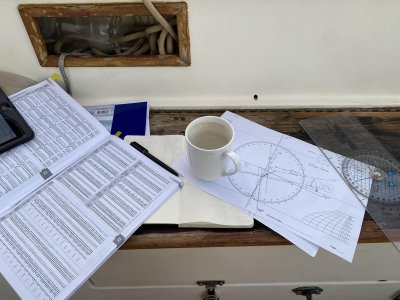
Astro nav advice wanted, and which Atlantic Chart.

Tombuoy2

New Member
Joined
25 Oct 2025
Messages
5
Visit site
Good evening, newby to the forum so please go gently! I am hoping for some advice from those more experienced than I.

I have foolishly agreed to join a mate in trying to obtain YM Ocean qualification. Having happily sailed for years with just an ICC, we did the YM Offshore recently, and now face with the prospect of Astro navigation. Problem is I am not the most academic at the best of times!

Realistically, this Astro nav bit is a means to an end for me, I just need to learn enough to take a few sights good enough to pass the exam. I doubt I’ll use the Astro nav in the future, as on my previous 8 transatlantics we have been happy enough with navionics etc.

So what do I need to cover the basics? I’m thinking sun sights only.

I’ve picked up a secondhand Sextant & ordered the RYA Astro navigation handbook.

Should I get Tom Cunliffes book too if it makes it easier to understand?

Was going to order Reeds Astro Navigation tables 2025, is that the most convenient?

Are any of the apps worth considering?

I’d like to plot the sights on a chart. Seen Imray chart 100 but it has a conical projection, is that ok or is Admiralty chart 4012 more use?

Is there anything else needed?

I’m helping a friend take his boat from Canaries to Caribbean next month, so hoping to learn the basics and use the trip to get the necessary sights.

Any advice gratefully received! Thanks.
 
Good evening, newby to the forum so please go gently! I am hoping for some advice from those more experienced than I.

I have foolishly agreed to join a mate in trying to obtain YM Ocean qualification. Having happily sailed for years with just an ICC, we did the YM Offshore recently, and now face with the prospect of Astro navigation. Problem is I am not the most academic at the best of times!

Realistically, this Astro nav bit is a means to an end for me, I just need to learn enough to take a few sights good enough to pass the exam. I doubt I’ll use the Astro nav in the future, as on my previous 8 transatlantics we have been happy enough with navionics etc.

So what do I need to cover the basics? I’m thinking sun sights only.

I’ve picked up a secondhand Sextant & ordered the RYA Astro navigation handbook.

Should I get Tom Cunliffes book too if it makes it easier to understand?

Was going to order Reeds Astro Navigation tables 2025, is that the most convenient?

Are any of the apps worth considering?

I’d like to plot the sights on a chart. Seen Imray chart 100 but it has a conical projection, is that ok or is Admiralty chart 4012 more use?

Is there anything else needed?

I’m helping a friend take his boat from Canaries to Caribbean next month, so hoping to learn the basics and use the trip to get the necessary sights.

Any advice gratefully received! Thanks.
Welcome to the forums.

The YM Ocean exam has three sections. Preparation of boat and crew then management of boat and crew on the passage and finally a set of sights showing that you can do the minimum to produce a fix using your sextant. The minimum is a meridian pass latitude run on to a sun sight reduced position line to produce a fix. You also need to do a Compass check. I find Tom Cunliffe‘s book really helpful but it’s all according to your learning style and who you get on with. Other people swear by Mary Blewitt but I don’t find her easy to read.

The maths is simple adding and subtracting so don’t lose too much sleep over that part.

I use the full ‘Nautical Almanac’ as it’s referred to in the books you’ll read and it’s what I’m used to.

Before somebody else gives me away, I ought to confess I’m one of the examiners. Let me know if you want any other advice.
 
Thank you for your response, never expected a YM examiner to reply! Really useful info, thank you.

Prep & management of boat and crew I am fairly comfortable with having done a few longer trips, Certainly need to focus on the detail there, but the Astro nav is totally new, and somewhat scary!
To be honest, in 50k miles of sailing, including several longer passages, I have never used it nor seen it used properly.
So it’s somewhat a case of learning how to pass the exam. (Yes I don’t doubt it’s handy if all the satélites fall out of the sky or your electronics explode & the iPad dies) but I guess I’m looking for the most idiot proof way to get the desired results.

I signed up to an online course, but find the content difficult to digest. Thanks for your recommendation of Tom Cunliffes book, he has a style of passing on information that makes sense.

Will get the full nautical almanac, thank you.

And are any of the apps worth getting?

Thanks.
 
No problem.

Sorry your online course isn’t being very helpful for you.

The RYA teaches sight reduction using sight reduction tables for air navigation AP3270 and you can often pick up second hand copies. Just be aware that AP3270 comes in three volumes and volume 1 (selected stars) goes out of date. If you’re not going to do star sights you don’t need it anyway.

Most people find a pro-forma to do the calculations on useful as it prompts you what to do. Lots available and I expect your course will have one for you to download and use. Lots of others available on the www.

I’m not aware of any apps that will help you pass the written exam etc.

There are people on these forums who are extremely competent Astro navigators. Some did it professionally. At least one I know on here used to run a Sea School and his wife teaches Astro.

Keep asking questions and I’m sure you’ll get lots of answers. Hopefully helpful ones.
 
You may like to try this Offshore Navigation
Written by a simple sailorman for simple sailormen. 30 plus years ago over 3000 people signed up for the course which lead to an AYF qualification.

Cupla other points. I would download from the net the ' daily pages' the almanac covering the duration of the voyage and also buy next year's almanac. Why? Because there is a lot of useful info in the full almanac that never goes out of date.

I would plot my noon position on something like Admiralty chart 4012, North Atlantic southern part. I would plot the sights on either plotting sheets you produce yourself or try and get hold of the US plotting sheets which you will get about a week or more onto. I forget the number. You would probably only need one for a near east-west crossing.
I can't imagine not using a 'proforma' or better still a 'sight book'. Apart from simplifying the task and reducing the risk of errors a lot of the info can be entered before you take your sight - even just copied from the previous day. True navigators could work up their mer-alt beforehand, note down a few numbers on the palm of their hand and then go 'the full Errol Flynn' and read the latitude straight off the sextant. A sure way to confound your friends, impress your enemies and win over the ladies.

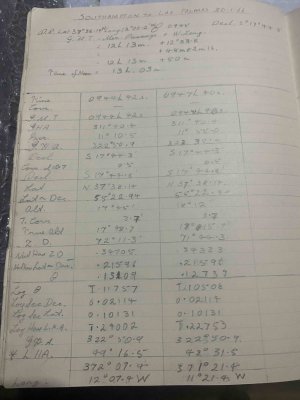
Below is a page of my very first sight book, a few months shy of 60 years ago when I was a newly minted uncertified and uncertificated junior 4th officer in the 'Cape Mail'.
Note. That shows the reduction of 2 morning sun sights using the Haversine formula and logarithms but you should get the idea. The right hand page had the mer-alt and all the day's run stuff.sbook1.jpg
 
Last edited:
If you can get a copy, "Navigation with Alice" by Frank Debenham is an excellent and light-hearted introduction to the principles (not the practice) of celestial navigation. He wrote it to introduce trainee RAF navigators to the principles of navigation in WW2.

Another excellent introduction to the principles is called "Sextant" - can't recall the author but I posted a review here a few years back. It Introduces various principles using a frame story of a trans-Atlantic passage.

I find that understanding the principles (which are easy) helps understanding of the various practical techniques.

The review is here: Sextant: Book review
 
Last edited:
You can download all the tables you might need here.490020569_10232402607381225_7853668578811037227_n.jpg
I was a bit surprised that the Reeds astro Tables use a different calculation method than that taught by the RYA. But once you know what's going on it's usable too. I'm usually somewhere between 2 and 20nm from my plotted sight. Well I was, depending on when I get round to plotting. I keep the sights in a book along with the GPS position when I took them so I can plot them when I get round to it. I've got half a dozen from the last two years that I haven't got round to plotting yet :-) I have an IPAD app that will calculate and plot them that I use on the boat to check that the sight itself is reasonable.
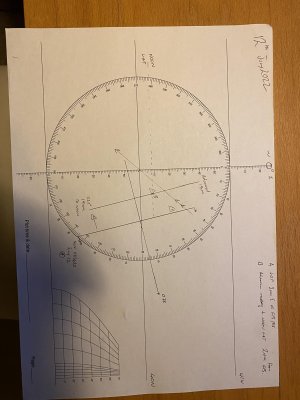
I just do them to post on Facebook for clout. The hardest thing is organising all the right tables if you download everything as PDF.

490663055_10232410855547424_311804873318876572_n.jpg
 
You might want to have a look at some of the resources on this site. I found his course on astro straightforward and comprehensive and there are several free downloads that you might find helpful.

Starpath School of Navigation Title Page
There may be free downloads but $349 for the online Astro course when the OP has already paid for another?
 
You may like to try this Offshore Navigation
Written by a simple sailorman for simple sailormen. 30 plus years ago over 3000 people signed up for the course which lead to an AYF qualification.

Cupla other points. I would download from the net the ' daily pages' the almanac covering the duration of the voyage and also buy next year's almanac. Why? Because there is a lot of useful info in the full almanac that never goes out of date.

I would plot my noon position on something like Admiralty chart 4012, North Atlantic southern part. I would plot the sights on either plotting sheets you produce yourself or try and get hold of the US plotting sheets which you will get about a week or more onto. I forget the number. You would probably only need one for a near east-west crossing.
I can't imagine not using a 'proforma' or better still a 'sight book'. Apart from simplifying the task and reducing the risk of errors a lot of the info can be entered before you take your sight - even just copied from the previous day. True navigators could work up their mer-alt beforehand, note down a few numbers on the palm of their hand and then go 'the full Errol Flynn' and read the latitude straight off the sextant. A sure way to confound your friends, impress your enemies and win over the ladies.

Below is a page of my very first sight book, a few months shy of 60 years ago when I was a newly minted uncertified and uncertificated junior 4th officer in the 'Cape Mail'.
Note. That shows the reduction of 2 morning sun sights using the Haversine formula and logarithms but you should get the idea. The right hand page had the mer-alt and all the day's run stuff.View attachment 201183
I think I might have a go at your book. Is there any way to buy it and download it rather than just reading it online?

Somewhat to my surprise I was able to find the sextant that I bought many years ago. It could do with a clean, but appears serviceable.
 
I think I might have a go at your book. Is there any way to buy it and download it rather than just reading it online?

Somewhat to my surprise I was able to find the sextant that I bought many years ago. It could do with a clean, but appears serviceable.
I didn't realise that it couldn't be downloaded on that site. If anyone can direct me to a reliable and free PDF host I would be no end pleased, this Calameo site is my third. In the meantime PM/DM me your email addy and I will send the PDF directo, gratis, free, and for nothing.
 
I didn't realise that it couldn't be downloaded on that site. If anyone can direct me to a reliable and free PDF host I would be no end pleased, this Calameo site is my third. In the meantime PM/DM me your email addy and I will send the PDF directo, gratis, free, and for nothing.
Thanks again. Sorry I can’t help with a PDF host.
 
I think I might have a go at your book. Is there any way to buy it and download it rather than just reading it online?

Somewhat to my surprise I was able to find the sextant that I bought many years ago. It could do with a clean, but appears serviceable.
Check your errors, side, index and perpedicularity. Top tip. There are others that Frank can explain but those 3 are enough for us plebs.

:)
 
Top