Are Underwater Snubbers A Thing?

OTOH if you rig two idntical non-load sharing snubbers and the first one breaks, then, unless it failed from an intrinsic weakness, the second one is likely to follow it if those conditions persist.

The cycle life of the backup snubber will be zero if it is rigged as Dockhead suggested. This, together with little or no chafe, will make it more durable than the primary snubber.

Breaking even a new, unused, backup snubber in addition to the primary snubber is obviously possible, but not very likely if the snubber is correctly sized.

I'd also think I wouldnt want the stretch to say the same even if the primary snubber snaps, I'd want it to decrease, and the restoring force to increase, in response to the worsening conditions.
I am not sure why you want the stretch to decrease.
 
Last edited:
cycle life ofThe the backup snubber will be zero if it is rigged as Dockhead suggested. This, together with little or no chafe, will make it more durable than the primary snubber.

Breaking even a new, unused, backup snubber in addition to the primary snubber is obviously possible, but not very likely if the snubber is correctly sized.


I am not sure why you want the stretch to decrease.
RE "cycle life ofThe the backup snubber will be zero if it is rigged as Dockhead suggested" I think this hasn't been definately established (see above, though this was an edit so might have been after your reply)

I might want the stretch to decrease because the forces involved apparently stretched the "primary" snubber beyond its breaking point, so I now might want a stronger "spring" operating, which will stretch less for a given force.
 
RE "cycle life ofThe the backup snubber will be zero if it is rigged as Dockhead suggested" I think this hasn't been definately established (see above, though this was an edit so might have been after your reply)

I might want the stretch to decrease because the forces involved apparently stretched the "primary" snubber beyond its breaking point, so I now might want a stronger "spring" operating, which will stretch less for a given force.
You could use two snubbers at once, with both working, to reduce the elasticity, if you wanted to.

I've never done that -- I rig multiple snubbers as Noelex described, with one not working and in reserve. I think Noelex meant "expenditure of cycle life of the backup snubber will be zero". But if you got caught out without a thick enough snubber, doubling thinner ones could be an OK move.

I think it's better to have a thicker and longer snubber, tuned with the right amount of elasticity, for the given conditions, which is what I try to do. Thicker snubber is more chafe resistant, too.

If you look at a table of cycle life vs. % of BS load you will see the curve is not linear at all, so you want to tune the snubber -- that is, select thickness and length -- to keep the loads as a % of BS to a range where the cycle life is decent.

Noelex, maybe you could remind us of your unusual snubber arrangement with Dyneema leaders? Are you still using that?
 
Noelex, maybe you could remind us of your unusual snubber arrangement with Dyneema leaders? Are you still using that?
We employ a nylon snubber attached to our stern cleats. This snubber is guided via low-friction rings to the bow. A short, thick Dyneema section is connected with soft shackles where the snubber passes over the bow roller. The nylon provides stretch, while the Dyneema offers chafe protection where necessary over the bow roller. It has proven to be an excellent system tested over 2,000 nights at anchor on this boat.

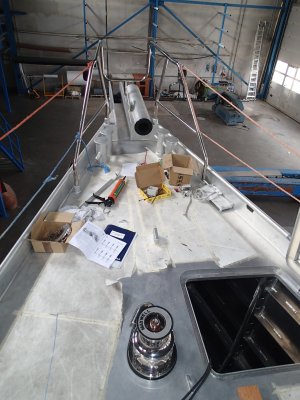
However, our general anchoring arrangement is a little unusual. Our chain and windlass is stored well back from the bow, primarily to keep the chain weight more central, but this also makes it easy to divert the snubber from running along the deck to passing over the bow roller (see the photo below taken during construction). Many yachts could rig a snubber from stern cleats, but the specifics will be different when the chain is stored directly at the bow as it is in most yachts.


P9080860.jpeg
 
You could use two snubbers at once, with both working, to reduce the elasticity, if you wanted to.

I've never done that -- I rig multiple snubbers as Noelex described, with one not working and in reserve. I think Noelex meant "expenditure of cycle life of the backup snubber will be zero". But if you got caught out without a thick enough snubber, doubling thinner ones could be an OK move.

I think it's better to have a thicker and longer snubber, tuned with the right amount of elasticity, for the given conditions, which is what I try to do. Thicker snubber is more chafe resistant, too.

If you look at a table of cycle life vs. % of BS load you will see the curve is not linear at all, so you want to tune the snubber -- that is, select thickness and length -- to keep the loads as a % of BS to a range where the cycle life is decent.

Noelex, maybe you could remind us of your unusual snubber arrangement with Dyneema leaders? Are you still using that?
I suggested something in between having "two snubbers at once" and "one not working in reserve". i.e. having the second snubber come on load once the first snubber has extended...er...a bit (which I havn't attempted to work out an optimum for) because I think it might be advantageous to offer progressive load sharing, and might also be actually rather difficult to guarantee to avoid, plus I cant see why you would want to.

To avoid it with confidence you'd have to ensure that the first snubber definately bust before the second one became loaded. Since I understand a nylon rope can extend between 20 and 50% before failure, (though fatigue will reduce that) that implies that for a worst/limit case, with new parallel snubbers, the secondary must be 50% longer, which doesnt sound like the "bit slacker" you mention. That Practical Sailor article is a bit coy about specific recommendations, but their "worked example" is 33 ft, so a semi-guaranteed-non-load sharing backup to that would have to be 50 ft long. Seems a bit of an unnecessary constraint.

Be that as it may, my original question was prompted by someone saying it was difficult to deploy a "storm" snubber, but this wee sub-discussion hasn't really identified a difficulty, so thats nice
 
I suggested something in between having "two snubbers at once" and "one not working in reserve". i.e. having the second snubber come on load once the first snubber has extended...er...a bit (which I havn't attempted to work out an optimum for) because I think it might be advantageous to offer progressive load sharing, and might also be actually rather difficult to guarantee to avoid, plus I cant see why you would want to.

To avoid it with confidence you'd have to ensure that the first snubber definately bust before the second one became loaded. Since I understand a nylon rope can extend between 20 and 50% before failure, (though fatigue will reduce that) that implies that for a worst/limit case, with new parallel snubbers, the secondary must be 50% longer, which doesnt sound like the "bit slacker" you mention. That Practical Sailor article is a bit coy about specific recommendations, but their "worked example" is 33 ft, so a semi-guaranteed-non-load sharing backup to that would have to be 50 ft long. Seems a bit of an unnecessary constraint.

Be that as it may, my original question was prompted by someone saying it was difficult to deploy a "storm" snubber, but this wee sub-discussion hasn't really identified a difficulty, so thats nice
You are using the wrong parameter for nylon stretch. It can normally survive ONE CASE, or a very few cases, of stretch to 20% or 30% (not 50%), but reduction of cycle life rises steeply after 15%. Your snubber should be sized to stretch less than 10% at the expected maximum load, if you expect to get a reasonable life span out of it. And even then, it should be replaced regularly.

As to length, my LIGHT CONDITIONS snubber is 10m long. I have a few heavier ones from 20m and even longer.

A backup snubber needn't necessarily be a heavier longer one. When I deploy two snubbers, they are usually both "storm length". Because in lighter conditions, there is much less need for a backup. But if for some reason you want to use a longer one as a backup, the difference in length would not be a problem. You just tie the longer one, further up the chain.

If you want both of them working to some extent -- I don't really see any problem with that, but note that this will reduce elasticity. Maybe there could be conditions where that would be desirable. Maybe your idea is to make the elasticity progressive, like a progressive rate spring. That might actually be a good idea.
 
How do you know what the maximum expected worst case load is? Not a dumb question or intended as a trick question. Unless you've spent time with a load cell it is very hard to know. It depends on ...
  • Intensity. Wind and waves.
  • Waves. How much fetch? How deep is the water?
  • Rode. How much weight (depends on depth, scope, type, and size)? How much stretch? How long is the snubber?
  • Boat. Windage? Weight? Is out of the average for any chart you are using?
The ABYC chart is based on testing of monohulls in non-breaking but steep waves (long fetch, shoaling bottom), with all-chain and scope such that there is very little catenary remaining. Some snatching. The worst case and one you should absolutely avoid. In fact, though, it can be higher. I broke a 2000-pound working load cell due to a large wake that caught me with all-chain rode in 5 feet of water with little catenary. Bang, the shackle blew (4000# BS?) and the load cell could not be calibrated. Breaking conditions can and have snapped chain. But you should never be in that situation.

I did some testing an got a range of 4:1 in one spot, identical weather. All I changed was the rigging of the anchor. A different 35-foot boat would add further variables. As a result, I had two bridles. One, 7.5mm ice climbing rope, that was very stretchy and would help an anchor keep its grip in the most insecure bottom. But it could technically overload in a strong storm and why put the wear on it? The other was 1/2-inch 3-strand. It was strong enough for anything, stretchy enough for comfort, and was what I used 90% of the time. I saved the 7.5mm floss for nights with storms and insecure bottoms, both, when I needed a very soft ride.

There can't be one right answer. Only compromises. Pick the one you like.
 
If you anchor in five feet of water, with large waves, with an all chain rode, which in that depth of water, isn't going to give any useful catenary, expect trouble. But you know that now.
 
We trialed different snubbers (diameter and length) until we achieved the ideal amount of stretch (too much stretch is almost as bad as not enough stretch) while achieving good reliability without frequent snubber breaks. Don’t worry about small differences; these have little impact.

The tuning is easy: thinner and longer snubbers stretch more. Thicker and longer snubbers break less frequently.

This is optimised on our yacht for severe conditions. In mild/moderate conditions, the snubber does little on our boat apart from reducing the chain rumbling.

This will be different for those vessels with very light chain and a small anchor, especially if they sometimes anchor in very shallow water. Here the stretch may need to be optimised even in mild/moderate conditions. This will require a more complicated set up where the snubber is adjusted to match the conditions, but most boats can avoid these complications. This saves waking up and making changes to the snubber if conditions change.
 
How do you know what the maximum expected worst case load is? Not a dumb question or intended as a trick question. Unless you've spent time with a load cell it is very hard to know. It depends on ...
  • Intensity. Wind and waves.
  • Waves. How much fetch? How deep is the water?
  • Rode. How much weight (depends on depth, scope, type, and size)? How much stretch? How long is the snubber?
  • Boat. Windage? Weight? Is out of the average for any chart you are using?
The ABYC chart is based on testing of monohulls in non-breaking but steep waves (long fetch, shoaling bottom), with all-chain and scope such that there is very little catenary remaining. Some snatching. The worst case and one you should absolutely avoid. In fact, though, it can be higher. I broke a 2000-pound working load cell due to a large wake that caught me with all-chain rode in 5 feet of water with little catenary. Bang, the shackle blew (4000# BS?) and the load cell could not be calibrated. Breaking conditions can and have snapped chain. But you should never be in that situation.

I did some testing an got a range of 4:1 in one spot, identical weather. All I changed was the rigging of the anchor. A different 35-foot boat would add further variables. As a result, I had two bridles. One, 7.5mm ice climbing rope, that was very stretchy and would help an anchor keep its grip in the most insecure bottom. But it could technically overload in a strong storm and why put the wear on it? The other was 1/2-inch 3-strand. It was strong enough for anything, stretchy enough for comfort, and was what I used 90% of the time. I saved the 7.5mm floss for nights with storms and insecure bottoms, both, when I needed a very soft ride.

There can't be one right answer. Only compromises. Pick the one you like.
Well, that's easy -- you observe the snubber. With some experience with ropes, you can tell when the snubber is loaded too much to live long.

You use awfully skinny snubbers. I guess your boat is several times lighter than mine, so what you're doing is out of my experience range.

As we discussed, you can make a snubber stronger whilst maintaining the same amount of elasticity by making it thicker and LONGER. So it's not necessarily a compromise between strength and elasticity. Within the limits of possible length. Those may be strict in your case -- I think you mentioned your usually in as little as 3m of water.

I am typically anchored in 10m to 15m of water, with 30m to 100m of chain out, and rarely less than 6m. My shortest snubber is 10m.

Another advantage for me is heavy chain. Dashew preaches lighter high test chain, and rely on the snubber for damping. I have huge respect for Dashew, but I love the effect of heavy chain, enough to tolerate 330kg of it in my bows (Dashew's boats had chain lockers near the mast step). Except when racing, when I offload the chain, but to be honest I don't notice any difference. The catenary of 70m or 80m of 12mm chain out in deep water absorbs an enormous amount of energy, enough not to need a snubber at all in less than maybe 30 knots of wind.

Like Dashew, I can anchor on very short scope when necessary. It works with a heavy, good anchor in very deep water. Dashew writes that he is often on 2.5:1.
 
. . . This will be different for those vessels with very light chain and a small anchor, especially if they sometimes anchor in very shallow water. Here the stretch may need to be optimised even in mild/moderate conditions. This will require a more complicated set up where the snubber is adjusted to match the conditions, but most boats can avoid these complications. This saves waking up and making changes to the snubber if conditions change.
I think that's Thinwater's case. Which is different from ours,

I do have different subbers for different conditions, but it's not a fine difference which needs to be changed all the time. Basically my "light" snubber for >30 knots and <40 knots, and my storm snubbers. If the shelter is imperfect, those wind ranges move down.

I don't have chain rumble problems (aft main cabin), so don't use any snubber at all most of the time. I'm writing this at anchor right now, in 20-25 knots of wind and no snubber. Smooth as silk, even though it's shallow water for me, about 6m.
 
Like Dashew, I can anchor on very short scope when necessary. It works with a heavy, good anchor in very deep water. Dashew writes that he is often on 2.5:1.
(y)
This is an advantage that those who preach the benefits of "small is adequate" miss out on.

They advocate using a minimum of 5:1 overnight, and in only moderate winds deploying dual anchors. The snubber needs to be optimised even in mild/moderate conditions. Sensible precautions if in some substrates there is little reserve anchor holding capacity, but these limitations should be unnecessary.

There is nothing wrong with using longer scopes with any ground tackle option, providing it is reasonable to do so, but the option to safely deviate from this mandate opens up many anchoring opportunities.
 
Last edited:
You are using the wrong parameter for nylon stretch. It can normally survive ONE CASE, or a very few cases, of stretch to 20% or 30% (not 50%), but reduction of cycle life rises steeply after 15%. Your snubber should be sized to stretch less than 10% at the expected maximum load, if you expect to get a reasonable life span out of it. And even then, it should be replaced regularly.

As to length, my LIGHT CONDITIONS snubber is 10m long. I have a few heavier ones from 20m and even longer.

A backup snubber needn't necessarily be a heavier longer one. When I deploy two snubbers, they are usually both "storm length". Because in lighter conditions, there is much less need for a backup. But if for some reason you want to use a longer one as a backup, the difference in length would not be a problem. You just tie the longer one, further up the chain.

If you want both of them working to some extent -- I don't really see any problem with that, but note that this will reduce elasticity. Maybe there could be conditions where that would be desirable. Maybe your idea is to make the elasticity progressive, like a progressive rate spring. That might actually be a good idea.
The 50% number came off the Internyet as a maximum from one of the big rope boys, and was taken as a limit case for the absolute avoidance of load sharing, rather than as something I would do. A subsequent search gives 40%. Nailing jelly to a tree search syndrome

Re, "Maybe your idea is to make the elasticity progressive, like a progressive rate spring. That might actually be a good idea"

Yes, I intended to mention this up above, but I said variable rate rather than progressive, which was perhaps misleading. I was thinking of the way the coil spacing changes along the length of the spring, which I suppose is something to do with it. "It gives you something like a tunable variable rate spring. Many motorcycles have these, and probably a lot of people never tune them, but they could if they wanted or needed to".

Im not really sure it counts as an "idea", though. Just seemed the obvious, even default, way to do it

I suppose if less than 10% stretch is the desiratum, maybe starting load sharing at 5% stretch might be reasonable, so each successive backup could be 5% longer (or attached 5% closer in the chain loop if the same length)

I might want some kind of alarm so I know if the highest level backup snubber is approaching its limits. Perhaps some polyester twine set at 5 or 10%, so it busts at the assigned danger level, would do it crudely.

Long term Practical Sailor recomends nylon snubbers and rodes be monitored for permanent elongation and condemned at 10%, which seems ...er...practical, though I cant interpret the second graph.

Checking Rope Strength - Practical Sailor
 
Last edited:
Just to add complications ....

If the snubber is a bridle an one leg fails, you'll need to free the non-failed leg before loading the new bridle. Otherwise the boat will hang at a crazy angle. Just sayin'.
You didn't add complications.
They were already there.
Dont beat yourself up.
 
The 50% number came off the Internyet as a maximum from one of the big rope boys, and was taken as a limit case for the absolute avoidance of load sharing, rather than as something I would do. A subsequent search gives 40%. Nailing jelly to a tree search syndrome

Re, "Maybe your idea is to make the elasticity progressive, like a progressive rate spring. That might actually be a good idea"

Yes, I intended to mention this up above, but I said variable rate rather than progressive, which was perhaps misleading. I was thinking of the way the coil spacing changes along the length of the spring, which I suppose is something to do with it. "It gives you something like a tunable variable rate spring. Many motorcycles have these, and probably a lot of people never tune them, but they could if they wanted or needed to".

Im not really sure it counts as an "idea", though. Just seemed the obvious, even default, way to do it

I suppose if less than 10% stretch is the desiratum, maybe starting load sharing at 5% stretch might be reasonable, so each successive backup could be 5% longer (or attached 5% closer in the chain loop if the same length)

I might want some kind of alarm so I know if the highest level backup snubber is approaching its limits. Perhaps some polyester twine set at 5 or 10%, so it busts at the assigned danger level, would do it crudely.

Long term Practical Sailor recomends nylon snubbers and rodes be monitored for permanent elongation and condemned at 10%, which seems ...er...practical, though I cant interpret the second graph.

Checking Rope Strength - Practical Sailor

I work on ultimate elongation of nylon at about 40%, at which point it will fail. It is unlikely you will be standing watching the elongation so you need to make some educated guesses. I also work on a 4:1 safety factor which means the maximum stretch, elongation, that I accept is 1m for a 10m snubber. My snubbers, in fact a bridle, have potential of 30m for each arm - but around 15m is down the side decks and from the side decks to the attachment point on the chain. If I have planned ahead and there is room in the anchorage I can extend the rode (chain) and, some of the 'spare' of the snubbers, each of them, from the cockpit. By being able to extend your snubber, easily and safely, means you don't need a cross section of spare snubbers, one should be replacement in case the existing device fails and another can be heavier duty (but you will find that the ability to extend your snubber by a factor of 2 will be sufficient (or you did not listen to the weather forecast)

I liken a snubber to be like the suspension of a car - you would not use one 'type' of suspension device in a car, they have hydraulics, springs (and the foam in the seats) so why accept a single simple snubber. You can easily add those rubber dog bone things and they will extend the life of the snubber and if you watch the snubber and the rubber devices they stretch and react differently. Similarly you are contending with differently derived tensions - the wind, yawing, swell and chop. So think outside the box.

The last notable UK weather event of note was the storm in the Scillies - some people took to storm preparation, many (some of whom are members here, moved to somewhere with more shelter. There are no medals for sitting out Storms.

Jonathan

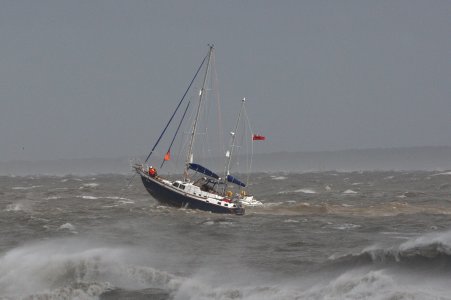
Image 8 to Quo Vadis (strong gale 9) 013 2.JPG
 
I work on ultimate elongation of nylon at about 40%, at which point it will fail. It is unlikely you will be standing watching the elongation so you need to make some educated guesses. I also work on a 4:1 safety factor which means the maximum stretch, elongation, that I accept is 1m for a 10m snubber. My snubbers, in fact a bridle, have potential of 30m for each arm - but around 15m is down the side decks and from the side decks to the attachment point on the chain. If I have planned ahead and there is room in the anchorage I can extend the rode (chain) and, some of the 'spare' of the snubbers, each of them, from the cockpit. By being able to extend your snubber, easily and safely, means you don't need a cross section of spare snubbers, one should be replacement in case the existing device fails and another can be heavier duty (but you will find that the ability to extend your snubber by a factor of 2 will be sufficient (or you did not listen to the weather forecast)

I liken a snubber to be like the suspension of a car - you would not use one 'type' of suspension device in a car, they have hydraulics, springs (and the foam in the seats) so why accept a single simple snubber. You can easily add those rubber dog bone things and they will extend the life of the snubber and if you watch the snubber and the rubber devices they stretch and react differently. Similarly you are contending with differently derived tensions - the wind, yawing, swell and chop. So think outside the box.

The last notable UK weather event of note was the storm in the Scillies - some people took to storm preparation, many (some of whom are members here, moved to somewhere with more shelter. There are no medals for sitting out Storms.

Jonathan

View attachment 197960
Applying your car suspension analogy, the boat system perhaps lacks the damping provided by the hydraulics. Adding a drogue might provide some.

Re the scary picture, to my inexperienced eye, he's either still got quite good catenary, or hes on a rather short scope (though perhaps the upward pitching of the bows in that snapshot view is exaggerating that impression).

But as you suggest, the Mr Miyagi defence would be always be better, if an option.
 
Applying your car suspension analogy, the boat system perhaps lacks the damping provided by the hydraulics. Adding a drogue might provide some.

Re the scary picture, to my inexperienced eye, he's either still got quite good catenary, or hes on a rather short scope (though perhaps the upward pitching of the bows in that snapshot view is exaggerating that impression).

But as you suggest, the Mr Miyagi defence would be always be better, if an option.

Well spotted

If you look carefully there is another line taken off the port bow, which must be attached to an, out of sight, horn cleat.

The anchor is being retrieved by the man on the bow, with the white hat. Its not a hat, but a helmet.

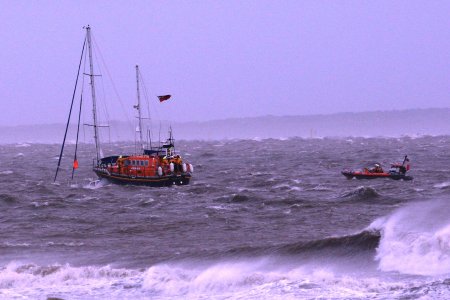
The line on the port bow is from the RNLI Lifeboat, that is off picture forward of the yacht, but seen in the second picture.

These are conditions you might get if you ignore the weather forecasts and don't seek shelter. There are no medals for sitting out Storms.

I heard about the event and happened to be in the UK, staying in Manchester. I took the lifeboat crew out for lunch and was given chapter and verse.

shout to Quo Vadis (strong gale 9) 009.JPG

Defying weather forecasts, causing a lifeboat to be launched, the storm in the Scillies, I think helicopters were involved.

Jonathan
 
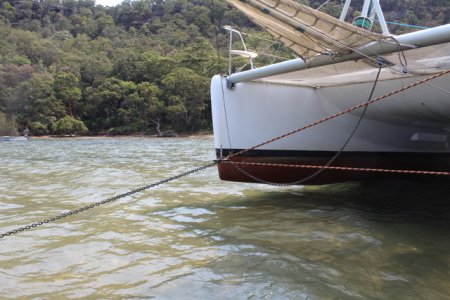
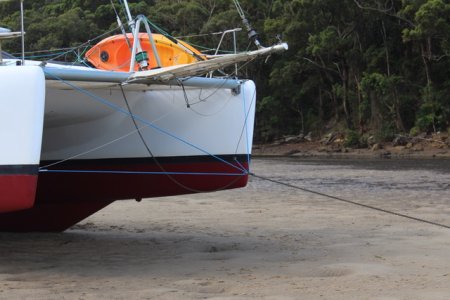
In this sequence of picture we have beached Josepheline - to illustrate.

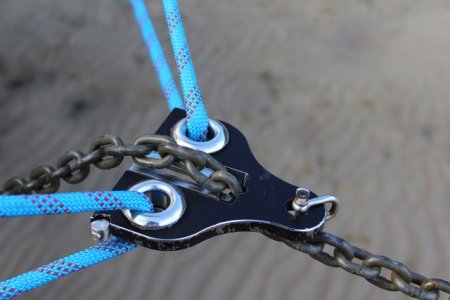
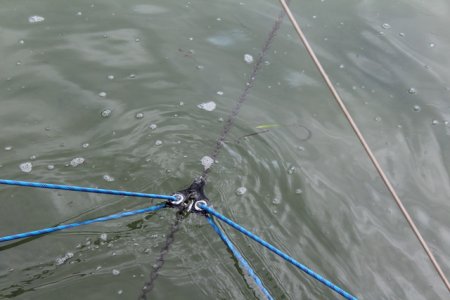
This our snubber, bridle, arrangement - with fairly obvious differences you can design your own similar arrangement for a monohull.


The snubbers are are secured at pad eyes at the bow waterline. We have our cordage sewn with a big eye at one end specifically to secure at the bow. If you are following any of this you might want to specify how long is the sewn overlap for the eye - we had ours doubled 'normal'.

The snubbers are then taken to a bridle plate, aka (in mono speak) a chain hook, or a rolling hitch).

IMG_0028.jpeg

The bridle plate is custom made, there is a monohull version, and incorporates 2 stainless LFRs. The little shackle is to secure it at the bow when not infuse.

IMG_4740.jpeg

An important feature is the manipulation of scope. The bridle plate, or the location of same, dictates the scope, the angle at the anchor. The bridle plate is at sea level, over 1m below the bow roller. Your calculation ignores the height of your bow roller above the water and the calculation is simply water depth and length of rode deployed.

and this is the bridle plate when we have water under the keels, its at sea level

IMG_4728.jpeg


IMG_4750.jpeg

The snubbers are then routed from the bridle plate to a turning block on the bow, deck level.

From the turning blocks on the bow the snubbers are then routed down the side decks to clutches at the stern, then turning block and finally to sheet winches. This amount is about 15m snubbers and we have a further 15m we can deploy, using the winches to take any tension, The spare snubber is stored as you would spinnaker sheets, in sheet bags.

We have no concerns of UV nor abrasion the braided cover is specifically designed to be abrasion proof .

The first picture is using 12mm kermantle and the other pictures, 10mm kernmantle, 12mm rope did not have the elasticity.

Our stanchions have open bases, so the snubbers are routed through them, but you can source a whole variety of devices to keep the snubbers (running down the sidekicks) neat and tidy. If you plan you could run headsail furling lines and snubbers through the same devices.

Jonathan
 
Well spotted

If you look carefully there is another line taken off the port bow, which must be attached to an, out of sight, horn cleat.

The anchor is being retrieved by the man on the bow, with the white hat. Its not a hat, but a helmet.

The line on the port bow is from the RNLI Lifeboat, that is off picture forward of the yacht, but seen in the second picture.

These are conditions you might get if you ignore the weather forecasts and don't seek shelter. There are no medals for sitting out Storms.

I heard about the event and happened to be in the UK, staying in Manchester. I took the lifeboat crew out for lunch and was given chapter and verse.

View attachment 197967

Defying weather forecasts, causing a lifeboat to be launched, the storm in the Scillies, I think helicopters were involved.

Jonathan
Looks like he's sunk (and/or the lifeboat has run him down) but perhaps its a bit foreshortened and hes in a trough. Drammatic stuff in either case.
 
Top