Are Underwater Snubbers A Thing?

Adding some detail to post 79

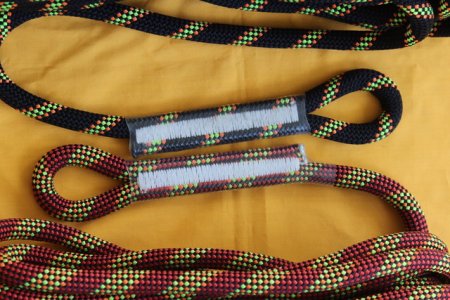
These are our sewn eyes that we secure to the pad eyes at the bow
IMG_9983.jpeg


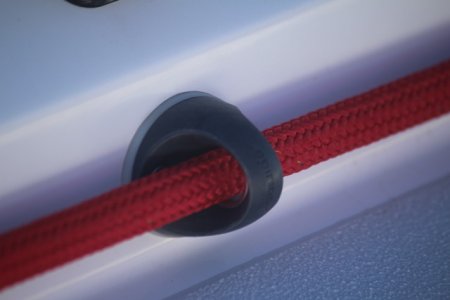
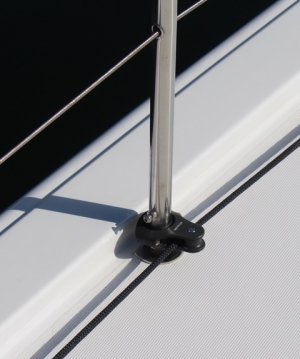
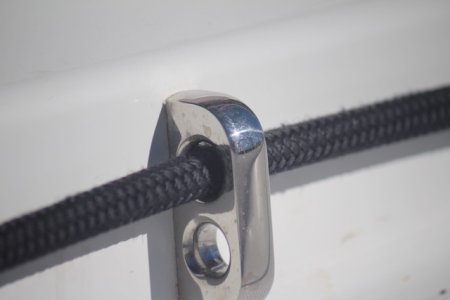
To keep your snubber(s) neat and tidy chandlers will be quite pleased to sell you a device like these.
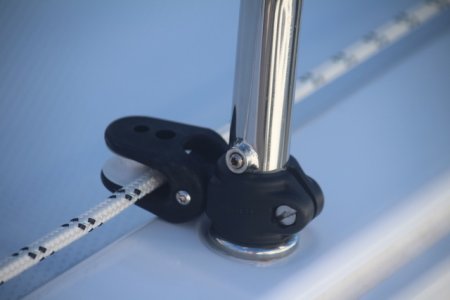
IMG_8354.jpeg

IMG_8362.jpeg

IMG_9577.jpeg


IMG_8363.jpeg

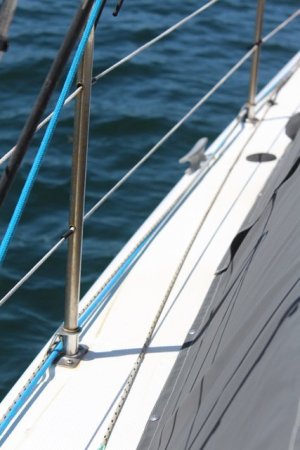
We don't use any of the hardware above to keep our snubbers neat and tidy, our snubbers are routed through the stanchion bases, the blue rope on the deck. I think our stanchions might have come from Ronstan.
IMG_4864.jpeg

Jonathan
 
Looks like he's sunk (and/or the lifeboat has run him down) but perhaps its a bit foreshortened and hes in a trough. Drammatic stuff in either case.

He, or she, is in a trough.

Given the sea state a very neat recovery. No damage, except to pride, no one was hurt, except pride.

Its worthy of note - if in these, or those, conditions you decide to bail out, without calling on the RNLI then as you retrieve the rode you remove the catenary. If the anchor is well set (and its a good anchor) it might not pop out and with every passing wave the snatches at the bow roller become huge - you don't want you fingers any where near the bow roller. You also need someone competent at the throttle (and hope the anchor pops out)

Jonathan
 
In this sequence of picture we have beached Josepheline - to illustrate.

This our snubber, bridle, arrangement - with fairly obvious differences you can design your own similar arrangement for a monohull.


The snubbers are are secured at pad eyes at the bow waterline. We have our cordage sewn with a big eye at one end specifically to secure at the bow. If you are following any of this you might want to specify how long is the sewn overlap for the eye - we had ours doubled 'normal'.

The snubbers are then taken to a bridle plate, aka (in mono speak) a chain hook, or a rolling hitch).

View attachment 197970

The bridle plate is custom made, there is a monohull version, and incorporates 2 stainless LFRs. The little shackle is to secure it at the bow when not infuse.

View attachment 197973

An important feature is the manipulation of scope. The bridle plate, or the location of same, dictates the scope, the angle at the anchor. The bridle plate is at sea level, over 1m below the bow roller. Your calculation ignores the height of your bow roller above the water and the calculation is simply water depth and length of rode deployed.

and this is the bridle plate when we have water under the keels, its at sea level

View attachment 197975


View attachment 197971

The snubbers are then routed from the bridle plate to a turning block on the bow, deck level.

From the turning blocks on the bow the snubbers are then routed down the side decks to clutches at the stern, then turning block and finally to sheet winches. This amount is about 15m snubbers and we have a further 15m we can deploy, using the winches to take any tension, The spare snubber is stored as you would spinnaker sheets, in sheet bags.

We have no concerns of UV nor abrasion the braided cover is specifically designed to be abrasion proof .

The first picture is using 12mm kermantle and the other pictures, 10mm kernmantle, 12mm rope did not have the elasticity.

Our stanchions have open bases, so the snubbers are routed through them, but you can source a whole variety of devices to keep the snubbers (running down the sidekicks) neat and tidy. If you plan you could run headsail furling lines and snubbers through the same devices.

Jonathan
I'm guessing more chain will run out through the plate if you take'in the slack?

Plate is all-steel, or aluminium, with steel inserts?

Whats the wee shiny cylinder in the cutout left rear? looks like it might be retaining a rod or the end of a cable?

Neat arrangement, though it requires holes in the hull which would give me pause if I ever got the boat to the point where I might consider something like it. I suppose it could be combined with a bobstay fitting though, and I do sort of fancy a bowsprit.
 
He, or she, is in a trough.

Given the sea state a very neat recovery. No damage, except to pride, no one was hurt, except pride.

Its worthy of note - if in these, or those, conditions you decide to bail out, without calling on the RNLI then as you retrieve the rode you remove the catenary. If the anchor is well set (and its a good anchor) it might not pop out and with every passing wave the snatches at the bow roller become huge - you don't want you fingers any where near the bow roller. You also need someone competent at the throttle (and hope the anchor pops out)

Jonathan
I'd probably be single handed, perhaps in more than one sense.
But then it would be my fault, so that would be just as well.
Maybe cut and run?
 
I suggested something in between having "two snubbers at once" and "one not working in reserve". i.e. having the second snubber come on load once the first snubber has extended...er...a bit (which I havn't attempted to work out an optimum for) because I think it might be advantageous to offer progressive load sharing, and might also be actually rather difficult to guarantee to avoid, plus I cant see why you would want to.

To avoid it with confidence you'd have to ensure that the first snubber definately bust before the second one became loaded. Since I understand a nylon rope can extend between 20 and 50% before failure, (though fatigue will reduce that) that implies that for a worst/limit case, with new parallel snubbers, the secondary must be 50% longer, which doesnt sound like the "bit slacker" you mention. That Practical Sailor article is a bit coy about specific recommendations, but their "worked example" is 33 ft, so a semi-guaranteed-non-load sharing backup to that would have to be 50 ft long. Seems a bit of an unnecessary constraint.

Be that as it may, my original question was prompted by someone saying it was difficult to deploy a "storm" snubber, but this wee sub-discussion hasn't really identified a difficulty, so thats nice
I think you're overcomplicating this. If the backup snubber is working only very little, then it's not exhausting its cycle life. So there's no practical difference between having the backup slack all the time, or working a bit.

Nor is the fine calibration of elasticity necessary. It needs to be somewhere in the ballpark.

I like your idea of progressive springing with a heavier snubber coming into action at a certain degree of stretch in the thinner and shorter normal snubber. If you tune it just right, you won't even have to wait for the light snubber to break -- it will pass loads to the heavy snubber before it gets out of its limits.

But I wouldn't bother with it on my boat. In conditions bad enough to need a backup snubber (>40 knots of wind or imperfect shelter), I simply rig two "storm" snubbers.
 
He, or she, is in a trough.

Given the sea state a very neat recovery. No damage, except to pride, no one was hurt, except pride.

Its worthy of note - if in these, or those, conditions you decide to bail out, without calling on the RNLI then as you retrieve the rode you remove the catenary. If the anchor is well set (and its a good anchor) it might not pop out and with every passing wave the snatches at the bow roller become huge - you don't want you fingers any where near the bow roller. You also need someone competent at the throttle (and hope the anchor pops out)

Jonathan
If it's survival conditions the best thing is to jettison the ground tackle with a fender at the end for later retrieval. It can be really dangerous to try to handle the ground tackle in really bad conditions, with pitching, etc.
 
I'm guessing more chain will run out through the plate if you take'in the slack?

Plate is all-steel, or aluminium, with steel inserts?

Whats the wee shiny cylinder in the cutout left rear? looks like it might be retaining a rod or the end of a cable?

Neat arrangement, though it requires holes in the hull which would give me pause if I ever got the boat to the point where I might consider something like it. I suppose it could be combined with a bobstay fitting though, and I do sort of fancy a bowsprit.
There is a pin passing through one side to stop the chain falling out should the plate ever bee inverted. It is not now included in the drawings as found to be unnecessary.

Some yachts already have a pad eye down on the waterline at the bow to take a bobstay. Many yachts have a movable prodder, you push it out if you want to fly a code zero and some have no bobstay some have one. If its a movable prodder then the bob stay attachment is ideal. Yachts don't 'want' fixed bob stays - they increase costs in a marina or dockyard. Movable prodders are very fashionable.

But bob stays introduce another complication for the anchor rode.

It has been made from Duplex stainless, the one in the pictures was painted black, by mistake. I've made them from BIS80, they are made from Hardox 450 and galvanised and made from the 7075 alloy of aluminium. The inserts of the LFRs are stainless and would, possibly, react with aluminium - but you can buy 2 part threaded LFRs, also made from 7075 aluminium which would be ideal. I prefer the HT steel route.

There is a mono hull version - but devising a snubber arrangement with 2 snubbers, a bridle is possible on a monohull and it then gives you the 'V' arrangement that helps to steady yawing - and increases the life of the snubbers as they are sharing the tensions.

The best time to contemplate all of this is with a new build - then you can have the blocks at deck level on the bow with appropriate backing plates (or simply attach to bow cleats) and similarly have a pad eye at the bow waterline attached, again with backing plates. Working in the bow is a thankless task and usually involves 2 people as it is so narrow. I've been involved as a spectator in fitting out a mono hull going up to Alaska and fully involved in custom built catamarans.

Most people here on YBW have read my views on snubbers, I'm criticised for being boringly repetitive, and many now have a snubber down the sidedeck. I would not say its common practice - I don't know. Sourcing climbing rope for the snubber when retired from a gym is an issue in the UK - you might find it easier in Taiwan - when you are ready.

Jonathan
 
Last edited:
If it's survival conditions the best thing is to jettison the ground tackle with a fender at the end for later retrieval. It can be really dangerous to try to handle the ground tackle in really bad conditions, with pitching, etc.
I agree.

The problem arises - how many carry a spare rode, including anchor? that can be used as a primary in adverse conditions. Some carry a spare anchor, the one they retired when they bought their new gen model (and their retired anchor will not have improved in performance with time :( )

When we downsized our chain to HT 6mm we added 15m extra for a spare rode and added 40m of 3 ply nylon (which we used if we anchored in a 'V' or 'fork'). With 6mm chain and lots of rope its easy to deploy from a dinghy, in benign conditions, or off the foredeck if the conditions are a bit more challenging. We could have used climbing rope - but did not have a long enough length. Our anchors were all lightweight, aluminium, Fortress, Spade and Excel - now we would drop the Spade or Excel and replace with Viking's Odin (lightweight because they use HT steel) and a better design than Spade or Excel and the original Viking.

Jonathan
 
Note on Toomey (1988) US Navy Masters Thesis Dissertation on The Dynamic Behavious of Nylon and Polyester Rope Under Simulated Towing Conditions,

(from the perspective of a hypothetical underwater anchor snubber.)

https://apps.dtic.mil/sti/tr/pdf/ADA194pdf750.

Well I read it, initially attempting to understand the whole thing, but I not an engineer, and latterly concentrated on the temperature and immersion aspects which seemed most relevent, so there is still stuff I don’t understand, which may undermine my conclusion.

Testing of rope cycling to a maximum reference load or a maximum reference extension are contrasted in the discussion. I’m unclear which of these test regimes would be most relevent to the authors target towing application, where neither would be controlled, but it would seem a snubber is being cycled to a maximum extension determined by the length of the chain loop when “bar taught”.

Half inch rope was tested, probably of uncertain application to most Navy towing due to scale effects, but an appropriate scale for yachts.

In some, apparently preliminary tests “wet” meant pre-soaked for 24 hrs prior but not continually wetted (p.25. Para 2), perhaps an appropriate model for an on-deck snubber, less so for a tow rope, less still for a submerged snubber or rode. Fresh water rather than (unlikely but not quite ridiculous) distilled test water, or more appropriate seawater was used, probably for convenience. Weight gain is stated as 65 percent, but that would be a moving target as dripping and drying proceeds, and its unclear how it was hit

For the main tests, however, they used a short splice for dry samples and a glued socket (The glued joint sometimes slipped) for wet testing, which allowed submerged testing.

This set up allowed for free span lengths of up to 36 in and allowed for 100% immersion. (P40, para 3) MB

For wet testing, minimal (?) temperature rise was observed in the water jacket of the load cell, interpreted as meaning the reservoir was “effective”. These measurements were apparently not used. Rope temperatures were measured by an embedded thermocouple.

Towing loads are considered to consist of three components, a “steady pull” base load, from the towing vessel, the forces due to the yaw of the tow off the general heading, which oscillates with a period of minutes and was not simulated, and shorter term oscillations, with periods of one to a 15 seconds, from wave action.

I would guess that for Anchor Loads the analogous “steady pull” is from wind pressure and may not be so steady in strength or direction, the yaw component comes from veering, and is rather similar, though perhaps with a shorter period with generally smaller, lighter vessels than navy tows, and the wave component is similar, though hopefully of smaller amplitude (and generally shorter period?) than for an open-sea tow.

Ropes under test took some time to stabilise (defined as max load changing by less than 10lbs over 10 cycles, or at an (arbitrary?) 10,000 cycle limit). Stiffness increased, then flattened, while extension decreased, then flattened, as the rope became conditioned.
(Fig 29)

Core temperatures of up to 70C are shown for dry polyester, 40C wet, with 40C dry, 20C wet, for nylon. Temperature rise occurred during the first 400 cycles, then flattened, generally falling off by a few degrees to the plateau for nylon.(Fig 30).

Temperature for dry polyester is shown as reaching 130C in (Fig 31) and this appears to be an actual data point, not an extrapolation.

the temperature at stabilization became quite severe for the polyester rope and, at high frequencies and strain amplitudes an extrapolation to higher strain amplitudes may begin to approach the polyester heat stiffening temperature of 170C.” (Page 64, Para 2)

the figures show, the primary effect of cycling the rope while continually wet was to drastically reduce the core temperature.(page 79, Para 3)

The observed difference between polyester and nylon is attributed partly to the greater thermal conductivity of the latter (p89 Para 5)

So as far as I can tell this paper doesnt support the (forum consensus?) view that internal heating in rodes or snubbers (particularly polyester) is an “urban myth” and it would seem to provide some support for the view that cooling by submersion might be of value, though of course that does not necessarily mean it would be worth the trouble.

Polyester is probably a less likely choice than nylon as a snubber but the Practical Sailor article that started me on this jive has “Although we tested only nylon, keep in mind that you can get the same results with Dacron (I THINK this is American for polyester). You just need to make the snubber longer
 
Last edited:
Polyester is probably a less likely choice than nylon as a snubber but the Practical Sailor article that started me on this jive has “Although we tested only nylon, keep in mind that you can get the same results with Dacron (I THINK this is American for polyester). You just need to make the snubber longer

Dacron is a brand name used by Du Pont for its polyester, so is American It is used generically as being any polyester, viz Dacron sails or sailcloth. ICI, UK, developed their polyester fibre, Terylene. One of the latest development was Polar Fleece, introduced by Maldon Mills in the 1980s and now copied and further developed in China.

Jonathan
 
Last edited:
Dacron is a brand name used by Du Pont for its polyester, so is American It is used generically as being any polyester, viz Dacron sails or sailcloth. ICI, UK, developed their polyester fibre, Terylene. One of the latest development was Polar Fleece, introduced by Maldon Mills in the 1980s and now copied and further developed in China.

Jonathan
I suppose it would have been more accurate to say Dacron was American for Terylene, but TBH I'd forgotten about Terylene.

Had a look for more on heat effects on cyclically loaded synthetic ropes, but didn't find much. There’s a Practical Sailor article on overheating ropes Overheating Ropes - Practical Sailor January 21, 2019 Updated May 26, 2020, which suggests that observed melting is often a result of energy release on breakage and not evidence of internal heat buildup, and that ropes below an inch diameter don’t heat up unless massively overloaded. They suggest external frictional heating is more significant, and that sharp bends are a common culprit. Internal heating may still be an issue for sea anchor rodes and dock lines.

Similarly, Weller et al (2015) in a review of offshore industrial synthetic mooring ropes https://archimer.ifremer.fr/doc/00266/37750/36082.pdf suggest internal hysteric rode heating is only likely to be significant for large diameter highly loaded applications.

OTOH Ning et al (2018), measure temperatures up to around 80C in 1 cm rope cycled over a sheave by embedded thermocouple and observe morphological changes consistent with fibre melting microscopically, so it seems at least possible that higher localised temperatures might exist at the micro scale.

Oman et al (2025), investigating the effect of temperature on climbing ropes, note the difficulty of internal temperature measurement and do not attempt it, but find that 8 hrs at 100C, reduces the strength of nylon climbing ropes by 24%.

So nothing as on-point as the Navy paper, though I doubt its a one off


Weller Samuel, Johanning L., Davies Peter, Banfield S. J. (2015). Synthetic mooring ropes for marine renewable energy applications. Renewable Energy. 83. 1268-1278. Redirecting, Synthetic mooring ropes for marine renewable energy applications

https://www.researchgate.net/public...chanism_of_fiber_ropes_when_bent_over_sheaves
Ning, Fanggang & Li, Xiaoru & Hear, Nick & Zhou, Rong & Ning, Xin. (2018). Thermal failure mechanism of fiber ropes when bent over sheaves. Textile Research Journal. 89. 004051751876714. 10.1177/0040517518767147.

https://www.sciencedirect.com/science/article/pii/S259012302502540X
Simon Oman, Jernej Klemenc, Aleš Gosar, Marko Nagode, Critical factors affecting the strength of climbing ropes: A study of wear, fatigue loading and temperature, Results in Engineering, Volume 27, 2025,106471
 
Last edited:
I'm really glad that neither myself nor my boat gives a toss about all that. We just anchor (successfully), making due allowance for the actual and expected conditions. Why try to make it seem so complicated, that you put people off anchoring?
 
I'm really glad that neither myself nor my boat gives a toss about all that. We just anchor (successfully), making due allowance for the actual and expected conditions. Why try to make it seem so complicated, that you put people off anchoring?
Might give more scope, in less crowded anchorages?
 
Last edited:
. . . how many carry a spare rode, including anchor? that can be used as a primary in adverse conditions. Some carry a spare anchor, the one they retired when they bought their new gen model (and their retired anchor will not have improved in performance with time :( ) . .
I do. And the spare is a 45kg Spade.

What I don't have is 100m of spare 12mm chain, but I've got a whole lot of rope.
 
I do. And the spare is a 45kg Spade.

What I don't have is 100m of spare 12mm chain, but I've got a whole lot of rope.
You really only need the chain to offer abrasion resistance, absent from the rope. Most, if not all, modern anchors will be successfully set on an all rope road. Though if you are trying to set at a 2:1 scope you might have issues and need patience. If the rope is nylon, or has elsticity, you can undersize the rope asd use the elAsticity to temper any snatch loads.

Abrasion on the seabed for rope is an issue, long term, but overnight if you are anchoring on sand you would be fine.

The sensible option is to have a short length of chain of the appropriate link size. Most chain on most yachts is well oversized in terms of strength and moving down a size but having more of it is the best compromise. Our second rode had 15m of 6mm chain but we also carry 2m lengths of 8mm chain, off the original rode, for shore lines round rocks and we could shackle 2 together if push came to shove.

6mm chain is the smallest chain you can source that will fit a windlass. But its so light its easy to retrieve by hand. I have doscovered you can source G120 4mm high tensile chain and if we had not already had the 15m x 6mm option I'd have sourced some, had it galvanised TDG and used that for a second rode. At 6mm and better 4mm the chain would be ideal to retrieve using a drum (for rope) winch and with a bit of imagination you could do without a windlass, completely, and use a drum winch for both 6mm and 4mm HT TDG chain.

I can see the old salts of fixed ideas (if my dad did it - it must be right etc etc) throwing up their hands in horror at the idea of a 4mm HT chain. But it would have the strength, after TDG, of 8mm G30, be lighter, abrasion resistant and take up little room. HT chain is harder than G30 chain, and harder means lower abrasion rates added to a harder gal coating - also more abrasion resistant than HDG.

Jonathan
 
I'm really glad that neither myself nor my boat gives a toss about all that. We just anchor (successfully), making due allowance for the actual and expected conditions. Why try to make it seem so complicated, that you put people off anchoring?
Most of the recent, last 40 years :), knowledge base on cordage (or anchoring) has been known for years and has resulted in practices that you follow (not necessarily knowing why). All that is happening now is that the knowledge base through trial and error is now being quantified. Superimpose on this the idea that we now have cordage with better characteristics - Nylon and Polyester are 'only' 70 years old and replaced flax and hemp, now we have introduction of high tensile textile, Kevlar and Dyneema (which replace nylon and polyester in whole or part). But we only use dyneema and kevlar because someone has done the tests that you deride.

UV testing being a prime example - Kevlar is susceptible so it was assumed Dyneema would be the same - now we use uncovered dyneema without a second thought.

The other example is the commonplace use of chain that is a size to large - adding a snubber allows use of a lighter chain (though the cost of the new gypsy is a major disincentive to change). We still see the belief that you need chain to encourage your anchor to set. This might have been true for a CQR, Delta maybe even a Fortress. Modern, good, anchors will set, if you don't rush it, at a 2:1 all rope rode. Undoubtedly weight and a better scope does help - but its not essential (unless its hard and scoured seabed).

We are seeing the same evolution NOW with the introduction of Lithium and the use of TDG instead of HDG. People like Geem and Sea Change (+ others) have done the testing, by doing the research and using Lithium - we are the beneficiaries

TDG has been around for decades but its only now that it is realised the coating is harder than HDG and TDG is demanded in the studs for wind power pylons (and more mundane - those clips used to secure rail lines to sleepers and nails in nail guns).

There is nothing wrong with developing a data base and defining the characteristics of components.

Jonathan
 
Last edited:
I'm sure you know this, but it's worth pointing out for the benefit of others that you can tune the elasticity of the snubber not only with diameter, but with LENGTH. I would NEVER use 12mm snubber on a boat over 36'; you should start with correct strength value, then make the snubber long enough in that size, to give you the stretch you need. I have a variety of snubbers for different conditions -- shorter and thinner ones for less extreme, and thicker and longer ones for more extreme conditions. My lightest snubber is 16mm octoplait nylon; I think it's 10m long. I am about 25 tonnes loaded, 54'.

Nor do I use a snubber all that much, almost never in anything under 30 knots. Heavy chain and deep water produce catenary which absorbs an amazing amount of energy.

I'm interested in the comment:

'I would NEVER use 12mm snubber on a boat over 36'; you should start with correct strength value,'

You use, for your lightest snubber 16mm octoplait for a 54' x 25t yacht

Marlow 16mm multi plait has a UTS of 6.6t

A 35' Bav wights 5.8t, say load it up, cruising weight of 8t.

12mm Marlow multi plait has a UTS of 3.8t.

To me your 16mm/6.6t 'everyday' snubber is a bit wimpy for a 54' x 25t yacht compared to my idea of 12mm/3.8t snubber for a 35' x 8t Bav. In fact I'd suggest 10mm multi plait, UTS of 2.8t would be adequate.

On our cat 38' x 7t (at cruising weight) that has the same windage as a 45' x 12.6t (say 14.6t loaded up) Bavaria we found 12mm kernmantle had insufficient elasticity and we down sized to 10mm.

Both ropes are nylon and will have a similar elasticity, say 40% at UTS.

Our snubber can be extended from, around 15m to 30m. I find Kernmantle 'better, than octaplait because it has a braided outer cover specially designed to reduce the impact of abrasion.

I don't know the windage of your yacht, nor the 35' Bavaria. but length and weight are crude proxies for windage. To better compare like with like strip out the ballast, the keel, of the monohulls to compare with a multihull - its crude but measuring windage is also crude.

I have measured rode tension and snatch loads for our cat and the maximum tension or load I have recorded is 650kg (no snubber) with a 2.8t UTS and a 4: 1 safety factor I have it about right - especially as you would never stick around for tensions to get to 650kg (you would move, deploy more snubber) - the snatch loads are frightening.

Jonathan
 
Last edited:
I'm interested in the comment:

'I would NEVER use 12mm snubber on a boat over 36'; you should start with correct strength value,'

You use, for your lightest snubber 16mm octoplait for a 54' x 25t yacht

Marlow 16mm multi plait has a UTS of 6.6t

A 35' Bav wights 5.8t, say load it up, cruising weight of 8t.

12mm Marlow multi plait has a UTS of 3.8t.

To me your 16mm/6.6t 'everyday' snubber is a bit wimpy for a 54' x 25t yacht compared to my idea of 12mm/3.8t snubber for a 35' x 8t Bav. In fact I'd suggest 10mm multi plait, UTS of 2.8t would be adequate.

On our cat 38' x 7t (at cruising weight) that has the same windage as a 45' x 12.6t (say 14.6t loaded up) Bavaria we found 12mm kernmantle had insufficient elasticity and we down sized to 10mm.

Both ropes are nylon and will have a similar elasticity, say 40% at UTS.

Our snubber can be extended from, around 15m to 30m. I find Kernmantle 'better, than octaplait because it has a braided outer cover specially designed to reduce the impact of abrasion.

I don't know the windage of your yacht, nor the 35' Bavaria. but length and weight are crude proxies for windage. To better compare like with like strip out the ballast, the keel, of the monohulls to compare with a multihull - its crude but measuring windage is also crude.

I have measured rode tension and snatch loads for our cat and the maximum tension or load I have recorded is 650kg (no snubber) with a 2.8t UTS and a 4: 1 safety factor I have it about right - especially as you would never stick around for tensions to get to 650kg (you would move, deploy more snubber) - the snatch loads are frightening.

Jonathan
I'll defer to your much more exact knowledge based on research, what concerns smaller boats. We never used anything that small on our previous boat (Pearson 365), but that's much heavier than your cat.

Another factor besides strength is chafe resistance. Smaller cordage is much more vulnerable; I wouldn't go below a certain size regardless of strength.

And what concerns strength -- I don't think light and heavy weather snubbers need to be the same strength, nor do any of them necessarily need to be as strong as the chain. They need to be strong enough to keep the expected loads within whatever percentage of their UBS for reasonable cycle life, in my view.
 
You really only need the chain to offer abrasion resistance, absent from the rope. Most, if not all, modern anchors will be successfully set on an all rope road. Though if you are trying to set at a 2:1 scope you might have issues and need patience. If the rope is nylon, or has elsticity, you can undersize the rope asd use the elAsticity to temper any snatch loads.

Abrasion on the seabed for rope is an issue, long term, but overnight if you are anchoring on sand you would be fine.

The sensible option is to have a short length of chain of the appropriate link size. Most chain on most yachts is well oversized in terms of strength and moving down a size but having more of it is the best compromise. Our second rode had 15m of 6mm chain but we also carry 2m lengths of 8mm chain, off the original rode, for shore lines round rocks and we could shackle 2 together if push came to shove. . . .
I wouldn't try to set the anchor on 2:1 on rope; I think the catenary of heavy chain is fundamental to that kind of anchoring. And nor would I need to unless there just wasn't space where I was anchoring, because I've got no length limitation with rope like I do with chain. I have miles of rope on board.

The chain leader is a good idea. I have this on my kedge. I should put on my list to acquire some 12mm leader for my spare bower.

Another thing I should do is splice on some rope onto the end of my primary anchor chain. If I had had that back then in Greenland I would have used more scope. Just because you CAN doesn't mean it's optimum, notwithstanding Dashew.
 
I wouldn't try to set the anchor on 2:1 on rope; I think the catenary of heavy chain is fundamental to that kind of anchoring. And nor would I need to unless there just wasn't space where I was anchoring, because I've got no length limitation with rope like I do with chain. I have miles of rope on board.

There is no suggestion you should, ever, attempt to anchor at a 2:1 scope - I mention it only to indicate a chain leader is not necessary.

I agree that

'Just because you CAN doesn't mean it's optimum'

No need to splice rope to your main bower - as long as you can add the rope if necessary, splice an eye and have a shackle handy. I'm very much pianist having tope to close to chain, rope holds water which engenders the chain too corrode.

Your situation is not typical as your yacht is large and the chain is heavy. Many members here have slightly :) smaller yachts with 6mm or 8mm chain - adding cordage to extend the rode length is not so difficult.

But if you mark your chain clearly, so you know when the bitter end is abut to arrive and you have a decent chain lock - then you can secure the end and add the cordage. When you come to retrieve I assume you will have a capstan and the chain weight should not be an issue (tough feeding the bitten through the gypsy might take some care (and gloves).


I have mentioned that 'modern' anchors can be set at 2:1. 'Modern' is possibly ambiguous. Some anchors that are modern are badly deigned and set shallow. But anyone reading these threads will know which I refer to.

Jonathan
 
Last edited:
Top