

thinwater
Well-Known Member
Rocna also seem to be concerned about internal heating
"Finally, when nylon is 'cycled' at a significant fraction of its ultimate strength, high levels of internal heat are generated. This heat severely lowers the rope's physical properties. Moreover, it is worse still when the rope is wet. This is a key reason behind many anchor rode and tow-line rope failures which appear strange at first inspection, if chafe is not an issue and the failures occur well below the rope's rated strength."
(My bolding). That bit (though it seems counterintuitive) would seem to negate the underwater snubber idea. Its not completely clear that "wet" here is intended to include submerged (which I would expect to give rather efficient cooling) but since the rope is apparently here being considered as a rode, rather than as a snubber, it probably is.
I suppose a clue might be provided by the location of rode failures, which, from the above statements, and in the abscence of chafe/presence of heat damage, would be expected to mostly occur underwater. I dont know if this data is available.
However, a rope that is cycled at more than about 15% of its BS is not going to last long anyway. Rocna has quite a few "not quite true" statements in their knowledge base. My favorites are the rubbish about tandem anchors, which is just nonsense.
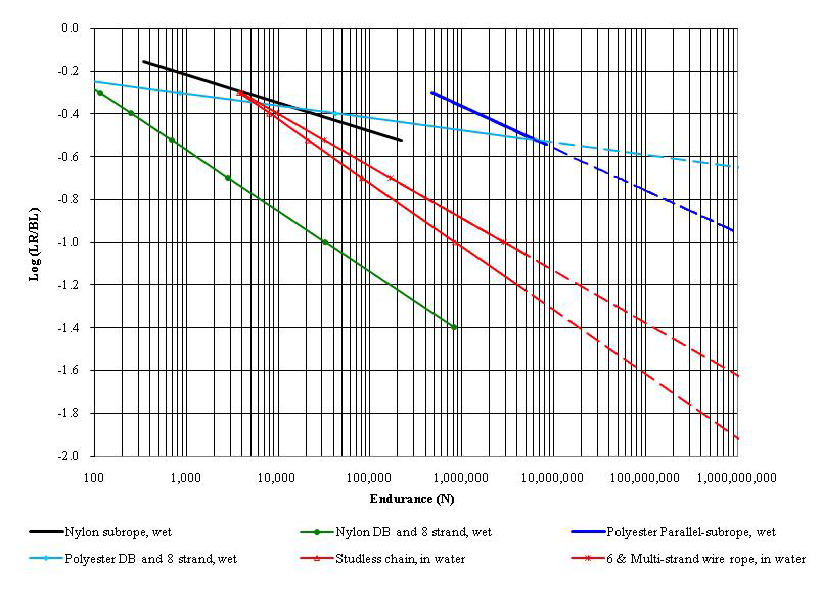
Failure below rated strength is not a surprise. It is expected. It is fatigue. If you have a surge several times per minutes for the duration of a storm, how many cycles is that one storm? A few thousand? That would put you at 20% BS. And then add UV. The real WLL of nylon is only about 10% BS, and that is not because of heat, at that low factor. The rope is not heating. Urban legend.
For example, this US Navy study: Towing study, rope heating

 ). Vyv has an excellent article summarising why it is unnecessary to 'invest' in a large anchor.
