
Are Underwater Snubbers A Thing?

Rocna also seem to be concerned about internal heating

"Finally, when nylon is 'cycled' at a significant fraction of its ultimate strength, high levels of internal heat are generated. This heat severely lowers the rope's physical properties. Moreover, it is worse still when the rope is wet. This is a key reason behind many anchor rode and tow-line rope failures which appear strange at first inspection, if chafe is not an issue and the failures occur well below the rope's rated strength."

(My bolding). That bit (though it seems counterintuitive) would seem to negate the underwater snubber idea. Its not completely clear that "wet" here is intended to include submerged (which I would expect to give rather efficient cooling) but since the rope is apparently here being considered as a rode, rather than as a snubber, it probably is.

I suppose a clue might be provided by the location of rode failures, which, from the above statements, and in the abscence of chafe/presence of heat damage, would be expected to mostly occur underwater. I dont know if this data is available.

However, a rope that is cycled at more than about 15% of its BS is not going to last long anyway. Rocna has quite a few "not quite true" statements in their knowledge base. My favorites are the rubbish about tandem anchors, which is just nonsense.

Failure below rated strength is not a surprise. It is expected. It is fatigue. If you have a surge several times per minutes for the duration of a storm, how many cycles is that one storm? A few thousand? That would put you at 20% BS. And then add UV. The real WLL of nylon is only about 10% BS, and that is not because of heat, at that low factor. The rope is not heating. Urban legend.

For example, this US Navy study: Towing study, rope heating
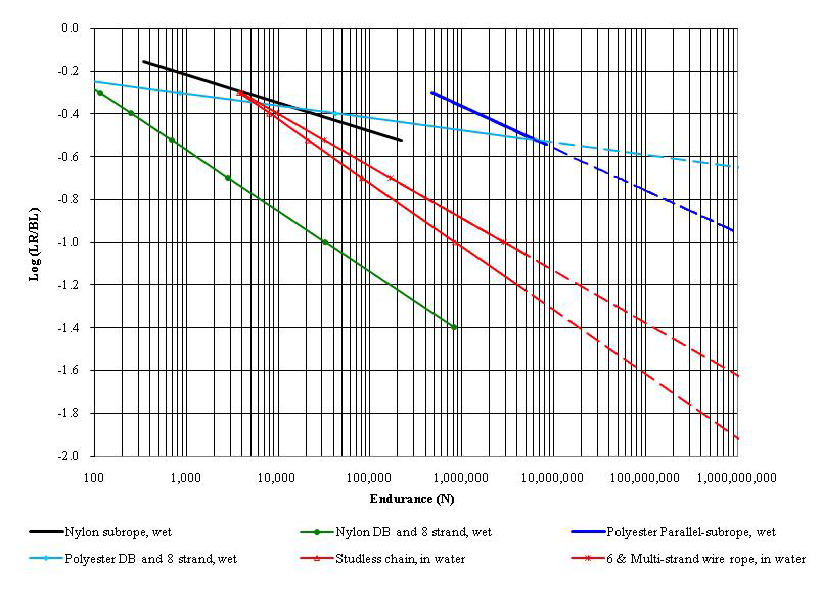
rope+fatigue+life.png
 
However, a rope that is cycled at more than about 15% of its BS is not going to last long anyway. Rocna has quite a few "not quite true" statements in their knowledge base. My favorites are the rubbish about tandem anchors, which is just nonsense.

Failure below rated strength is not a surprise. It is expected. It is fatigue. If you have a surge several times per minutes for the duration of a storm, how many cycles is that one storm? A few thousand? That would put you at 20% BS. And then add UV. The real WLL of nylon is only about 10% BS, and that is not because of heat, at that low factor. The rope is not heating. Urban legend.

For example, this US Navy study: Towing study, rope heating
rope+fatigue+life.png
Thanks.

That paper''ll take a bit of digesting. I'll have a look after dinner, though I note from the graph that there seems to be a distinction made here at least (if not by Rocna) between "wet" and "in water" (submerged?) though the latter treatment regime only seems to be applied to chain.

But perhaps its a semantic distinction, based on the solid impervious nature of steel?

And, picky proof reading wise (in case I cant say anything more constructive once I've tried to read it, which is very likely) I'd say the second word (understanding) should almost certainly be "undertaking".

Tsk Tsk.
 
Dont disbelieve it, but your picture is a poor match to your words.
VERY shiny though
Having spent hours in mask and snorkel watching my anchor and chain in winds from nearly nothing to well over a gale, noelex's photo is exactly what it is - a snapshot. In any wind the boat will veer from side to side, in some cases as much as 140 degrees from one extreme to the other. As it veers it mostly drags the chain across the bottom. At the apex of the swing the chain will tighten, lifting off the bottom in winds of 20 knots or more. The veer will then reverse, the chain slacken and the process starts again on the opposite tack.

In stronger winds, 25 knots or more, there is somewhat less of the chain on the bottom but in my experience even in force 9, some chain will touch the seabed at times.

If you study the photos on this page you will see clear evidence that the chain has been lifting off the seabed right up to the anchor. Oversize anchors – necessary?
 
I think Thinwater answers the question raised in the thread, a wet snubber is not intentional, they do get wet, it is inescapable - they are used in the sea but being wet is unnecessary.

I provide links to articles, which I hope are still accessible.

This is an article a strong wind event on one yeacht

Slammed in the Med: How We Survived 70-Knot Winds and Chaos at Anchor


I have written a number of article on snubbers:

The art of snubbing, in the nicest possible way

Know how: Ground Tackle - SAIL Magazine

How to: Dealing with Snatch Loads in an Anchorage

Anchor Snubber Tips

Know how: Expanding your Anchoring Repertoire - SAIL Magazine

Anchor Snubber Shock Load Test - Practical Sailor

There is considerable repetition in the articles.


This my answer to the questions that are raised in the first article I attach, the strong wind event.

Adjustable Snubber Bridle and Chain Hook - Practical Sailor

You need a snubber that will be elastic and demonstrably stretches, dyneem is useless, it does not stretch. Nylon is the best snubber cordage, it will stretch by about 40% to failure, it is cheap, you can source it anywhere. Read Thinwater's posts - elastic cordage suffers from fatigue, cyclic stretching - you will not know it is worn - but it will eventually fail with a sound like gunshot.

You do not want cordage too thick (it will not stretch) nor too thin (It will suffer from fatigue too quickly) - 10mm or 12mm climbing rope, kernmantle, is ideal for most yachts, from 30'-50'. It has an abrasion resistant outer cover and is designed to stretch if a climber falls. We used 10mm kernmantle on a 38' cat with the windage of a 45' AWB. We actually bought 12mm but it was insufficiently stretchy - and settled on 10mm (its not an exact science - suck it and see).

Secure the snubber at the bow, run the snubber forward to your chain hook and then double back to the transom routing the snubber through the devices you use to keep you headsail furling Iines neat and tidy. At the transom run it through a turning block (like you do a spinnaker sheet) and secure to a sheet winch - you want a tail of about deck length, so you have, say 10m down the deck, 2m of rope forward of the bow, a couple of wraps round a winch and then 10m spare. The 10m is there in case you find yourself with a storm quickly approaching and you know you will need more snubber (see the first link I offer).

If you set up, roughly, as I describe your chain hook (which might not be a hook at all) will be just forward of the bow. If your snubber fails or you have a storm snubber you want to use you only have a short section of the rode to retrieve and you can swap snubbers. You don't need lots of room, you are only moving your yacht a metre or so forward.


Enough for an introduction.

I have a host of pictures and an update on how our arrangement works. If questions develop I can post pictures for clarity.

Jonathan

Thinwater has written a number of articles on yawing and has an eBook on anchoring. His blog has some invaluable data for access look for the link at the end of his posts. Vyv Cox, previous post, has some relevant articles, check his website (and some stunning photos :) ). Vyv has an excellent article summarising why it is unnecessary to 'invest' in a large anchor.
 
Last edited:
An interesting discussion, but I can't see me using a mid rode snubber. I like to keeping life simple.
My approch, although not optimised for high winds, is to use a bridle made of 3 three strand nylon. Slipped inside 2 lengths of fire hose each about 2m long.
I then spliced soft eyes in the both ends of the rope, large enough to drop over the bow mooring cleats.
At the midpoint of the rope I stitched in a hard eye (thimble). I used multiple diagonal stitches to pull the rope together and then served the eye with a long whipping.
The fire hose is stitiched to the rope, close to the long eyes, and pulled tight along the rope and stitched to prevent it riding up the rope. The fire hose acts as chafe protection as the bridle goes through the fairleads and over the bow.
I use a chain hook to attach the bridle to the chain. The working length of the bridle is about 10m.
This system works as both a means of taking the load off the windlass, and as a very effective snubber.
I've been using it now for at least 10years.
The maximum wind strength I've recored at anchor is in the high 50's knots.
I can see the rope stretching and relaxing as the gusts come through and the boat shears through the wind.
I've only occasionally had the hook drop off the chain, only when anchoring in zero wind and tide, when the chain is vertical.
I keep the system permanently rigged in the anchor locker, and use it every time I anchors, literally 1000's of times over the last 10 years or more.
I think of it as more or less bullet proof and very easy to use.
46ft yacht, about 16tons, draft 3.3m, 80m of 10mm chain, plus 30m of nylon, which I've never used.
 
The snubber doesn't need to be underwater. You can attach it to an eyebolt through the stem just above the waterline. I've seen a few boats using this solution.

Depending on your freeboard at the bow, you can get a useful improvement in scope this way, and it solves chafe completely. Worthwhile in many cases I think. Chafed-through snubbers is the leading cause of disasters whilst anchored in storms.

It's not hard to rig -- you can thread it or clip it on with one of those trick boathooks (like the Swedish "Hook 'n Moor"), tie it onto the chain on deck, and away you go.

What concerns veering at anchor -- this is caused by the centre of lateral resistance in the air being forward of the center of lateral resistance underwater. Almost all sailboats will try to turn downwind. One of several reasons why it's much better to use a drogue set to the stern for storm survival -- because the bow will naturally blow off downwind and will lie there stably. The way to solve this is either (a) set a riding sail to bring back the centre of lateral resistance in the air to behind the keel; and/or (b) use an anchor spring line to hold the boat a bit off the wind. I've used both of these and both work great.

To use an anchor spring line, bend a line onto the anchor chain and let the chain out by 10m or whatever, tie that line off to a midship cleat. Adjust the line until part of the tension is taken up by it, enough to pull the bow of the boat a bit off the wind. It works great.
 
. . . You need a snubber that will be elastic and demonstrably stretches, dyneem is useless, it does not stretch. Nylon is the best snubber cordage, it will stretch by about 40% to failure, it is cheap, you can source it anywhere. Read Thinwater's posts - elastic cordage suffers from fatigue, cyclic stretching - you will not know it is worn - but it will eventually fail with a sound like gunshot.

You do not want cordage too thick (it will not stretch) nor too thin (It will suffer from fatigue too quickly) - 10mm or 12mm climbing rope, kernmantle, is ideal for most yachts, from 30'-50'. It has an abrasion resistant outer cover and is designed to stretch if a climber falls. We used 10mm kernmantle on a 38' cat with the windage of a 45' AWB. We actually bought 12mm but it was insufficiently stretchy - and settled on 10mm (its not an exact science - suck it and see). . .
I'm sure you know this, but it's worth pointing out for the benefit of others that you can tune the elasticity of the snubber not only with diameter, but with LENGTH. I would NEVER use 12mm snubber on a boat over 36'; you should start with correct strength value, then make the snubber long enough in that size, to give you the stretch you need. I have a variety of snubbers for different conditions -- shorter and thinner ones for less extreme, and thicker and longer ones for more extreme conditions. My lightest snubber is 16mm octoplait nylon; I think it's 10m long. I am about 25 tonnes loaded, 54'.

Nor do I use a snubber all that much, almost never in anything under 30 knots. Heavy chain and deep water produce catenary which absorbs an amazing amount of energy.
 
Last edited:
First and foremost, discussion is good. Sometimes you throw out a half-baked idea just to see if someone has a twist that might make sense of it. this one was new.

In a weird way, I suppose I do just this on my trimaran. The rope is primarily rope (some chain at the anchor) and the bridle is Dyneema. As a result, the nylon is entirely underwater. However, overheating a rope rode is very unlikely because if it is properly sized it is well out of the heating range when working. The only place it could heat is rubbing on the side plates of the roller, particularly if the cleat is some distance from the roller. This is an issue with dock lines. The evidence heating people observe is from friction, not hysteresis, which both mathematically and through common sense is pretty obvious (rub your hands together). But that is another thread.

[I published an article on rope heating. Rope Heating. This is probably more digestible than the US Navy study.]

Why Dyneema for the bridle?
  • Trimaran bridles are hard to rig because they are out on the tips of skinny amas. No fun with waves. So with Dyneema I can leave it rigged and just pull it back when sailing. Less weight and bulk, and better UV resistance.
  • I have more than enough stretch in the nylon rode alone. In fact, too much stretch can lead to increased yawing. My nylon rode is one size over to reduce stretch and for easier pulling (no windlass on that boat).
  • The legs of a nylon bridle stretch asymmetrically with a side load, making nylon less stable than Dyneema from a yaw reduction perspective. This is worse with a long trimaran bridle. Pretty darn trivial, but it's a plus not a minus in the Dyneema column.
How do you attach a bridle to a nylon rode? I used a Prusik hitch made with a Dyneema/polyester blend sling. The slipping force (about 1500 pounds) is well above my maximum rode tension. You can also easily rig multiple equalized Prusiks on the rode.
 
First and foremost, discussion is good. Sometimes you throw out a half-baked idea just to see if someone has a twist that might make sense of it. this one was new.

In a weird way, I suppose I do just this on my trimaran. The rope is primarily rope (some chain at the anchor) and the bridle is Dyneema. As a result, the nylon is entirely underwater. However, overheating a rope rode is very unlikely because if it is properly sized it is well out of the heating range when working. The only place it could heat is rubbing on the side plates of the roller, particularly if the cleat is some distance from the roller. This is an issue with dock lines. The evidence heating people observe is from friction, not hysteresis, which both mathematically and through common sense is pretty obvious (rub your hands together). But that is another thread.

[I published an article on rope heating. Rope Heating. This is probably more digestible than the US Navy study.]

Why Dyneema for the bridle?
  • Trimaran bridles are hard to rig because they are out on the tips of skinny amas. No fun with waves. So with Dyneema I can leave it rigged and just pull it back when sailing. Less weight and bulk, and better UV resistance.
  • I have more than enough stretch in the nylon rode alone. In fact, too much stretch can lead to increased yawing. My nylon rode is one size over to reduce stretch and for easier pulling (no windlass on that boat).
  • The legs of a nylon bridle stretch asymmetrically with a side load, making nylon less stable than Dyneema from a yaw reduction perspective. This is worse with a long trimaran bridle. Pretty darn trivial, but it's a plus not a minus in the Dyneema column.
How do you attach a bridle to a nylon rode? I used a Prusik hitch made with a Dyneema/polyester blend sling. The slipping force (about 1500 pounds) is well above my maximum rode tension. You can also easily rig multiple equalized Prusiks on the rode.
Don't forget that nylon loses strength when wet also (as shown in your really helpful table above).

I have had enough broken snubbers in storms to have learned not to undersize them. You can get more elasticity, if you need it, by making it longer.

In a really bad storm it's good to rig TWO snubbers, so one will remain if one breaks.

And lastly, being sure that the chain is well belayed so that it won't rip out of the windlass if the snubber fails. Not relevant to you, I guess, since you have a rope rode -- you probably make it off on a cleat or samson post, right?

Rope rode has an advantage here also in that it also provides stretch. Long enough polyester doesn't really need a snubber.
 
... Rope rode has an advantage here also in that it also provides stretch. Long enough polyester doesn't really need a snubber.

Nearly all rope rode in the US is nylon. Quite stretchy and the reason I went up a size. Polyester is more common in the UK, from what I understand. Less fatigue and more abrasion resistant, but not as much shock absorption. You can't even buy polyester rode from marine sources. A matter of some debate. Some like polyester to extend chain, if they already have > 200 feet of chain. Most of the people that use rope, like me, cruise relatively shallow waters with sand and mud bottoms. I only anchor in more than 3 meters about one time in one hundred. Two meters is normal.
 
Nearly all rope rode in the US is nylon. Quite stretchy and the reason I went up a size. Polyester is more common in the UK, from what I understand. Less fatigue and more abrasion resistant, but not as much shock absorption. You can't even buy polyester rode from marine sources. A matter of some debate. Some like polyester to extend chain, if they already have > 200 feet of chain. Most of the people that use rope, like me, cruise relatively shallow waters with sand and mud bottoms. I only anchor in more than 3 meters about one time in one hundred. Two meters is normal.
After reading Dashew's "The Right Rode", years ago, I use only polyester.

You can use any polyester rope. I'm even using polyester double braid for my kedge. Octoplait would be better.
 
After reading Dashew's "The Right Rode", years ago, I use only polyester.

You can use any polyester rope. I'm even using polyester double braid for my kedge. Octoplait would be better.
I think "You can use any polyester rope" isn't right. While I agree with DB for a kedge (less stretch is better), you need the extra stretch of octaplait for rode. A good halyard weave will feel like anchoring with steel cable. In fact, I have done just that, intentionally, for certain tests. If used with minimal chain (obviously, if you have >75 feet of chain on it, the nature of the rode matters less and less) the impact force with all-polyester DB can be 4 times higher than nylon, 50% greater than all chain with no snubber in very shallow water with no cateary (worst case with severe snatching), and double that of polyester octaplait. Basically DB yacht line is woven to be all wrong for anchoring. Even polyester DB dock lines can give a very rough ride; it is common for folks to want to recycle old sheets and halyards for this, but they should not. On the other hand, I'm testing some recycled polyester docklines righ now, and they have a looser weave and are working nicely ... though I would prefer nylon.

I strongly considered a polyester rode, based on testing, but it would have been octaplait and I would have down-sized from what I have. The real reason I ended up with nylon for my tri (the cat uses chain) is that I got it for free, which has a very nice ring to it.
 
I strongly considered a polyester rode, based on testing, but it would have been octaplait and I would have down-sized from what I have. The real reason I ended up with nylon for my tri (the cat uses chain) is that I got it for free, which has a very nice ring to it.

My reason for using 10mm or 12mm Kernmantle is that its specifically made to be elastic, it has an outer cover specifically as it protects from abrasion and in Australia you can source free retired rope from climbing gyms. I understand that gyms in the UK are not allowed to pass on retired ropes - but I think if you have powers of persuasion you might find someone sympathetic. Sending rope to land fill will ensure the rope will be almost as good as new in 100 years time. - re-purposing seems a better idea.

I've been using retired climbing rope for about 10 years and then decided I'd gift new rope to Josepheline - and bought some. I have never broken a climbing rope. As I said I bought 12mm and found it did not have the stretch and moved down to 10mm. Josepheline has the windage of a 48' Bav though Josepheline weighs 7t in full cruising more, full of fuel, water etc. and a bad is about 12t. ! recall Starzinger used retired climbing ropes on Hawk, which was a 50" alloy yacht - I think I remember (its not an original Neeves idea :) ).

I know you can extend the stretch by using a longer snubber, which is why I could extend my snubber, bridle, from around 13m to 26m - but I don't like a long snubber forward of the bow as if you want to retrieve in strong winds its hard work - better if the snubber attachment is 'AT' the bow.

Jonathan
 
Having spent hours in mask and snorkel watching my anchor and chain in winds from nearly nothing to well over a gale, noelex's photo is exactly what it is - a snapshot. In any wind the boat will veer from side to side, in some cases as much as 140 degrees from one extreme to the other. As it veers it mostly drags the chain across the bottom. At the apex of the swing the chain will tighten, lifting off the bottom in winds of 20 knots or more. The veer will then reverse, the chain slacken and the process starts again on the opposite tack.

In stronger winds, 25 knots or more, there is somewhat less of the chain on the bottom but in my experience even in force 9, some chain will touch the seabed at times.

If you study the photos on this page you will see clear evidence that the chain has been lifting off the seabed right up to the anchor. Oversize anchors – necessary?

Absolutely, but it’s important to realise that for most of the time at anchor, the majority of the chain is rolling around on the seabed.

A nylon snubber attached to the chain halfway between the anchor and the boat will spend most of its time on the seabed.


View attachment 197772
That being the case, to keep the hypothetical in-line snubber off the bottom in all conditions, you would seem to have the low water anchoring depth (strictly speaking, the minimum depth under the bows, which will vary with swing and veer) to play with.

Thats not too much of a limitation unless you are in very shallow water.

However, in my present hypothetical context, (which assumed internal heating was a real threat) I would also want to keep the snubber out of the air.

If my bow roller were 1 metre above the water, assuming a 1:5 depth/scope ratio and a worst case bar-tight rode, that seems to mean a hypotenuse of 5 metres rode in the air before it touches the water, more if the bows are higher than a metre, which they probably are, more still if you have the swing room to increase the scope for the extreme conditions, more still if you add a "safety margin" of depth, perhaps to attenuate the UV, for which muddy water will be preferred.

This, plus the relaxed snubber length would seem to be the minimum anchoring depth allowing a fully submerged snubber without ground contact, which, in many locations, wont be achievable.
 
Last edited:
The snubber needs to be attached to the vessel, which could done on an\ yacht as long as you are prepared to drill a hole in the stem, just above the water line, and install a pad eye and a backing plate.

Or

You attach, say, dyneema as part of the length and the dyneema is such as to allow all the elastic rode to be under water, or at least regularly wet. The issue is joining the dyneema to the snubber.

However - I think you are over thinking this. A number or people here on YBW are using long(ash) snubbers. In host threads, there have been many, a number of members having indicated they are using, at least deck length snubbers. Many who use long snubbers simply don't post. The impact of heat has never been raised in the past - suggesting it is simply not an issue. If snubber failure was an issue, or worse - snubbers being impacted by heat (as opposed to abrasion or UV) it would have enjoyed a decent airing. Mention of heat is notable by its absence, abrasion is discussed, UV not, heat not and in fact snubber failure is seldom mentioned.

I'd ignore the issue of internal heating (and keeping the snubber wet) and focus on the other failure mechanisms.

Jonathan
 
Don't forget that nylon loses strength when wet also (as shown in your really helpful table above).

I have had enough broken snubbers in storms to have learned not to undersize them. You can get more elasticity, if you need it, by making it longer.

In a really bad storm it's good to rig TWO snubbers, so one will remain if one breaks.

And lastly, being sure that the chain is well belayed so that it won't rip out of the windlass if the snubber fails. Not relevant to you, I guess, since you have a rope rode -- you probably make it off on a cleat or samson post, right?

Rope rode has an advantage here also in that it also provides stretch. Long enough polyester doesn't really need a snubber.
If you over size a snubber it will not offer elasticity.

You need a snubber that works for you up to, say, 30 knots of wind and a storm snubber for stronger wind. But you also need to decide how you are going to replace or augment the 30 knot snubber, with your 50 knot snubber. Saying is easy - doing it more difficult.

Working on the bow in 30 knots, at night, in the rain with a rapidly developing chop is no laughing matter. Read the article.

Jonathan
 
What concerns veering at anchor -- this is caused by the centre of lateral resistance in the air being forward of the center of lateral resistance underwater. Almost all sailboats will try to turn downwind. One of several reasons why it's much better to use a drogue set to the stern for storm survival -- because the bow will naturally blow off downwind and will lie there stably. The way to solve this is either (a) set a riding sail to bring back the centre of lateral resistance in the air to behind the keel; and/or (b) use an anchor spring line to hold the boat a bit off the wind. I've used both of these and both work great.

To use an anchor spring line, bend a line onto the anchor chain and let the chain out by 10m or whatever, tie that line off to a midship cleat. Adjust the line until part of the tension is taken up by it, enough to pull the bow of the boat a bit off the wind. It works great.

You have covered a yacht that has a natural propensity to veer but veering can occur in an anchorage where in strong winds the wind is fuelled dow valleys, through gaps in the trees. Read people's experiences in, say, Skye and they will talk of williwaws - bullets of winds from varying directiona.

Adding a ride sail will only make the effects worse.

Shore lines come to mind

Jonathan
 
I think "You can use any polyester rope" isn't right. While I agree with DB for a kedge (less stretch is better), you need the extra stretch of octaplait for rode. A good halyard weave will feel like anchoring with steel cable. In fact, I have done just that, intentionally, for certain tests. If used with minimal chain (obviously, if you have >75 feet of chain on it, the nature of the rode matters less and less) the impact force with all-polyester DB can be 4 times higher than nylon, 50% greater than all chain with no snubber in very shallow water with no cateary (worst case with severe snatching), and double that of polyester octaplait. Basically DB yacht line is woven to be all wrong for anchoring. Even polyester DB dock lines can give a very rough ride; it is common for folks to want to recycle old sheets and halyards for this, but they should not. On the other hand, I'm testing some recycled polyester docklines righ now, and they have a looser weave and are working nicely ... though I would prefer nylon.

I strongly considered a polyester rode, based on testing, but it would have been octaplait and I would have down-sized from what I have. The real reason I ended up with nylon for my tri (the cat uses chain) is that I got it for free, which has a very nice ring to it.
Well, I agree with this.

Octoplait is best, handles more nicely, doesn't hockle, has a lot more stretch than double braid.

But double braid polyester also stretches; it it's long enough and/or thin enough it might be enough. If not, you can still use it, you just need a snubber.
 
If you over size a snubber it will not offer elasticity.

You need a snubber that works for you up to, say, 30 knots of wind and a storm snubber for stronger wind. But you also need to decide how you are going to replace or augment the 30 knot snubber, with your 50 knot snubber. Saying is easy - doing it more difficult.

Working on the bow in 30 knots, at night, in the rain with a rapidly developing chop is no laughing matter. Read the article.

Jonathan
I don't understand the phrase "if you oversize a snubber, it will not offer elasticity". It's not binary. The thicker the snubber is, the less elastic it is for a given length. You can oversize it all you want provided you add length to maintain the elasticity you want. Within the physical limits of length of course.

The rest I agree with -- been there, done that. My snubber are more <40 knots, >40 knots, because <30 knots I use no snubber at all. I use whatever snubber is required for the worst case winds that night because, as you correctly state, changing snubbers in a developing storm is awful.
 
I'm sure you know this, but it's worth pointing out for the benefit of others that you can tune the elasticity of the snubber not only with diameter, but with LENGTH. I would NEVER use 12mm snubber on a boat over 36'; you should start with correct strength value, then make the snubber long enough in that size, to give you the stretch you need. I have a variety of snubbers for different conditions -- shorter and thinner ones for less extreme, and thicker and longer ones for more extreme conditions. My lightest snubber is 16mm octoplait nylon; I think it's 10m long. I am about 25 tonnes loaded, 54'.

Nor do I use a snubber all that much, almost never in anything under 30 knots. Heavy chain and deep water produce catenary which absorbs an amazing amount of energy.

I've measured snatch loads at anchor at short scope 'sheltered. by a headband, but because the head land caused the wind to yaw the yacht veered from side to the other. The result was the yacht 'sailed' at anchor. I was not using a snubber - I wanted to measure effects without elasticity and was using a dyneema bridle. The maximum snatch loads were 650kg - and the sudden snatch was so aggressive I terminated testing.

A snatch of 650kg is like driving at some speed into a brick wall (I genuinely thought something would break) - you would move to a different location and/or deploy more chain and/or add a snubber - or do all of these things, each of which will reduce the snatch loads.

But focussing on the 650kg - well beyond comfort - for 12mm nylon UTS of 3,000kg (depends on the actual weight of nylon (not the diameter) and the construction is well within a 4:1 safety factor and a bit below the WLL of G30 x 8mm chain.

Your 10m x 16mm snubber (UTS5,500kg) maybe fine for a 54' yacht, it must be fine - you use it. It would not snub a 35' x 10t AWB - it lacks elasticity under the conditions and with the tensions likely to be experienced by a 35; yacht. You could make it longer - but it will then be so heavy it will act a bit like chain (catenary). Basically - it lacks elesticity.


All yachts are different, all anchoring conditions are poorly quantified, how many people, apart from Thin water and myself, measure tension in the rode.

This is from the guru on snubbers - it fills in some of the gaps. It must be good - he worked in academia in Australia.

Anchor Chain Calculator (incl. rope) app for iOS and Android

Jonathan
 
Last edited:
Top