
Are Underwater Snubbers A Thing?

Another factor besides strength is chafe resistance. Smaller cordage is much more vulnerable; I wouldn't go below a certain size regardless of strength.

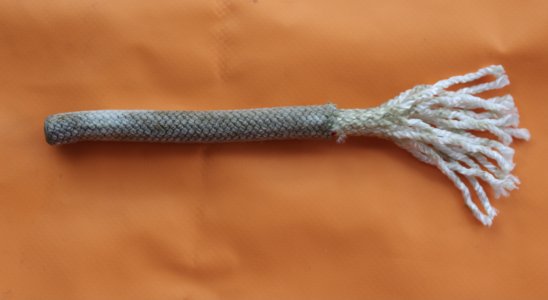
I would not use octaplait, or any plait or 3 ply as my primary because wear of one part of the (unpotected) cordage weakest the whole. Better put - you cannot see the damage, in many cases, its hidden in the inner threads. Kernmantle has a braided outer sleeve specifically designed to resist abrasion. If the cover suffers abrasion you would see it and it will not have damaged the inner core.
IMG_4822.JPG
 
I may be wrong, but ISTM that there's a world of difference between the weekend cruiser who wants to anchor to watch the sunset with a nice glass (me :)), who can just bugger off home if things get iffy, and the long-term world-girdling guy who needs his setup to keep him alive in really severe conditions.
A lot of the arguments over anchoring seem to be because people confuse the two. I've sat out on a mixed rode and a Delta anchor for years, including 6s and 7s, and only dragged once but, if I were heading off round the world, yes, I'd want a different setup (and a different boat)
 
I may be wrong, but ISTM that there's a world of difference between the weekend cruiser who wants to anchor to watch the sunset with a nice glass (me :)), who can just bugger off home if things get iffy, and the long-term world-girdling guy who needs his setup to keep him alive in really severe conditions.

A lot of the arguments over anchoring seem to be because people confuse the two. I've sat out on a mixed rode and a Delta anchor for years, including 6s and 7s, and only dragged once but, if I were heading off round the world, yes, I'd want a different setup (and a different boat)
I'm sympathetic to your post - you are not alone - but you can decide not to read posts on anchoring and, say, Lithium. But then don't go to, say, Rhum

If you live in the UK then your world includes, named storms, and people who want to sail round the UK or sail to Skye.

It also includes people who want to sail to to the Scilly Islands in the summer

Storm tactics at anchor: Surviving gales in Scilly - Yachting Monthly

some of them will have ambitions, not to sail round the world but maybe - go to the Med.

Slammed in the Med: How We Survived 70-Knot Winds and Chaos at Anchor

I won't deny them the opportunity to prepare. How are they going to learn?

No-one 20 years ago knew much about snubbers - now some people have them as 'standard' - how do I, sitting in Sydney, know - they tell me.


Anchoring, and all it incurs is a bit like Lithium - you don't need it but when you do - its amazingly useful. Some members do comment as you have done, less politely, but they still read my posts :).


The other problem is - all yachts are different and what works for a 35' AWB might not be suitable for a 54' ....

Every day is a school day

Jonathan
 
True.

I read most threads, because there's always the chance to pick up a new tip, but I give up and go elsewhere when a thread degenerates into trench warfare
there is a balance

A little bit of controversy can encourage new thinking.

But life is too short to read every thread - so I scan the titles and maybe read 2-4 threads in more detail (and Have some members on ignore)

Jonathan
 
I'm sympathetic to your post - you are not alone - but you can decide not to read posts on anchoring and, say, Lithium. But then don't go to, say, Rhum

If you live in the UK then your world includes, named storms, and people who want to sail round the UK or sail to Skye.

It also includes people who want to sail to to the Scilly Islands in the summer

Storm tactics at anchor: Surviving gales in Scilly - Yachting Monthly

some of them will have ambitions, not to sail round the world but maybe - go to the Med.

Slammed in the Med: How We Survived 70-Knot Winds and Chaos at Anchor

I won't deny them the opportunity to prepare. How are they going to learn?

No-one 20 years ago knew much about snubbers - now some people have them as 'standard' - how do I, sitting in Sydney, know - they tell me.


Anchoring, and all it incurs is a bit like Lithium - you don't need it but when you do - its amazingly useful. Some members do comment as you have done, less politely, but they still read my posts :).


The other problem is - all yachts are different and what works for a 35' AWB might not be suitable for a 54' ....

Every day is a school day

Jonathan
What's wrong or special about "Rhum", which is now more correctly known as Rum?
 
True.

I read most threads, because there's always the chance to pick up a new tip, but I give up and go elsewhere when a thread degenerates into trench warfare

Do you read all anchor posts? You are a better man than I am, my eyes glaze over as soon as I spy anything longer than a few paragraphs.

You are of course correct, anchoring is a non subject for most sailors sailing locally. Buy any anchor, a length of chain some rope and you are in business. In fifty years of sailing I can't recall ever anchoring in much over 30kts of wind - why is this? It's because I sail mostly Western Europe, where there is usually a marina or excellent shelter or moorings within 20 miles of wherever you happen to find yourself.
Yet poor sods asking about their Leisure 17 often end up being earholed with the full snubber

As you say, these questions are all about perspective, lithium batteries are both a waste of time and an excellent solution for boaters; new anchors are also a waste of money and a valuable improvement on the old. Depends.

.
 
Do you read all anchor posts? You are a better man than I am, my eyes glaze over as soon as I spy anything longer than a few paragraphs.

You are of course correct, anchoring is a non subject for most sailors sailing locally. Buy any anchor, a length of chain some rope and you are in business. In fifty years of sailing I can't recall ever anchoring in much over 30kts of wind - why is this? It's because I sail mostly Western Europe, where there is usually a marina or excellent shelter or moorings within 20 miles of wherever you happen to find yourself.
Yet poor sods asking about their Leisure 17 often end up being earholed with the full snubber

As you say, these questions are all about perspective, lithium batteries are both a waste of time and an excellent solution for boaters; new anchors are also a waste of money and a valuable improvement on the old. Depends.

.
Another problem is - threads and posts often lack any or sufficient detail and respondents simply don't know what the quantitative question is. Is it someone who came into an inheritance and has a yacht on order or is it someone with a bit of knowledge simply wanting some reassurrance. People forget 'a picture is worth a thousand words' and many seem to think a question of a 20' yacht will have exactly the same answer as the same question for the owner of a 50' yacht.

Jonathan
 
Snubber testing Article on Practical Sailor site.

Anchor Snubber Shock Load Test - Practical Sailor

Good article, but it prompted a few questions

An in-line snubber on an all-chain rode, say half-way along it, and thus submerged, would be a bit more trouble to set up but it would not be chafed on the boat (there would be some chafe from the chain but I would expect it to be less), it would be protected from UV, and it would be water cooled, (the article identifies internal friction heating as a failure mode.)

There might be gotchas that I haven't thought of that prevent doing this, or it might be an SOP that I havnt heard of, though I would have expected the article to have mentioned it in the latter case.

IF it isn't a thing, WHY isn't it?

Other questions:-

Veering about at anchor is mentioned as a downside of snubbers (though I think it also happens without them) but there is no mention of using a drogue to prevent this. IF it were a set fairly deep it would also resist straightening of the catenery, so might have a similar effect to a snubber. I suppose a drogue hanging up on the bottom might be too likely.

I have heard of weights being positioned on the rode, which perhaps tend to resist veering as well as straightening of the catenery.

Weights are...er... heavy though. Wouldnt a float, which would have to be pulled underwater to straighten the catenery, have a similar effect without the weight penalty?
Oh dear what an article! Rubber compensators are for mooring at dock to reduce snatching. They serve no purpose as a snubber at anchor. Shallower the water, longer the snubber! Thicker the snubber the less effective it will be! 5m is a decent length. And I suggest you deploy them on a side cleat - they are further aft than the bow and will reduce hobby horsing. A 15m snubber is nice to have - make sure it doesn’t fall off if you are in shallow water (before the storm hits). I recommend the Mantus ‘hook/claw - it has a very handy heavy duty plastics attachment that will keep the hook in place. Don’t forget the point of a snubber line is to reduce snatching and a potential unsetting of your anchor. If the snubber is too thick it won’t work. Rubber compensators in your snubber is not seaman like imho!!
 
Oh dear what an article! Rubber compensators are for mooring at dock to reduce snatching. They serve no purpose as a snubber at anchor. Shallower the water, longer the snubber! Thicker the snubber the less effective it will be! 5m is a decent length. And I suggest you deploy them on a side cleat - they are further aft than the bow and will reduce hobby horsing. A 15m snubber is nice to have - make sure it doesn’t fall off if you are in shallow water (before the storm hits). I recommend the Mantus ‘hook/claw - it has a very handy heavy duty plastics attachment that will keep the hook in place. Don’t forget the point of a snubber line is to reduce snatching and a potential unsetting of your anchor. If the snubber is too thick it won’t work. Rubber compensators in your snubber is not seaman like imho!!
Another problem with threads - people don't read the whole thread :)

Think outside the box! Keep lateral thinking alive - its part a British 'thing' Tudor Ricards was an exponent at Manchester Business School....

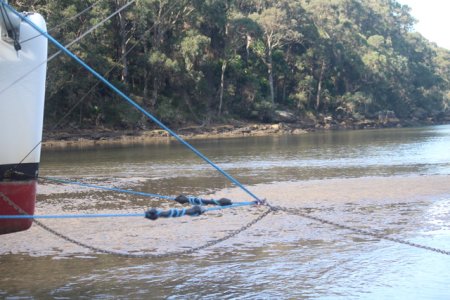
This is a rubber dog bone type device. Doing what its meant to do, though not in a marina

The bridle, its a cat :) is secured at the bow, taken to a bridle plate (where the chain is secured) and the snubber then taken to a deck turning block and then to the transom. The chain is secured with a bridle plate with LFRs, the port and starboard snubber lines run through the LFRs. The 'long' part of the snubber, from transom to bride plater stretches more than the short part (with the rubber devices). This is advantageous as the scope is improved - but LFRs are low friction not no friction so the tensions don't equalise

But you want both arms to contribute to snubbing, adding the rubber devices helps do just that.

IMG_5077.jpeg

Jonathan
 
Another problem with threads - people don't read the whole thread :)

Think outside the box! Keep lateral thinking alive - its part a British 'thing' Tudor Ricards was an exponent at Manchester Business School....

This is a rubber dog bone type device. Doing what its meant to do, though not in a marina

The bridle, its a cat :) is secured at the bow, taken to a bridle plate (where the chain is secured) and the snubber then taken to a deck turning block and then to the transom. The chain is secured with a bridle plate with LFRs, the port and starboard snubber lines run through the LFRs. The 'long' part of the snubber, from transom to bride plater stretches more than the short part (with the rubber devices). This is advantageous as the scope is improved - but LFRs are low friction not no friction so the tensions don't equalise

But you want both arms to contribute to snubbing, adding the rubber devices helps do just that.

View attachment 198178

Jonathan
What a complicated and time consuming set up. Much easier to have all chain, of a decent size, and not need a cat's cradle of bits of string. And I'm still waiting to be told about what's wrong with Rum. 🙂
 
The Mantus chain 'claw' is simply a copy of a similar device from the lifting industry. They are VERY difficult to disengage if under tension. They need to be perfectly aligned to release the chain.

I would not touch them with a barge pole. A chain hook is simpler. Interestingly the lifting industry uses chain hooks everywhere, claws just for chain shortening (which you do at leisure).

Jonathan
 
What a complicated and time consuming set up. Much easier to have all chain, of a decent size, and not need a cat's cradle of bits of string. And I'm still waiting to be told about what's wrong with Rum. 🙂


You do love to be contrary. I hate to become involved in your person likes and dislikes but can I suggest maybe you could swap sides of the berth with your wife

Sorry, but why is it time consuming)

Its set up and left for use. No problem its Scotland with UV as the snubber has a braided outer sleeve, specially to protect the working core. You deploy the chain attach the bridle plate and sit back and enjoy the view. (maybe with a glass of decent whisky). Some of us don't want to break our backs, empty our wallets, fill the bow locker, need larger power cables for the windlass, use more 'valuable' amps and destroy sailing efficiency with heavy chain - a decent snubber replaces some chain or if you have a long snubber (more) chain.


Nothing wrong with R(h)um - that's why I quoted it. Its lovely. I'm surprised you took exception. Glasgow Uni did a photogrammetric survey and then map of the island.

Jonathan
 
Oh dear what an article! Rubber compensators are for mooring at dock to reduce snatching. They serve no purpose as a snubber at anchor. Shallower the water, longer the snubber! Thicker the snubber the less effective it will be! 5m is a decent length. And I suggest you deploy them on a side cleat - they are further aft than the bow and will reduce hobby horsing. A 15m snubber is nice to have - make sure it doesn’t fall off if you are in shallow water (before the storm hits). I recommend the Mantus ‘hook/claw - it has a very handy heavy duty plastics attachment that will keep the hook in place. Don’t forget the point of a snubber line is to reduce snatching and a potential unsetting of your anchor. If the snubber is too thick it won’t work. Rubber compensators in your snubber is not seaman like imho!!
IIRC the article says the rubber snubbers tested were not very effective but were quite expensive.

There are some double spring based things I've seen being used for mooring, on Cyprus I think, but I guess they maybe dont have the travel to be effective as snubbers either.
 
You do love to be contrary. I hate to become involved in your person likes and dislikes but can I suggest maybe you could swap sides of the berth with your wife

Sorry, but why is it time consuming)

Its set up and left for use. No problem its Scotland with UV as the snubber has a braided outer sleeve, specially to protect the working core. You deploy the chain attach the bridle plate and sit back and enjoy the view. (maybe with a glass of decent whisky). Some of us don't want to break our backs, empty our wallets, fill the bow locker, need larger power cables for the windlass, use more 'valuable' amps and destroy sailing efficiency with heavy chain - a decent snubber replaces some chain or if you have a long snubber (more) chain.


Nothing wrong with R(h)um - that's why I quoted it. Its lovely. I'm surprised you took exception. Glasgow Uni did a photogrammetric survey and then map of the island.

Jonathan
Ha ha, - contrary. It's a forum. We don't all have to agree with you about everything.

I'm not at all sure about the relevance of your allusion to my wife. That seems to me to be an unnecessary and possibly unpleasant personal comment.

My question about Rum was in response to your statement in No106, where you said, "But don't go to, say, Rhum" (sic). That gave the impression that your view, from Australia, is that there is something particularly difficult about anchoring at Rum. Is there?
 
IIRC the article says the rubber snubbers tested were not very effective but were quite expensive.

There are some double spring based things I've seen being used for mooring, on Cyprus I think, but I guess they maybe dont have the travel to be effective as snubbers either.
those springs are highly effective especially stern too in the med - the best kit. my boat was 35ft and I got away with rubber compensators and that special stretch mooring lines from Jimmy Green (they are blue and yellow) Actually just the lines kept everything sweet when I med moored on the wrong pontoon once. It was so rocky it would have been dangerous to get aboard but everyone (it was quite a spectacle!) marvelled at the elasticity of my mooring lines - you could see them stretch.
 
The Mantus chain 'claw' is simply a copy of a similar device from the lifting industry. They are VERY difficult to disengage if under tension. They need to be perfectly aligned to release the chain.

I would not touch them with a barge pole. A chain hook is simpler. Interestingly the lifting industry uses chain hooks everywhere, claws just for chain shortening (which you do at leisure).

Jonathan
Agree and I prefer a chain hook (and I use one on my 5m snubber) but when using a 15 snubber in shallow water I use the Mantus. It is hard to get off but it's also not coming off without your help! Over 40 knots and I use the Mantus.
 
Another problem with threads - people don't read the whole thread :)

Think outside the box! Keep lateral thinking alive - its part a British 'thing' Tudor Ricards was an exponent at Manchester Business School....

This is a rubber dog bone type device. Doing what its meant to do, though not in a marina

The bridle, its a cat :) is secured at the bow, taken to a bridle plate (where the chain is secured) and the snubber then taken to a deck turning block and then to the transom. The chain is secured with a bridle plate with LFRs, the port and starboard snubber lines run through the LFRs. The 'long' part of the snubber, from transom to bride plater stretches more than the short part (with the rubber devices). This is advantageous as the scope is improved - but LFRs are low friction not no friction so the tensions don't equalise

But you want both arms to contribute to snubbing, adding the rubber devices helps do just that.

View attachment 198178

Jonathan
ffs you have to be different 😂 That makes perfect sense. btw they are called compensators.
 
Ha ha, - contrary. It's a forum. We don't all have to agree with you about everything.

I'm not at all sure about the relevance of your allusion to my wife. That seems to me to be an unnecessary and possibly unpleasant personal comment.

The reference to your wife was not intended in any way to insult - Its just you seem to get out of the bed on the wrong side, too often.

Its a very old expression, so I thought you would recognise it (I was obviously wrong).

He is in an argumentative mood - thus he got out of the wrong side of the bed this morning.

Apologies.

Jonathan
 
Top