Are Laminate Sails worth it for cruisers

Interesting thread.
In the Tropics, laminate sails have a short life. A Captain on a 72ft cruiser/racer (that only cruises these days) who moves between the .Caribbean and the Med says they replace their laminate sails every 5 years. UV kills them. They are .North sails.
My experience, albeit several years ago with the laminate sails that came on my last boat, was that 4 years killed those sails. Another guy here got 3 years out of his laminate genoa. Really not an issue in the UK but anybody thinking of doing an Atlantic circuit, you may be better putting on a set of .Dacron sails and saving your laminates for when you get home. The sun here is brutal.
Not relevant to the OP or anyone sailing near sailmakers lofts, but there is also the issue of repairability. Laminate sails are very difficult (probably impossible) to repair with onboard means. On a big boat delivery from the US after two days we broke the genoa and there were shreds of plastic and carbon filaments flapping all over the place, one third of the sail basically disappeared; in Horta the local guy used the remains of the sail as sort of template to sew layers and layers of full width dacron to rebuild some sort of shape, the owner bought a new sail delivered to Gibraltar.
If I count the number of times I restitched or repaired my own or other people dacron sails with the sewing machine I kept on board...
My last genoa is in Hydranet, the sailmaker showed me a couple of sails having 2-4 transats and they were like new, very convincing fabric.
 
Thanks. -👍
Though from a cruising perspective on ocean passages the boat will always be on windvane so the wind angle will not change, & wind tends to be very consistent. I'm more interested to know if , say, pointing away from the destination by 30 odd deg instead of goose winged dead downwind is going to take lots longer or not much or none at all instead of rolling for a few weeks. VMG seemed to be the best bit of data available for this but maybe there are other ways /things involved to learn
I have a graph which does just that: it visually answers the question "I am going at X knots with wind angle A, if I modify the angle to B what is the minimum speed I have to reach to offset the longer course?"
Very basic graph actually it's a modified sinus and cosinus representation; I'll post it if I can find the file. 🥺
 
I have a graph which does just that: it visually answers the question "I am going at X knots with wind angle A, if I modify the angle to B what is the minimum speed I have to reach to offset the longer course?"
Very basic graph actually it's a modified sinus and cosinus representation; I'll post it if I can find the file. 🥺
I’ve seen that used effectively. With the rig stalled out, deep running, there’ll be little difference in sails, new, old, laminate or not. But that extra speed is a damned sight easier to find with laminate sails once laminar airflow is restored.
 
I have a graph which does just that: it visually answers the question "I am going at X knots with wind angle A, if I modify the angle to B what is the minimum speed I have to reach to offset the longer course?"
Very basic graph actually it's a modified sinus and cosinus representation; I'll post it if I can find the file. 🥺
👍
Great idea. I've actually got a boat basic website which runs all the time on a raspberry pi with links to various manuals & checksheets, that would be a fun bit of python to add to it to while away some nights out of internet range anchored 😁
 
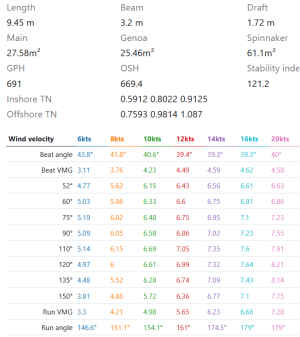
Just found the Hanse polars based on a genoa & spinnaker.
I can get good speeds at 40 deg- at least that is what I think they are.
I cannot get anywhere near the downwind speeds with the self taker, although I can meet the speeds for 52 degrees much closer than 52 degrees, which is the point of my tuning etc. But the ST needs 16 kts.of wind & the water flat rather than a steep chop which stops the boat dead.
This is due to a ST pointing closer & more efficient not being furled. I hardly ever use the genoa due to being single handed
I can feather the main on the traveler in gusts, if it is not reefed but ideally I need to be reefed in 20 kts.


hanse 311.png
 
👍
Great idea. I've actually got a boat basic website which runs all the time on a raspberry pi with links to various manuals & checksheets, that would be a fun bit of python to add to it to while away some nights out of internet range anchored 😁
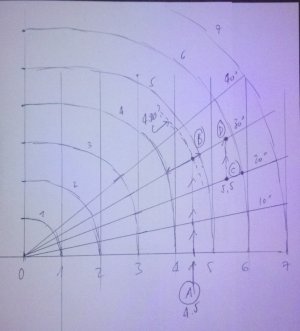
I could not find the file, before I forget I have sketched it by hand, I am sure a fine master of all informatic tools as yourself can draw a proper one in two minutes :)
Construction.
Horizontal axis: boat speeds (they are actually VMG speeds), draw vertical lines at 1kt - 2kt - 3kt... etc etc. The horizontal axis is aligned with the wind direction.
Centered on origin O, draw arcs of circles of radii equal to speeds
From origin O, draw lines leaving at 10° 20° 30° etc etc
Densify lines at your leisure (example bold for round speeds X.0kt, semibold for X.5kt, thin lines for x.25kt), add 15° 25° lines, etc
Example 1
You are sailing dead downwind at 4.5kt, Point A along the horizontal axis. (In this case 4.5 is your VMG).
What minimum speed must I reach if I luff by 30°?
From Point A go up on a vertical line until you cross the 30° angled line, Point B. Mesure min speed from origin O and point B using the circles, in this case it would be about 4.80. The more circles you draw the easier to measure.

Example 2
You are sailing at 5.5kt, 20° from the wind. Plot the speed along the 20° line using the circles as scale, segment OC is your speed. Go upwards towards the 30° at Point D, read the minimum speed as segment OD. I have not drawn it but if you go downwards from point C until crossing the horizontal line you have your VMG.

The same graph can be used for beating, just add more angled lines at 35° - 40° - 45° - 50° - 55° which will be the useful ones.

In essence, all vertical lines are lines of equal VMG, by changing your angle to the wind you change your position between the circles (boat speed), the vertical lines tell you the breakeven speeds.


VMG.jpg
 
  • Like
Reactions: GHA
Just found the Hanse polars based on a genoa & spinnaker.
I can get good speeds at 40 deg- at least that is what I think they are.
I cannot get anywhere near the downwind speeds with the self taker, although I can meet the speeds for 52 degrees much closer than 52 degrees, which is the point of my tuning etc. But the ST needs 16 kts.of wind & the water flat rather than a steep chop which stops the boat dead.
This is due to a ST pointing closer & more efficient not being furled. I hardly ever use the genoa due to being single handed
I can feather the main on the traveler in gusts, if it is not reefed but ideally I need to be reefed in 20 kts.


View attachment 168735
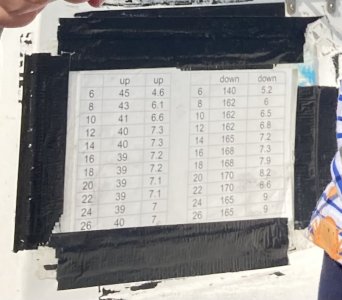
This is my targets. Same size boat, and to be honest over 18 knots downwind we’re on the plane and those numbers are very under. Shows the difference between a cruising focused and performance focused boat which have fairly similar size…


IMG_7577.jpeg
 
I could not find the file, before I forget I have sketched it by hand, I am sure a fine master of all informatic tools as yourself can draw a proper one in two minutes :)
Construction.
Horizontal axis: boat speeds (they are actually VMG speeds), draw vertical lines at 1kt - 2kt - 3kt... etc etc. The horizontal axis is aligned with the wind direction.
Centered on origin O, draw arcs of circles of radii equal to speeds
From origin O, draw lines leaving at 10° 20° 30° etc etc
Densify lines at your leisure (example bold for round speeds X.0kt, semibold for X.5kt, thin lines for x.25kt), add 15° 25° lines, etc
Example 1
You are sailing dead downwind at 4.5kt, Point A along the horizontal axis. (In this case 4.5 is your VMG).
What minimum speed must I reach if I luff by 30°?
From Point A go up on a vertical line until you cross the 30° angled line, Point B. Mesure min speed from origin O and point B using the circles, in this case it would be about 4.80. The more circles you draw the easier to measure.

Example 2
You are sailing at 5.5kt, 20° from the wind. Plot the speed along the 20° line using the circles as scale, segment OC is your speed. Go upwards towards the 30° at Point D, read the minimum speed as segment OD. I have not drawn it but if you go downwards from point C until crossing the horizontal line you have your VMG.

The same graph can be used for beating, just add more angled lines at 35° - 40° - 45° - 50° - 55° which will be the useful ones.

In essence, all vertical lines are lines of equal VMG, by changing your angle to the wind you change your position between the circles (boat speed), the vertical lines tell you the breakeven speeds.

Found a better drawing, this is the one I have laminated; extend the sector to say 60° and you're good for upwind too.
Downwind vmg
 
I could not find the file, before I forget I have sketched it by hand, I am sure a fine master of all informatic tools as yourself can draw a proper one in two minutes :)

thnx
Did quick spreadsheet - assumes course is straight to waypoint

L8tdsb6.png
 
Last edited:
I’d guess a knot should be quite easy to gain. For us, it’s much much more. The difference between laminar flow at 90 deg apparent and not, at 95 deg, is staggering. Which is why around 135 is our best course. We might, in 15kn wind, do 7kn on a dead run, maybe 8 at 150 degrees, and 15-16kn at 135.
 
I’d guess a knot should be quite easy to gain. For us, it’s much much more. The difference between laminar flow at 90 deg apparent and not, at 95 deg, is staggering. Which is why around 135 is our best course. We might, in 15kn wind, do 7kn on a dead run, maybe 8 at 150 degrees, and 15-16kn at 135.
That's you racers being totally fixated with getting somewhere as fast as possible 😁

On a trade wind passage speed not such a big deal, not rolling like a b"$t&r) 24 hours a day for weeks can easily outgun a day or 3 longer at sea. 😎 🌬
 
Not so much that as the general satisfaction of extracting the best from the boat. And also the boat feels fantastic at that speed. A bit like a planing powerboat being smoother and more stable on the plane.
 
Not so much that as the general satisfaction of extracting the best from the boat. And also the boat feels fantastic at that speed. A bit like a planing powerboat being smoother and more stable on the plane.
Take your word for it, I'll never know 😁
"extracting the best from the boat" -> not breaking stuff & being able to sit down & read the kindle when making the coffee instead of waiting to catch the pot as it flies across the cabin. Again... 😉😂
 
Sailing used to be a simple business. I had no idea that what I’ve been doing for, er, many years was so complicated. My boat will just keep the wind in its jib at an apparent wind of 145 degrees but a bit less is more comfortable, given that I no longer carry a spinnaker. Judging from the VMG meter, that is also about the best course for us
 
Sailing used to be a simple business. I had no idea that what I’ve been doing for, er, many years was so complicated. My boat will just keep the wind in its jib at an apparent wind of 145 degrees but a bit less is more comfortable, given that I no longer carry a spinnaker. Judging from the VMG meter, that is also about the best course for us
When it feels right, it probably is.
 
When it feels right, it probably is.
Up to a point. My boat’s best VMG to wind is achieved by sailing much closer than I or experienced guests have thought normal, with the jib’s luff almost lifting, rather than full-and-by. She is not a difficult boat to sail, but perfect sailing requires more concentration than ideal for a longer passage and I confess that I don't always try.
 
Up to a point. My boat’s best VMG to wind is achieved by sailing much closer than I or experienced guests have thought normal, with the jib’s luff almost lifting, rather than full-and-by. She is not a difficult boat to sail, but perfect sailing requires more concentration than ideal for a longer passage and I confess that I don't always try.
Ours is the same, inspite of the obvious difference. The windward telltales start to lift at about 40 true, to make best progress, you keep it right there. Obviously, it’s wave action and windshifts that conspire to throw you off. I’m kind of used to that with racing in smaller boats. There, if you fail to concentrate, you’re not 10 minutes late to the pub, you’re ignominiously last. For me, it’s a powerful incentive.
 
I think it's nice that sail trimming and sail shape is still mostly human and analog in nature , although you could possibly argue that wind speed and direction readouts come into play.

I think it was an aerodynamicist , Arvil Gentry , also a keen sailor that came up with the idea of Tell Tales on sails . Interesting that only two of the five boats I have owned came with tell tales. I don't know if that is par for other yachtsmen .

I remember a piece by Tom Cunliffe who mentioned that before tell tales, it took many years to learn how to trim a jib . All the other stuff we have, GPS,radar etc have been hand me downs from commercial shipping. It will probably be some time before sails come with electronic sensors all over them to a readout and suggestions on the helmsman's screen . I hope it's not too soon.
 
Top