Anchoring

I don't think I made it very clear in my post.
My bridle does have a chain hook.

Same as mine. Yes it does slide off v easily as soon as you take the tension off the bridle which I guess is the principle of its design. Personally I wouldn't anchor overnight without a snubber, not only because it takes the load off the windlass but also because it stops that irritating grinding of the chain in the bow roller which keeps me awake at night
 
Just a couple of BTW's:

1. If you don't have a chain hook you can put a rolling hitch on the chain and then attach the free end(s) of the snubber or bridle to suitable deck hardware. We wouldn't contemplate enything other than a very short stop without a snubber for all the reasons quoted above.

2. Any of the above comments on anchoring etiquette do NOT apply in a crowded French anchorage (speaking here for the North rather than the Med). French yachtsmen WILL anchor far too close and seem to take delight in dropping their hooks in as close proximity as possible to where you think yours lies. The concept of last in/ first out is unheard of! A bit of a strain on the entente cordial but there are some great anchorages in Brittany so well worth the bother!

Richard.
 
Mike,

Chain hooks 'kink' the chain - or the link in the hook is not aligned with the rest of the chain. But there are a number of hook designs and they all 'work' slightly differently. But the chain is not straight, you attach the hook, deploy more chain until you have a 'sag' of chain between bow roller and hook (this extra length of chain helps secure the chain on the hook and provides for the stretch of the snubber). The hooks with the highest reputation are the cast ones. Oddly the greatest complaint of hooks is that they fall off, usually because they have been allowed to drag over the seabed. But removing a hook is simplicity itself, they slide off. If you need to go to the bow anyway (and we like you need to massage the chain in the locker) then removing a hook is not onerous.

The ability to absorb snatch loads is an advantage that, to us, far outweighs any disadvantages of using a snubber - just think of that bungy jumper :)

There are hooks with locking devices to stop them falling off, Mantus and Witchard come to mind, but they require 2 hands to release.

Mike you could simply keep the set up you have now and add a hook onto the existing shackle.

Jonathan

thanks Jonathon, that is most helpful, I will order a hook now and attach it to the shackle as you suggest
regards

Mike
 
Any of the above comments on anchoring etiquette do NOT apply in a crowded French anchorage


Some of the Med anchorages are very tight. The snubber should not effect things.

There is no need to let out more rode when using a snubber. In strong wind just make sure that you have some nylon line (about 10m) to add some elasticity. So if you need 40m of scope let out 30m of chain and then let out the 10 m of snubber with the chain still attached as back up if the snubber breaks. You still have 40m of scope out so the swinging room is no different The nylon will stretch so allow a for a loop in the chain.

The important principal is to add elasticity in stronger conditions. As an alternative you can also run the snubber along the deck from stern cleats. This does not reduce the swinging room, but removes the risk of the snubber abrading on the bottom in light winds. Unfortunately few boats can use a snubber attached to the rear without chafe or other practical problems.

A rolling hitch is a simple way to attach the snubber, but I have found it occasionally slips in bad conditions. Maybe its my lousy knot tying ability, but a rolling hitch is hard to get wrong. A Prusik loop with a Kleimhist hitch is better and has never slipped in my hands, but a Dyneema soft shackle is the best, foolproof, simple and quick solution I have found.
 
Last edited:
Agree with much of what's been said above. I always use a chain hook - once anchored up I go to the bow, attach the hook and pay out another 3-5 meters of chain and then cleat it off. Usually then pay out another couple of metres to create loop of chain previously mentioned. In a strongish wind the chain loop will almost completely disappear as the anchor plait attached to the hook stretches out.

There are three big advantages to this arrangement I think;
1) the anchor plait acts as a spring to reduce the chances of the anchor being snatched out of the seabed
2) you're not relying on the windlass gypsy to hold the weight of a heavy boat, possibly in a strong wind
3) at night it's silent - no grinding of the chain against the anchor roller

In fact I have two of these - one hook spliced to 10m of 12mm plait and one to 10m of 16mm plait. This way I have two levels of 'elasticity' in the event that the wind really picks up!

Perfect set up! :)

Hurricane's image, Post #19, of the hook is similar to ours (and the ones that seem to get the best reviews). Ours has a fork and clevis pin rather than the single hole for the rope or shackle. Chain hooks cut from plate do seem to bend. My wife deploys the anchor but I attach the chain hook, I also retrieve (as we need to shovel the chain out of the way in the locker) but I find the illustrated hook easy to apply and detach with one hand (and they are not expensive and available almost everywhere).

If you can keep the hook under tension, decent loose loop dangling between bow roller and hook, and keep the snubber off the seabed (to ensure length then run from an aft cleat) there is less chance the hook will fall off - but it does not fall off if the wind is up, there is enough tension from the wind.

Chafe is a problem, work out your best arrangement and then simply thread your snubber through hose pipe (the hose pipe then being attached at the chafe points). We use Dyneema hollow tape but its not easy to find and not cheap. Old fire hose is highly regarded (but I have never found any).

If a snubber does not stretch it will not dampen the snatch loads (but will take the load off the windlass).

Climbing rope makes excellent snubbers, its made to be strong and stretchy. Artificial climbing walls must retire rope and its useless for climbing - go ask and you might get it for free. But only suitable for yachts of about 30' to 45', to big for smaller, too small for larger. I picked up 6 pieces 13-15m each. We use 2 at a time, bridle, so we carry 2 spares and I gave the other 2 to a friend.

Jonathan
 
Chafe is a problem, work out your best arrangement and then simply thread your snubber through hose pipe (the hose pipe then being attached at the chafe points).

My bridle has plastic tubes threaded over it where it passes through the fairleads.
As you say, there must be significant chafing - my plastic tubes are quite worn and will probably need replacing soon.

Here's another pic of my bridle (you can just see the plastic tubes running through the fairleads).

IMG_5731e_Small_zps1h00cmpa.jpg


In the above pic, the load is high because this was the only anchor holding a raft of 4 boats - (3 x 43 footers and a 67 footer).
Note - no load on the windlass at all.
 
Hurricane,

Good image, illustrates much (better then the 1,000s of words!). I note you use those rubber bungee 'things'. When tested they are equivalent to about 2m of nylon but they 'stop' working at pretty low loads. So they work (so nothing wrong) - but an extra 2m of nylon each side is cheaper, easier to store and will offer elasticity beyond the load you would impose (even with all the extra you had attached!).

Jonathan
 
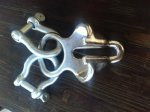
Having take all of this excellent advice on board I pitched up at our local chandler in Port Leucate to buy, among other things, a Wichard Chain Grip for our 12 mm Anchor Chain (we have a Monte Carlo MC5 arrived today!) and 'le monsieur' advised me that what I really needed was this set up ... (an Oscultati - Grillete Cadena 10mm - 12mm) for 34,90€ plus the Bow Shackles at 6,30€ each!

Bridle Chain Fixing.jpg

His argument was simple; to trap the chain with no kink plus easy release following subsequent reduction in tension after releasing the lines (might need to think about the risk of premature release if it emerges as a problem?) Will also need to fit Snubbers to those lines.
Be interesting to see how it all works out!
 
Looks a nice bit of kit. We use the same sort of device to secure the anchor to the bow roller when at sea (but a cast hook on the bridle).

Osculati have a good reputation and have some very good gear. But some of it is not tested - not an issue in this case as the hook is not critical - but unless it has some sort of specification I'd be twitchy about using any (untested, without a specification) kit to secure the ancho. Oscalati have a stainless bent link swivel anchor connector that is untested - hence the comment.

There is no indication of scale - I wonder why the 2 shackles and not attach the snubber, or bridle, direct to the hook. Maybe the shackles make it easier to attach to the chain when in use, more room to fiddle around.

Jonathan
 
Thanks Jonathan
The Oscalati piece is 16 cm top to bottom (or left to right in the picture). I was planning to fit 2 rubber Snubbers to the lines as per Hurricane's photo, or on looking again, are they rubber Mooring Compensators, I wonder? The shackles are there to attach the lines which will be made up with Thimbles at one end. As far as testing is concerned you make a valid point - looks like I'm going to be the guinea pig on this one!
Guy
 
Different suppliers seem to call these snubbers differently
These are similar to the ones we use.
http://www.marinescene.co.uk/product/4430/mooring-snubber-compensator-12mm-max-rope

I bought one of those Wichard chain hooks a couple of years ago to make a better strop fo holding the anchor whilst under way.
But I bought the wrong size so I never got to use it.
I see the point that the French Chandler is making though.
It would be interesting to see how well it works.

BTW - it is a good idea to have a couple of chain hooks on board anyway.
A couple of years ago, we knackered our windlass and is was very handy to have a chain hook on a short bit of rope tied off to a cleat whilst we manually recovered the anchor. Gave us the ability to have a rest ever now and then. Very hard work though and would have been impossible in a strong breeze.
 
Different suppliers seem to call these snubbers differently
These are similar to the ones we use.
http://www.marinescene.co.uk/product/4430/mooring-snubber-compensator-12mm-max-rope

I bought one of those Wichard chain hooks a couple of years ago to make a better strop fo holding the anchor whilst under way.
But I bought the wrong size so I never got to use it.
I see the point that the French Chandler is making though.
It would be interesting to see how well it works.

BTW - it is a good idea to have a couple of chain hooks on board anyway.
A couple of years ago, we knackered our windlass and is was very handy to have a chain hook on a short bit of rope tied off to a cleat whilst we manually recovered the anchor. Gave us the ability to have a rest ever now and then. Very hard work though and would have been impossible in a strong breeze.

Out of interest Hurricane- how does that work if you have the chain going through a bow roller- would the force not rip the roller apart if the cleat is a forward port or starboard one ?
 
Hurricane,

An idea, or application, I had not thought of. Ideally you would have 2. One could be attached to a rope that you pull the chain in with (more comfortable than pulling on chain and cleaner if you have anything of a muddy bottom). The other attached to the cleat to simply hold the chain to give you a rest and when you swap the pulling hook over. You could use one of them when at sea to secure the anchor and take the load off the windlass.

The Oscalati hook of Guy's looks easier to use, it simply drops onto the link. More conventional hooks need a bit more effort to align them, especially if they are a neat fit. Mine, like Guy's, is electro plated cast steel - and starting to rust I'll be looking out for Guy's version now. In the grand scheme of things it does not appear to be that expensive.

Thanks to you both.

Jonathan
 
The Oscalati hook of Guy's looks easier to use, it simply drops onto the link. More conventional hooks need a bit more effort to align them, especially if they are a neat fit. Mine, like Guy's, is electro plated cast steel - and starting to rust I'll be looking out for Guy's version now. In the grand scheme of things it does not appear to be that expensive.

I also have an Osculati chain hook and generally it works well. The only problem is that during the setting process you really need to keep the tension tight on both snubber ropes all the time otherwise the hook drops off the chain very easily
 
I can see Deleted User's point, could make it a bit tricky to set.
I was thinking of using a plastic tie to hold the hook in place while securing and adjusting the lines and then just cut it away the following morning when recovering the anchor? Time will tell!
I also like both Hurricane's and Jonathon's ideas - will definitely be carrying another couple of hook setups.
Cheers
Guy
 
I can see Deleted User's point, could make it a bit tricky to set.
I was thinking of using a plastic tie to hold the hook in place while securing and adjusting the lines and then just cut it away the following morning when recovering the anchor? Time will tell!
I don't think thats a good idea because if you have to raise the anchor in a big hurry in the middle of the night, say if you're dragging onto a lee shore, you don't want to be messing around with a knife trying to cut a cable tie. Maybe a short bungee cord to hold the hook in place which you then remove straightaway as soon as you get some tension on the snubber lines would be a better idea
 
I can see Deleted User's point, could make it a bit tricky to set.
I was thinking of using a plastic tie to hold the hook in place while securing and adjusting the lines and then just cut it away the following morning when recovering the anchor? Time will tell!
I also like both Hurricane's and Jonathon's ideas - will definitely be carrying another couple of hook setups.
Cheers
Guy

IMO, you really don't need anything else (cable ties etc) if you use one of these hooks.

lifting_chain_Hooks_H_323_rigging.jpg


It stays on really well with just the tension (weight) of the chain.
OK, it is a little fiddly to connect it but definately not worth securing it with a tie.


Out of interest Hurricane- how does that work if you have the chain going through a bow roller- would the force not rip the roller apart if the cleat is a forward port or starboard one ?

A bit like Jonathan said above only we just pulled the chain over the roller manually whilst someone else clipped on a chain hook with a short bit of rope made fast to a cleat.
At each pull, the hook was released and reattached.
I wouldn't want to do it again though.
 
IMO, you really don't need anything else (cable ties etc) if you use one of these hooks.

lifting_chain_Hooks_H_323_rigging.jpg


A bit like Jonathan said above only we just pulled the chain over the roller manually whilst someone else clipped on a chain hook with a short bit of rope made fast to a cleat.
At each pull, the hook was released and reattached.
I wouldn't want to do it again though.

Sorry to be a pain- but if the rope is attached to an offset cleat on the port or starboard and the chain is connected straight central through the bow roller does the force not tend to pull on the side of the roller to a degree where it would damage it or come off?
 
Top