Anchor snubber- long stretchy rope or rely on catenary

Peter,

Makes sense to me, as well. I just wondered!

The Delta was part developed as a result of the competition introduced by the Bruce. Part of the marketing at the time was the simple demonstration that you can catch a tennis ball in a Bruce (with a little practice) but cannot achieve the same result with a Delta - the same argument then as now. I note that Lewmar are sticking with this philosophy and their prototype new anchor is also a convex design. The Delta was better in terms of setting than the CQR but was rapidly eclipsed (for a variety of reasons) by Spade and Fortress - and these latter 2 seem to be surviving the test of time.

Anchor makers have a difficult time - they are confident of their product (or one hopes so) but need to be cautious - as they simply do not know how their product is going to be used, nor where. I think Geoff is exhibiting prudence and also is not going to stick his neck out - but give him a few more years at the helm and maybe we will see a change :)

I think that the 27kg Knox is unnecessary - and in your 45 knots blow - a smaller model would have held - though would have set more deeply - and maybe slightly more difficult to retrieve. But we will never know - and you sleep well (which is what it is all about!). So guessing on performance of a smaller model - its well, guessing :)

I'm still twitchy that the holes that allow the pockets in the fluke to drain might become blocked and the pockets retain water (and long term - rust). Stick a hose in them when you remember! I mention this as I saw another anchor that has a pocket when stowed had rusted through where the puddle collected, it had no drain holes. The anchor is exceptionally well constructed and strong - that shank is one of the strongest I have seen. The galvanising seems very good, possibly negating my fears of rust in the pockets!

I have not yet been defeated by ours, 13kg, but there is no perfect anchor, yet, maybe Knox??? - but until proven undefeated - assume it might have an Achilles heel. Our seabeds tend to be on the soft side - we don't have hard seabeds (or not that I have found) where any anchor would be defeated.

Jonathan

In French tests they mentioned that the Delta sometimes had trouble in resetting after a wind shift.
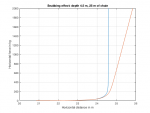
 
'Snubber or just catenary?' is a question whose answer depends on the depth you are accustomed to anchor in.

To illustrate this and get my own head around it in a quantitative way I did some calculations for a 10 tonne boat with 10mm chain, anchored in 4.5m depth with 25m of chain out, and for the same boat in 9m depth and 36m of chain out. I dd them with and without a snubber comprising a 5m length of 14mm nylon warp.

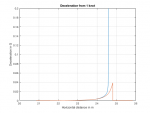
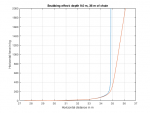
The results are that in the shallower depth the snubber makes a huge difference to jerks and accelerations (I simulated stopping from 1 knot), whereas in 9m it makes hardly any difference. I admit I was surprised at just how much this changed between the two depths. To put it another way, the maximum speed you can stop from without a big jerk goes up as depth goes up.

In shallow water
fig1a.png
Here the increase in force required to move the boat back a bit increases really very fast with only chain as it becomes completely taught (blue curve) whereas with the snubber (red curve) it's much more gradual. Surprise surprise, that translates to a hell of a jerk (you'd fall over, but in practice the bow will dip and the anchor probably move slightly, reducing the actual force a tad) when stopping from one knot without a snubber, but quite reasonable with a snubber.
fig2a.png

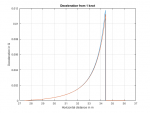
But in deeper water
fig1b.png
While the increase in force with snubber is still quite a bit gentler, the decelerations from moving at 1 knot are now comparable and neither will be at all severe.
fig2b.png

I hope interesting to some; the result of this maths is merely to confirm what others have already said from experience, but I enjoyed playing with the calculations anyway...
 
Last edited:
'Snubber or just catenary?' is a question whose answer depends on the depth you are accustomed to anchor in.

To illustrate this and get my own head around it in a quantitative way I did some calculations for a 10 tonne boat with 10mm chain, anchored in 4.5m depth with 25m of chain out, and for the same boat in 9m depth and 36m of chain out. I dd them with and without a snubber comprising a 5m length of 14mm nylon warp.

The results are that in the shallower depth the snubber makes a huge difference to jerks and accelerations (I simulated stopping from 1 knot), whereas in 9m it makes hardly any difference. I admit I was surprised at just how much this changed between the two depths. To put it another way, the maximum speed you can stop from without a big jerk goes up as depth goes up.

In shallow water
View attachment 72766
Here the increase in force required to move the boat back a bit increases really very fast with only chain as it becomes completely taught (blue curve) whereas with the snubber (red curve) it's much more gradual. Surprise surprise, that translates to a hell of a jerk (you'd fall over, but in practice the bow will dip and the anchor probably move slightly, reducing the actual force a tad) when stopping from one knot without a snubber, but quite reasonable with a snubber.
View attachment 72767

But in deeper water
View attachment 72768
While the increase in force with snubber is still quite a bit gentler, the decelerations from moving at 1 knot are now comparable and neither will be at all severe.
View attachment 72769

I hope interesting to some; the result of this maths is merely to confirm what others have already said from experience, but I enjoyed playing with the calculations anyway...

See. #8.
 

Yup, we agree! As I said, my graphs only confirm what others, including, maybe especially, you, have already said.

But I have this fetish for numbers so thought it worth doing them, if only for my own satisfaction. It always strikes me that the trouble with all anchoring threads is that everyone has valid experiences, and have drawn conclusions from those which are entirely valid in their circumstances, but others in different circumstances have reached different conclusions and then take to arguing. It's not that either are wrong, it's just that drawing general conclusions from observation is very dubious physics until and unless one pays attention to the numbers.
 
Yup, we agree! As I said, my graphs only confirm what others, including, maybe especially, you, have already said.

But I have this fetish for numbers so thought it worth doing them, if only for my own satisfaction. It always strikes me that the trouble with all anchoring threads is that everyone has valid experiences, and have drawn conclusions from those which are entirely valid in their circumstances, but others in different circumstances have reached different conclusions and then take to arguing. It's not that either are wrong, it's just that drawing general conclusions from observation is very dubious physics until and unless one pays attention to the numbers.

Yes, it wasn't meant to be a criticism. I'm actually pleased to see the figures.
A lot of modern boats tend to be lighter, and more skittish than "traditional" heavy displacement boats, and with them, carrying any extra weight is an anathaema. Consequently, many boats are using lighter chain, and while it is plenty strong enough, it doesn't give much useful catenary.
I have also found that if anchoring for an expected gale, it is better to anchor in deep, rather than shallow water. Mind you, I don't always practice what I preach, for the last three gales that I've been anchored in, I've been in particularly shallow, but perfectly sheltered (from the sea) places.
 
'Snubber or just catenary?' is a question whose answer depends on the depth you are accustomed to anchor in.

To illustrate this and get my own head around it in a quantitative way I did some calculations for a 10 tonne boat with 10mm chain, anchored in 4.5m depth with 25m of chain out, and for the same boat in 9m depth and 36m of chain out. I dd them with and without a snubber comprising a 5m length of 14mm nylon warp.

The results are that in the shallower depth the snubber makes a huge difference to jerks and accelerations (I simulated stopping from 1 knot), whereas in 9m it makes hardly any difference. I admit I was surprised at just how much this changed between the two depths. To put it another way, the maximum speed you can stop from without a big jerk goes up as depth goes up.

In shallow water
View attachment 72766
Here the increase in force required to move the boat back a bit increases really very fast with only chain as it becomes completely taught (blue curve) whereas with the snubber (red curve) it's much more gradual. Surprise surprise, that translates to a hell of a jerk (you'd fall over, but in practice the bow will dip and the anchor probably move slightly, reducing the actual force a tad) when stopping from one knot without a snubber, but quite reasonable with a snubber.
View attachment 72767

But in deeper water
View attachment 72768
While the increase in force with snubber is still quite a bit gentler, the decelerations from moving at 1 knot are now comparable and neither will be at all severe.
View attachment 72769

I hope interesting to some; the result of this maths is merely to confirm what others have already said from experience, but I enjoyed playing with the calculations anyway...

Interesting :)
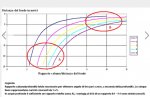
Not sure one can compare the effect on different depths using the same scope: given a fixed horizontal force (say boat pull), the necessary scope to lift the last link of chain (catenary tangent to sea bottom, supposedly horizontal) decreases as depth increases, example a 4:1 scope with 9m depth is roughly equivalent to a 6:1 scope in 4.5m; or conversely a 4:1 scope in 4.5m is roughly equivalent to 2.5:1 in 9m.
Maybe have a look with "equivalent" scopes at different depths and see what happens?


Image: Variation of needed scope vs changing depth for a tangent catenary, with different given horizontal pulls (coloured lines)
image.jpeg
 
Interesting :)
Not sure one can compare the effect on different depths using the same scope: given a fixed horizontal force (say boat pull), the necessary scope to lift the last link of chain (catenary tangent to sea bottom, supposedly horizontal) decreases as depth increases, example a 4:1 scope with 9m depth is roughly equivalent to a 6:1 scope in 4.5m; or conversely a 4:1 scope in 4.5m is roughly equivalent to 2.5:1 in 9m.
Maybe have a look with "equivalent" scopes at different depths and see what happens?


AT 200KgF on the chain, 25m chain in 4.5m water & 36m chain in 9m with 10mm chain both look pretty close to lifting the last link.
http://www.moondogmoving.co.uk/catenary.html

Fantastic JDC, don't suppose you posted an overview of the maths anywhere online? Probably beyond me but would be great to learn more.:cool:
 
A simple way to do some of your own calculations is to use a catenary calculator.

https://www.spaceagecontrol.com/calccabl.htm

Double the rode length; that places the anchor at the mid point just as the rode rises off the bottom. The sag will be depth plus freeboard. Reduce the chain wt. to correct for SG in water.

Many variation and other calculations are possible.
 
AT 200KgF on the chain, 25m chain in 4.5m water & 36m chain in 9m with 10mm chain both look pretty close to lifting the last link.
http://www.moondogmoving.co.uk/catenary.html

that graph moves a lot, beyond my fingers capability on a tablet :)


later addition: indeed I made a mental approximation about scopes and it was not correct, apologies
thou shalt never do mental calculation again. :)
 
Last edited:
... Fantastic JDC, don't suppose you posted an overview of the maths anywhere online? Probably beyond me but would be great to learn more.:cool:

You are being too kind I fear! My code is here:


Code:
g = 9.81;
y0 = 4.5;
s0 = 25;
m = 1e4;
%mass per unt length = 2kg/m

stretch = 1 / 1600; %20% stretch at 50% of BS according to Marlow. 5m long, 3.2 tonne BS
if nylon == 0,
    stretch = 0;
end

%lambda = Fx / m, ie the horozontal force divided by the mass of chain per
%unit length
l_mx = 250;
lambda = (0.1:0.01:l_mx);
[tmp, i_mx] = size(lambda);
yy = lambda * 0 + y0; x = lambda * 0;
l_crit = (s0^2 - y0^2) / 2 / y0;
i_crit = find(lambda > l_crit,1); i_crit = i_crit + 200; %the +200 is a bodge just for prettier graphs

%chain not yet off ground
for i = (1:i_crit-1),
    s_lifted = sqrt(y0^2 + 2 * lambda(i) * y0);
    x_lifted = lambda(i) * acosh(y0 / lambda(i) + 1);
    x(i) = x_lifted + s0 - s_lifted;
end

%all chain now lifting
y_ul = 0;
y_mx = 50;
x_mx = 0;
y = (y0:0.001:y_mx);
for i = (i_crit:i_mx),
    delta_s = sqrt(y.^2 + 2 * lambda(i) * y) - sqrt((y-y0).^2 + 2 * lambda(i) * (y - y0));
    j0 = find(delta_s <= s0, 1);
    yy(i) = y(j0);
    y_ul = max(y_ul, y(j0));
    x(i) = lambda(i) * ( acosh(yy(i) / lambda(i) + 1) - acosh((yy(i) - y0) / lambda(i) + 1) );
    x(i) = max(x(i), x_mx); % filter for smooth graph. Bodge alert!
    x_mx = x(i);
end

%add stretch due to snubbing line. F = sqrt(Fx^2 + Fy^2) but we only want the x component of it.
x = x + stretch * lambda * 2);

%energy absorbed = integral of force * distance
speed = lambda * 0 + 0.5; %initially moving at 1 knot
e = lambda * 0; ek = e; acc = e;
ek(1) = 0.5 * m * 0.5^2; 
for i = (2:i_mx),
    delta_e = lambda(i) * 2 * g * max(x(i) - x(i-1), 0);
    e(i) = e(i-1) + delta_e;
    ek(i) = ek(i-1) - delta_e;
    speed(i) = sqrt(2 * ek(i) / m);
    acc(i) = lambda(i) * 2 * g / m;
    if ek(i) <= 0,
        speed(i) = 0;
        ek(i) = 0;
        acc(i) = 0;
    end

end

%now simulate in the time domain
F = interp1(x, lambda * g * 2, (0:0.1:s0));
%resampes so that we now have a function of force per meter horozontally
[tmp, i_mx] = size(F);
for i = (1:i_mx),
    if isnan(F(i)),
        F(i) = 0;
    end
end

t_step = 0.1;
t = (0:t_step:150);
a = t * 0; v = a; xx = a + s0 - y0; % just defines vectors and sets initial conditions
[tmp, i_mx] = size(t);
for i = (2:i_mx),
    a(i) = ( 500 - F(floor(xx(i-1) * 10) + 1) )/ m;
    v(i) = v(i-1) + a(i) * t_step;
    v_damp = v(i)^2 * 2.5e3 * t_step / m; %magic damping number - about right, and ony there for approximate reults
    if (v(i) > 0),
        v(i) = v(i) - v_damp;
    else
        v(i) = v(i) + v_damp;
    end
    xx(i) = xx(i-1) + v(i) * t_step;
end

figure(1);
fprintf('Maximum value of y is: %d\n', y_ul);
s_ideal = sqrt(y_ul^2 + 2 * l_mx * y_ul);
fprintf('Ideal value of s is: %d\n', s_ideal);
plot(x, lambda * 2); grid on
xlabel('Horizontal distance in m');
ylabel('Horizontal force in kg');
title_string = sprintf('Snubbing effect: depth %2.1f m, %2.0f m of chain', y0, s0);
title(title_string);

figure(2);
plot(x, acc / g);grid on
title('Deceleration from 1 knot');
ylabel('Deceleration in G');
xlabel('Horizontal distance in m');

figure(3);
plot(t, xx); grid on

figure(4);
plot(t, v, t, a); grid on
 
Last edited:
...I have also found that if anchoring for an expected gale, it is better to anchor in deep, rather than shallow water...

I'm 100% in agreement! In fact I had an horrendous forecast once when in Lamlash (Arran), and went and anchored in 20m despite this reducing the scope/depth ratio to only 3. It worked a treat, no sheering around, all very calm really despite F10 blowing through. Boats further in had an awful time of it.
 
Sorry to resurrect this thread but reading it inspired me to change my snubber arrangement.
On our 12m / 8 tonne AWB I’d been using a 12mm bridle- it was sold to me as Nylon, but after 6 years it’s still relatively supple so I suspect it’s Polysoft or something similar. Anyway it’s done the job very well - we’re in Greece so anchor all the time.
Reading this thread I decided to change to 10mm nylon multiplait also set up as a bridle. It works in that it’s very stretchy, but possibly to well. We sleep in the forepeak and even in light winds the noise of the stretching is very intrusive. I’ve tried using plastic pipe thro the fair leads, to no avail.
Any thoughts before I return to the tried and tested ( and quiet) Polysoft?
 
Some parts of Greece are in for bad weather so it is a good time to look at your snubber. Yes, squeaking snubbers can be a nuisance.

Dyneema is less squeaky than nylon. Of course the majority of the snubber has to be nylon for stretch, but using Dyneema where it passes through the fairleads means there is much less chafe and less squeaking. You can also keep the nylon and use a hollow Dyneema protective sleeve over the top.

The other option is to rig the snubber from the stern cleats which can in some cases help reduce the squeaking or at least move the noise away from the front cabin.

Finally, some people use retired climbing rope which is a less squeaky (and cheaper) than octoplait. There is some debate if the construction of this type of rope results in more plastic deformation rather than the desired elastic deformation, but those that use this regularly seem happy this is not the case.
 
It is often frowned on but I use a hefty rubber snubber near the chain hook which means in light to moderate winds it does all the stretching without any noise. Once the wind has got up enough for it to be permenantly at full stretch then it is noisy enough for me not to worry about the bridle squeaking in the fairleads. Of course every now an again the wind is strong enough to overstretch the rubber which loses elasticity so I replace it maybe once every two years after that happens.
 
Sorry to resurrect this thread but reading it inspired me to change my snubber arrangement.
On our 12m / 8 tonne AWB I’d been using a 12mm bridle- it was sold to me as Nylon, but after 6 years it’s still relatively supple so I suspect it’s Polysoft or something similar. Anyway it’s done the job very well - we’re in Greece so anchor all the time.
Reading this thread I decided to change to 10mm nylon multiplait also set up as a bridle. It works in that it’s very stretchy, but possibly to well. We sleep in the forepeak and even in light winds the noise of the stretching is very intrusive. I’ve tried using plastic pipe thro the fair leads, to no avail.
Any thoughts before I return to the tried and tested ( and quiet) Polysoft?

Do you splice the loops to drop the bridle inner end over the deck cleats? We found that our 9m long snubber is silent since we adopted a spliced inner end instead of just tying off to the cleat.
 
Sorry to resurrect this thread but reading it inspired me to change my snubber arrangement.
On our 12m / 8 tonne AWB I’d been using a 12mm bridle- it was sold to me as Nylon, but after 6 years it’s still relatively supple so I suspect it’s Polysoft or something similar. Anyway it’s done the job very well - we’re in Greece so anchor all the time.
Reading this thread I decided to change to 10mm nylon multiplait also set up as a bridle. It works in that it’s very stretchy, but possibly to well. We sleep in the forepeak and even in light winds the noise of the stretching is very intrusive. I’ve tried using plastic pipe thro the fair leads, to no avail.
Any thoughts before I return to the tried and tested ( and quiet) Polysoft?

Does it float (Polysoft of PP)? If yes, probably Polysoft, if not, probably nylon. Another test is that battery acid eats nylon but not PP.

Basic chemistry.
---
Is the rope itself squeaking, or is it the rubbing in the fairlead (probably)? If that is the case, nylon tubular webbing works very well. Silent in most cases.
 
Sorry to resurrect this thread but reading it inspired me to change my snubber arrangement.
On our 12m / 8 tonne AWB I’d been using a 12mm bridle- it was sold to me as Nylon, but after 6 years it’s still relatively supple so I suspect it’s Polysoft or something similar. Anyway it’s done the job very well - we’re in Greece so anchor all the time.
Reading this thread I decided to change to 10mm nylon multiplait also set up as a bridle. It works in that it’s very stretchy, but possibly to well. We sleep in the forepeak and even in light winds the noise of the stretching is very intrusive. I’ve tried using plastic pipe thro the fair leads, to no avail.
Any thoughts before I return to the tried and tested ( and quiet) Polysoft?

On the ex boat, a 12m 9 ton wooden gaff cutter that owned me for thirty years, I had an arrangement that I saw in Don Street's "The Ocean Sailing Yacht", with a 10mm three strand bit of nylon starting with a hard eye shackled to its own eye in the bobstay stem fitting. Perfect peace, perhaps because the whole set up was under water when in use.

You do need to seize both legs of the thimble into the eye, as you would with any thimble in nylon under heavy strain.
 
"The Ocean Sailing Yacht", with a 10mm three strand bit of nylon starting with a hard eye shackled to its own eye in the bobstay stem fitting. Perfect peace, perhaps because the whole set up was under water when in use.
Plus you can deploy less anchor chain for the same scope.
 
Plus you can deploy less anchor chain for the same scope.

One problem with a snubber attached to the eye is that you must be VERY careful not to run the rope over it when recovering. I am aware of several people that had premature snubber failures, because the pressure of the chain cause internal damage to the snubber. The other is UV exposure (hard to remove, so it stays in place).

That said, it can be a very good answer.
 
Sorry to resurrect this thread but reading it inspired me to change my snubber arrangement.
On our 12m / 8 tonne AWB I’d been using a 12mm bridle- it was sold to me as Nylon, but after 6 years it’s still relatively supple so I suspect it’s Polysoft or something similar. Anyway it’s done the job very well - we’re in Greece so anchor all the time.
Reading this thread I decided to change to 10mm nylon multiplait also set up as a bridle. It works in that it’s very stretchy, but possibly to well. We sleep in the forepeak and even in light winds the noise of the stretching is very intrusive. I’ve tried using plastic pipe thro the fair leads, to no avail.
Any thoughts before I return to the tried and tested ( and quiet) Polysoft?

As already queried you have not defined if it is the snubber itself that squeaks or the snubber rubbing on something. You also do not define how your snubber (now a bridle) is arranged.

I think you need to identify where the squeak is generated.

Our bridle starts at the transom, (at spare clutches) and runs through the stanchion bases to turning blocks on the the bow, and then outboard (or inboard to between the 2 hulls).

If you have the same, or similar, arrangement try starting the arm of the bridle at the amidship cleats - your yacht is long enough, you must have amidship cleats - to see if you can move the squeak, or if your snubbers start at the bow - look at moving the securement point aft.

Our bridle arms (recycled climbing rope, which is not cheaper - but free) are now 30m long, with roughly 15m running from transom (the clutches) to turning block on the bow (its a cat) and then to a common chain hook. If wind develops we can deploy more snubber - because we use clutches and can run to the sheet winches. Normally we would have very little snubber/bridle outboard.

Jonathan
 
Top