Anchor snubber- long stretchy rope or rely on catenary

To answer some queries.
The original snubber line sinks, so I guess it’s nylon - being 12mm 3 strand, i’m suprised how flexible it is after 6 seasons.
Our yacht is an AWB monohull. We find a bridle snubber help reduce yawing at anchor. The snubber is secured on the boat at our bow cleats. There’s a chain hook spliced to the chain end. It squeaks (loudly) thro the fairleads with and without plastic pipe protection.
I’ll try securing to the mid ships cleats and see if that makes a difference.
The 10mm mutiplait is clearly giving a lot of stretch so I’m reluctant to revert to the 12mm x 3 strand nylon, but that might be what’s needed for a good nights sleep!
 
While I can understand that a stretchy snubber will give elasticity, which is lacking when anchored in shallow water, where catenary has very little effect, I find it difficult to see how a snubber will reduce yawing. In fact, if anything, I would have thought that yawing would tend to be worse.

Having a ketch, with radar and a soon to be removed wind generator on the mizzen, we have more windage aft than a sloop, and yaw very little. I also have an anchor (riding) sail, although seldom make use of it.
 
Last edited:
While I can understand that a stretchy snubber will give elasticity, which is lacking when anchored in shallow water, where catenary has very little effect, I find it difficult to see how a snubber will reduce yawing. In fact, if anything, I would have thought that yawing would tend to be worse.

Having a ketch, with radar and a soon to be removed wind generator on the mizzen, we have more windage aft than a sloop, and yaw very little. I also have an anchor (riding) although seldom make use of it.

I'll won't comment on your idea of catenary as that would open the thread to a polarised discussion but agree that a stretch snubber can't reduce yawing, but it does reduce the effect of yawing which is the main reason I use a snubber. As our boat does veer about a lot under anchor it comes up short at the end of each mini sailabout with a real jerk, and I don't like that fact the maximum force on the anchor happens at a 60-90 degree angle to the jerk that happened a couple of minutes before when it veered the other way. Can't do much about the angle with a snubber but it helps a lot with reduce the maximum force as it stretches like crazy at the point and damps it.

Much bigger question about reducing the veering about in the first place.
 
I'll won't comment on your idea of catenary as that would open the thread to a polarised discussion but agree that a stretch snubber can't reduce yawing, but it does reduce the effect of yawing which is the main reason I use a snubber. As our boat does veer about a lot under anchor it comes up short at the end of each mini sailabout with a real jerk, and I don't like that fact the maximum force on the anchor happens at a 60-90 degree angle to the jerk that happened a couple of minutes before when it veered the other way. Can't do much about the angle with a snubber but it helps a lot with reduce the maximum force as it stretches like crazy at the point and damps it.

Much bigger question about reducing the veering about in the first place.

You could try even an experimental anchor sail. You might be pleasantly surprised at the difference that it makes.
 
I'll won't comment on your idea of catenary as that would open the thread to a polarised discussion but agree that a stretch snubber can't reduce yawing, but it does reduce the effect of yawing which is the main reason I use a snubber. As our boat does veer about a lot under anchor it comes up short at the end of each mini sailabout with a real jerk, and I don't like that fact the maximum force on the anchor happens at a 60-90 degree angle to the jerk that happened a couple of minutes before when it veered the other way. Can't do much about the angle with a snubber but it helps a lot with reduce the maximum force as it stretches like crazy at the point and damps it.

Much bigger question about reducing the veering about in the first place.

Some thoughts, working backwards up your post.

The most effective ways to reduce yawing are:

1. Make a split riding sail. Split, in that the luff runs down the centre of the sail from head to foot, with head half way up the backstay, and tack taken forward. The clews are taken to each quarter to give a 40 to 60 included angle. This stops fluttering, gives progressive force increase if the boats head isn't into wind, and drag negates any tendency for the hull windage to take the boat forward.
2. Lay a forked moor. Anchor with bower, dig in, then motor forward in an arc, steering away from the bower until it's on your beam. Drop kedge, fall back. Aim for a 60 to 90 degree split when both anchor lines are taking strain. This will reduce yawing a little, but, more important, the anchor that snatches will be aligned correctly, unlikely to flip and re-set.

Using Strain to reduce Stress. "Snatch" . . . hmm. We're looking for a lower force to act for a longer period. So, the greater the stretch, the more distance can be travelled in order to halt or reverse the boat's motion - relative to the anchor or the pontoon. Nylon three strand will stretch up to 10% before you start risking some permanent deformation. So, 20m should give you 2m. Personally, I use more, usually 30m from chain to hawse. This allows me to let out 3m of chain from the chain stop to take the strain once nylon reaches its limit.

Light nylon (old climbing rope, about 11mm) gave my 12 tons a really soft ride, but the chain then occasionally hit the stops in really rough weather. The 16mm kedge warp gave a rougher ride, but never reached 10% stretch.

Now consider what a dog-bone rubber snubber can offer. About a 40cm shaft with a spiral of rope. Typical spirals seem to offer a 30 degree diversion from a straight line, so (40/cos 30) = 46.19, a cool 6.2 cm stretch, to be kind. Plus a further stretch of 4.6 cm from the rope. So, 10cm total, compared with 300 cm . . .

I'd call that a no-brainer . . . or a triumph of marketing over reason for rubber snubber salesmen.

The same logic can be applied to minimise stress on mooring cleats on pontoons. Use long, thin springs and fore and aft lines; limit their scope with heavy ropes so the boat can't bump anything which matters. Forget rubber snubbers - and stainless springs.

Rant over.

JimB
 
Last edited:
Some thoughts, working backwards up your post.

The most effective ways to reduce yawing are:

1. Make a split riding sail. Split, in that the luff runs down the centre of the sail from head to foot, with head half way up the backstay, and tack taken forward. The clews are taken to each quarter to give a 40 to 60 included angle. This stops fluttering, gives progressive force increase if the boats head isn't into wind, and drag negates any tendency for the hull windage to take the boat forward.
2. Lay a forked moor. Anchor with bower, dig in, then motor forward in an arc, steering away from the bower until it's on your beam. Drop kedge, fall back. Aim for a 60 to 90 degree split when both anchor lines are taking strain. This will reduce yawing a little, but, more important, the anchor that snatches will be aligned correctly, unlikely to flip and re-set.

Using Strain to reduce Stress. "Snatch" . . . hmm. We're looking for a lower force to act for a longer period. So, the greater the stretch, the more distance can be travelled in order to halt or reverse the boat's motion - relative to the anchor or the pontoon. Nylon three strand will stretch up to 10% before you start risking some permanent deformation. So, 20m should give you 2m. Personally, I use more, usually 30m from chain to hawse. This allows me to let out 3m of chain from the chain stop to take the strain once nylon reaches its limit.

Light nylon (old climbing rope, about 11mm) gave my 12 tons a really soft ride, but the chain then occasionally hit the stops in really rough weather. The 16mm kedge warp gave a rougher ride, but never reached 10% stretch.

Now consider what a dog-bone rubber snubber can offer. About a 40cm shaft with a spiral of rope. Typical spirals seem to offer a 30 degree diversion from a straight line, so (40/cos 30) = 46.19, a cool 6.2 cm stretch, to be kind. Plus a further stretch of 4.6 cm from the rope. So, 10cm total, compared with 300 cm . . .

I'd call that a no-brainer . . . or a triumph of marketing over reason for rubber snubber salesmen.

The same logic can be applied to minimise stress on mooring cleats on pontoons. Use long, thin springs and fore and aft lines; limit their scope with heavy ropes so the boat can't bump anything which matters. Forget rubber snubbers - and stainless springs.

Rant over.

JimB

+1
 
Some thoughts, working backwards up your post.

The most effective ways to reduce yawing are:

1. Make a split riding sail. Split, in that the luff runs down the centre of the sail from head to foot, with head half way up the backstay, and tack taken forward. The clews are taken to each quarter to give a 40 to 60 included angle. This stops fluttering, gives progressive force increase if the boats head isn't into wind, and drag negates any tendency for the hull windage to take the boat forward.
2. Lay a forked moor. Anchor with bower, dig in, then motor forward in an arc, steering away from the bower until it's on your beam. Drop kedge, fall back. Aim for a 60 to 90 degree split when both anchor lines are taking strain. This will reduce yawing a little, but, more important, the anchor that snatches will be aligned correctly, unlikely to flip and re-set.

Using Strain to reduce Stress. "Snatch" . . . hmm. We're looking for a lower force to act for a longer period. So, the greater the stretch, the more distance can be travelled in order to halt or reverse the boat's motion - relative to the anchor or the pontoon. Nylon three strand will stretch up to 10% before you start risking some permanent deformation. So, 20m should give you 2m. Personally, I use more, usually 30m from chain to hawse. This allows me to let out 3m of chain from the chain stop to take the strain once nylon reaches its limit.

Light nylon (old climbing rope, about 11mm) gave my 12 tons a really soft ride, but the chain then occasionally hit the stops in really rough weather. The 16mm kedge warp gave a rougher ride, but never reached 10% stretch.

Now consider what a dog-bone rubber snubber can offer. About a 40cm shaft with a spiral of rope. Typical spirals seem to offer a 30 degree diversion from a straight line, so (40/cos 30) = 46.19, a cool 6.2 cm stretch, to be kind. Plus a further stretch of 4.6 cm from the rope. So, 10cm total, compared with 300 cm . . .

I'd call that a no-brainer . . . or a triumph of marketing over reason for rubber snubber salesmen.

The same logic can be applied to minimise stress on mooring cleats on pontoons. Use long, thin springs and fore and aft lines; limit their scope with heavy ropes so the boat can't bump anything which matters. Forget rubber snubbers - and stainless springs.

Rant over.

JimB

Thanks - just on the points:

1) A split riding sail - yes very tempted and will probably go for that once I can afford it on top of my other current needs. I find it's slightly less if I take the rib off the foredeck but often I really don't want it in the water if things are iffy as I'd prefer to get away easily if needed. But I experimented with a bed sheet (I have no shame) and if attached from one side of the split back stay to the topping lift it seemed to have a good effect when swinging one way but not the other - so I think a riding sail might work. I couldn't carry on the experiment as my wife was laughing too much.

One other thing I try which does work sometimes is to use the whole boat as a riding sail by doing a Bahamian moor (or whatever the proper term is) to swing the boat away from the wind by 30 degrees so it can't pass through the wind easily and seems to halve the veering.

2) Forked moor - yes that's exactly what I used to do in the UK for decades and in the Caribbean and it's both easy to do, feels more secure and works instantly. But I have found in the Med (as we mostly sail in high season) that there is rarely room to do it and if there is then somebody will come up close to me even in an empty bay.

3) From a post somewhere above I describe my current arrangement which is 20m nylon of which I normally deploy just 3 or 4 metres with a dog bone right by the chain hook so it's a good handle for putting the hook onto the chain. If the weather gets tougher then I will deploy more. Obvious, yes, but a lot of people on the forum don't seem to like them.

So, I think I need to start saving for that riding sail.
 
This will reduce yawing a little, but, more important, the anchor that snatches will be aligned correctly, unlikely to flip and re-set.

Good post, Jim. My only comment is regarding the above sentence.

Yawing does create the optical illusion that the anchor is given a significant sideways pull. Underwater it obvious that this is not the case.

A permanent wind shift will result in a significant sideways pull on the anchor, but simply yawing does not tend to do this. The reason is that while the heading can change substantially, the actual bow position does not alter much when the boat yaws.

You can see this on a GPS plot, but you need one adjusted for the bow position (where the chain is attached) rather than the rear (where the GPS aerials are commonly located).

Here is an example. You can see a very significant yaw, it is quite rare for our boat to reach an yaw like this, but in this case the angle to the anchor is exactly the same, as if there was no yaw at all. The direction of pull has not changed despite the substantial yaw. This completely unchanged angle is not always the case, but the angle the chain makes relative to the anchor even with sideways movement is not great, certainly substantially less than the visual impression from the boat would lead you too believe.

This does not mean yawing is harmless. The side profile increases the drag coefficient so the force on the anchor rises (if the snubber does not average this out) but don’t be unduly concerned about a sideways pull on the anchor. The anchor will typically notice an increased pull but not a sideways force.

uXZ5O4M.jpg
 
Last edited:
Nylon webbing chafe gear will stop the squeak. See how it slides in the video.
http://sail-delmarva.blogspot.com/p/chafe-gear.html

A snubber will increase yawing very slightly. I've tested this. But the difference is minor and the max force is generally lower. However, a bridle will reduce yawing and serve as a snubber, making it very popular with cats. In fact, with my trimaran, I use Dyneema for the bridle, because it reduces yawing vs. nylon. On a prior cat I used Nylon. But in both cases that was with nylon rode, so I did not need shock absorption. In fact, arguably, I had too much stretch in the system. Like automobile suspension, there is an optimum amount of stretch for every situation, depend on the balance of wind an waves, and the design of the boat. No one answer, but a tuning problem that changes continuously. Lotsa chain and deep water, less snubber needed. Shallow water, more snubber needed. All rope... probably only 50 feet of so actually needed, the rest just adds to yawing. What fun.

One of the worst situations, BTW, is ~ 100 feet of chain and 15 feet of rope, no snubber. That 15 feet of rope is working too hard. Either all chain with snubber, over 200 feet of chain, or at least 50 feet of rope.

Yawing is a separate problem from surging in gusts and waves. It turns out a snubber does not help that much with the peak load, because the force is not from surging back, but from the wind and waves getting a good look at the side of the boat. You need to stop the yawing. The other false impression people have is that there is a "snatch" when the rode reaches the end of the swing. That doesn't actually make sense, since the swing is a smooth arc. What they notice is the snatch when the catenary suddenly comes out of the chain, after the wind gets a good look at the side of the bot and gives it a push. A snubber will treat the symptom a little, but the problem is the swing.
 
On a prior cat I used Nylon. But in both cases that was with nylon rode, so I did not need shock absorption. In fact, arguably, I had too much stretch in the system. Like automobile suspension, there is an optimum amount of stretch for every situation, depend on the balance of wind an waves, and the design of the boat.
Another great post.

Most boats use snubbers that are only a couple of metres long. This is enough to take the load off the windlass and reduce the chain noise, but for most boats there is not enough stretch for strong conditions.

There is a recent push for very long snubbers such as 30m. I am not convinced that more is always better, especially when thin snubbers are used. There is a risk of a slingshot effect after each gust.

I would suggest trying different length snubbers to determine the optimum. A couple of metres one way or the other will make little difference, but for most boats around 10-15 m seems the ideal length. Use this as a starting point. Different boats require different solutions, however don’t assume more stretch is always better.
 
Another great post.

Most boats use snubbers that are only a couple of metres long. This is enough to take the load off the windlass and reduce the chain noise, but for most boats there is not enough stretch for strong conditions.

There is a recent push for very long snubbers such as 30m. I am not convinced that more is always better, especially when thin snubbers are used. There is a risk of a slingshot effect after each gust.

I would suggest trying different length snubbers to determine the optimum. A couple of metres one way or the other will make little difference, but for most boats around 10-15 m seems the ideal length. Use this as a starting point. Different boats require different solutions, however don’t assume more stretch is always better.

In fact, I played with substituting sections of Dyneema for nylon, just to see the effect of tuning on yawing and surging. I'm not going to give answers, because there are so many.

However, I found that since I am generally anchored pretty shallow, by the time I subtract for the chain leader and the non-stretch bridle (trimaran or catamaran--this is required to control yawing), the remaining length of rope is not as long as you might think. It might not be much longer than the longest snubbers suggested, and certainly not more than double. If a long chain leader is used, the rope may not be long enough.

The corollary is that some blame rope for yawing, when there are other, much larger factors at play. I'm beginning to think that riding sails and similar adjustments may be far more important than is generally recognized. Boat that yaw may be doubling the load on the anchor; think about how much the windage increases if the boat is turned 30 degrees? It's huge.
 
I would agree with Noelex - try it. I too worried that longer might not work - but having tried it am convinced it is significantly better giving a more stable 'platform' - yawing appears to be reduced, though I don't know why. But until you try you are just guessing - and basically if you guess - you have no idea, at all. In lighter winds, say upto 25 knots, you arguably don't need a snubber at all as the chain catenary will give you enough snubbing. Its beyond about 25 knots when catenary has its back against the wall that snubbers come into play - though obviously it is sensible to deploy the snubber at the outset. If the ideal snubber is a variable feast, different characteristics for different wind and wave conditions - then you need to be able to vary the length - as changing snubbers would be a nuisance and at high windspeeds a bit of a faff.

In waves you need a very sensitive snubber, so thin, as you need a quick reaction.

Interestingly before the advent of 'cheap' electric windlass mixed rodes were the norm, often with short lengths of chain (and long lengths of nylon). Many people still use mixed rodes. There is no history of people complaining of a slingshot effect - so where the idea comes from?? - so far it has no basis. A slingshot effect that gusts come, stretch the snubber - and then suddenly disappear - no gust. Our experience is that as the wind eases - it does so over a reasonably finite time - roughly balanced by the transfer of the kinetic energy in the snubber - so any slingshot effect is contained.

Try it, guessing has no place on a yacht

Jonathan

I should emphasise that, like Thinwater, my experience is with a cat and using a bridle.

Edit

On the same theme - I have noticed recently that members here and I assume it is normal, can sometimes have quite small, or lightweight, yachts but hefty chain, So 8mm instead of 6mm and 10mm instead of 8mm. This will impact the catenary imposing its efforts on a yacht knocked back by a gust - and again I have never heard any mention or complaints over a sling shot effect.
 
Last edited:
^^ I only played with the "slingshot" problem a very little bit, and the boat I have now is too light to do it justice, so I quit. However, what I noticed was that with a smaller nylon rode the boat yawed significantly more, and that seemed to me to be due to the rode increasing movement. The impact loads from waves and surging straight back were lower with the thin line, but the peak loads from yawing were higher, exceeding the surging loads. They also last longer, because the boat is sideways to the wind for longer time.

I didn't quantify it carefully. I was working on something else and tossed the stretchy rode aside, since it was masking other yawing factors. But I think it would be an excellent project for someone with a yaw-prone monohull. Set an anchor with a short chain leader (10-20 feet) and attach two rope rodes, one rather thin and the other ~ twice the strength. Tension each one for about 15 minutes, alternating. Record yaw angles and peak loads, both surge and yaw. Light winds, and about 25 knots. I think there might be a very interesting story. I would do it myself, but my current tri is a featherweight and would not be representative.

The other thing I will add is that the slingshot effect is NOT from a rapid bounce caused by waves, like a car on a road, but rather from the lulls between sustained gusts and the rode getting shorter. In fact, I have heard it reported with all chain rodes in the right (wrong?) conditions; catenary coming out can do the same thing if the boat is yaw-prone. This would need to be tested in gusty conditions, because I think that is the ONLY time it is a real issue. When I tested it was going 12-30 knots every few minutes, one of the worst case scenarios. With a steady breeze I think there would have been nothing to report. This "gust" requirement is going to make testing harder! I recall it was a tough day.
 
Last edited:
If you want to determine the effect of a bridle, a snubber, a single anchor and 2 anchors set in a 'V' then:

Do what the man said - and dive on your anchor!

But you need 2 people, one on deck, one diving. We have done this in 5m depth 5:1 scope 20/25 knots.

You need clear instructions prior.

What you require is a sequence when you use

chain only, snubber and bridle slack - one anchor only

a single snubber, bridle is slack, I've only checked this with a cat.

bridle is in use, snubber slack

when anchored in a V, both rodes are in use

Only one anchor is in use, other rode slack (you need to do the check when anchored in a 'V' at the same time, same conditions).

You need to do this when the chain is actually being lifted off the seabed, hence 20/25 knots 5:1 scope.

With chain only you will find if you dive and simply touch the anchor that the anchor is constantly twitching. If you cannot see the anchor, it is buried - use a long screw driver, or metal rod (I use a bit of thin stainless rod). Touch the anchor anywhere - fluke is a large area, shank or roll bar if you can see it.

A twitching anchor reduces the shear strength of the seabed within which the anchor is embedded - lots of work in this area

Adding a snubber, better a bridle reduces the intensity of the twitching.

Adding a second anchor in a 'V' further reduces the intensity, in fact for periods one anchor no longer twitches.

With most modern NG anchors none of this matters, most of the time - as the reduced shear strength allows the anchor to dive more deeply. You cannot see this at the time, it is too slow - but leave a marker, go back and have another look - the anchor will have moved, a few cm, and set more deeply.

However if there is something in the seabed, beer can, shell - the anchor may catch this foreign matter and will then, possibly, drag. So minimise twitching: use a snubber, better a bridle, better anchor in a 'V'.

If an anchor is shallow setting then twitching may be the cause for these anchors to have a propensity to drag - but this is a guess, I've only checked our NG anchors.

I have not checked what happens, or what is the difference, between a long bridle (30m) and a short bridle (10m) and have only actually checked a bridle with 15m arms

But for a cat - a 15m bridle reduces twitching. For a cat 2 anchors in a 'V' reduces the frequency of twitching by around a factor of 2 times (this is a bit subjective - its noticeably better) - I assume this will be similar with a mono.

All of this is subjective, twitching has no technical meaning :( - but it is possible to 'feel' the difference.

Those of you keen to dive on your anchor, of which there are many - get out there, do some checking! (and soon before your northern winter set in)

Jonathan
 
Sorry but that's just an accident waiting to happen. You must have 3 people, one on deck, one diving, one on shark watch.

:o

Richard

Nah. To avoid being bitten by a shark you only need the help of one other person, but they must be a slower swimmer :).
 
If the wind is not rising, the anchor should not be moving or twitching at all.

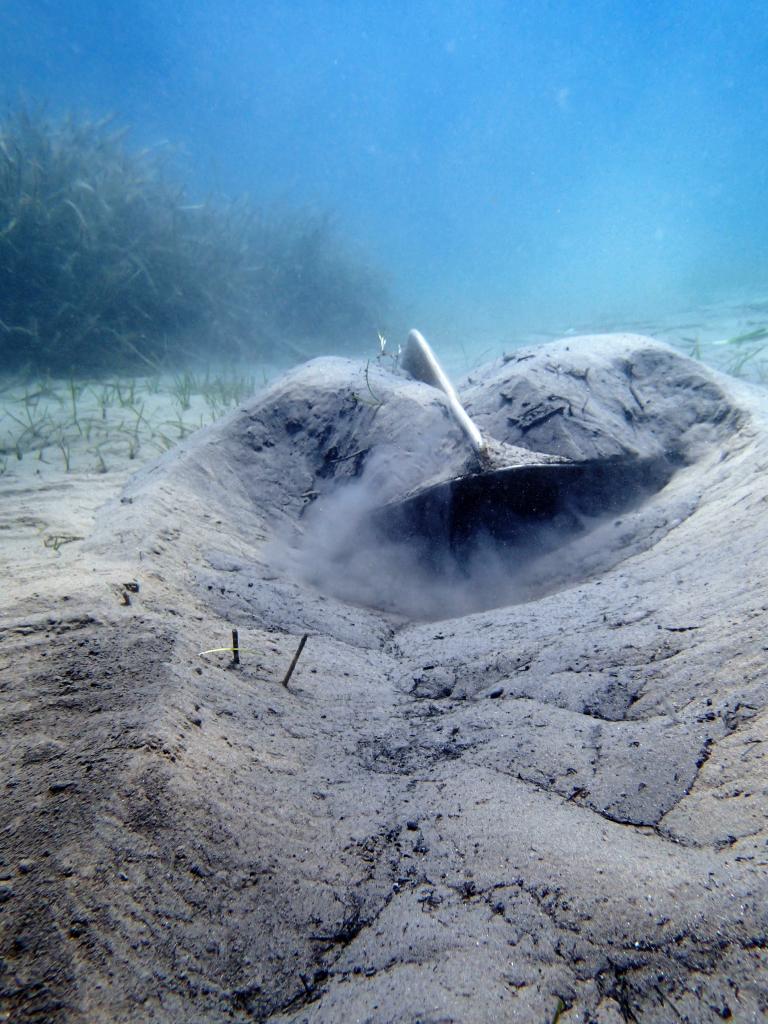
I have observed that some anchors, particularly the convex plow anchors in gusty conditions, have a tendency to twitch and often creep very slightly backwards without penetrating any deeper with each gust. Most owners do not notice. The total movement is often not enough to alert to them that there is a problem.

However, it is a sign that the anchor is under stress and these slow small movements are often followed by the normal fast drag everyone is familar with.

This happens much less often with concave anchors, but can occur if the anchor is really struggling, such as this Ultra at a short scope.
You can see the puffs of sand being thrown up as the anchor twitches:

img_1588264_0_aa0c4685912cda99f33f1d1f43cf8f5b.jpg


If you see or feel this, certainly do something about it. The anchor needs some help such as more scope.
 
Sorry Noelex,

There is no difference in the twitch of a Spade and an Excel - its the chain that imposes the twitch - the anchor just reflects what the chain is doing.

Both, or either simply dive further.

You need to move with technology and design and stop looking at the older models - many of us have moved on.

There is no difference - I have tested both.

I recall Vyv mentioning that his anchor, Rocna, also twitches.

Jonathan
 
Sorry Noelex,

There is no difference in the twitch of a Spade and an Excel - its the chain that imposes the twitch - the anchor just reflects what the chain is doing.

Both, or either simply dive further.

You need to move with technology and design and stop looking at the older models - many of us have moved on.

There is no difference - I have tested both.

I recall Vyv mentioning that his anchor, Rocna, also twitches.

Jonathan

Surely the important point being made by Noelex is that NG/concave anchors, in general, dig deeper with each twitch whereas plough/convex anchors do not? :confused:

Richard
 
Top