Anchor snubber- long stretchy rope or rely on catenary

Sorry Noelex,
There is no difference in the twitch of a Spade and an Excel - its the chain that imposes the twitch - the anchor just reflects what the chain is doing.

Jonathan, I understand your Spade anchor is a 7kg aluminium A80, which Spade recommend for catamarans less than 25 feet and less than 2T. You have a 38 foot cat.

Even when the wind is calm, your Spade is twitching because it is nervous :).
 
If the wind is not rising, the anchor should not be moving or twitching at all.

I have observed that some anchors, particularly the convex plow anchors in gusty conditions, have a tendency to twitch and often creep very slightly backwards without penetrating any deeper with each gust. Most owners do not notice. The total movement is often not enough to alert to them that there is a problem.

However, it is a sign that the anchor is under stress and these slow small movements are often followed by the normal fast drag everyone is familar with.

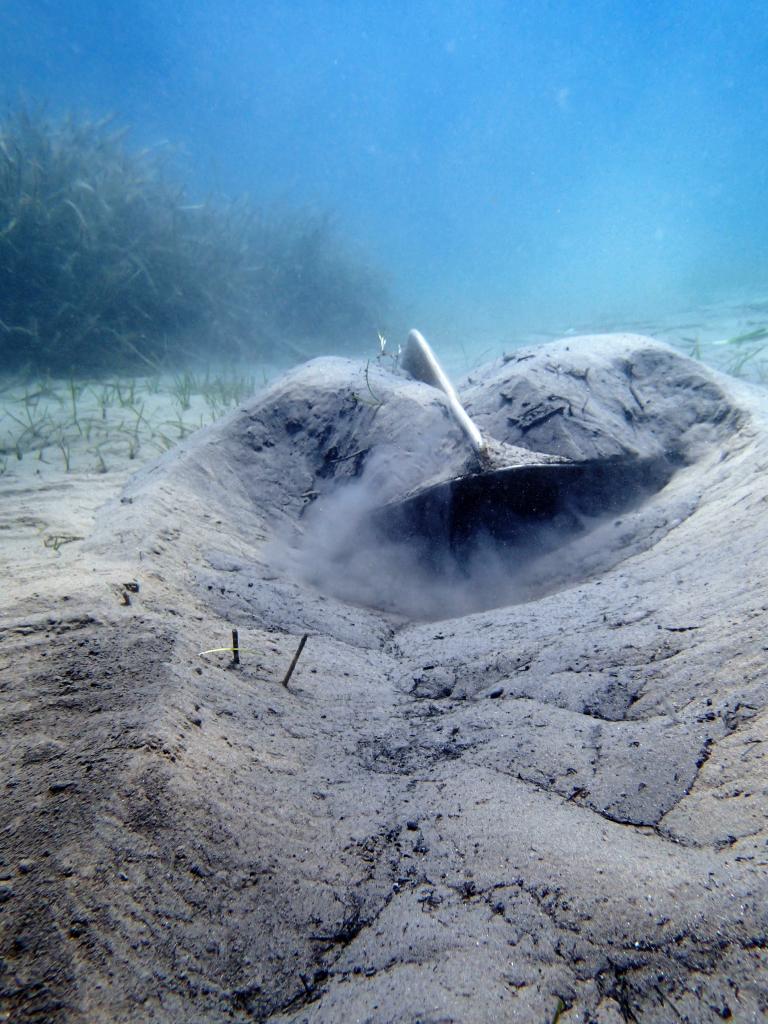
This happens much less often with concave anchors, but can occur if the anchor is really struggling, such as this Ultra at a short scope.
You can see the puffs of sand being thrown up as the anchor twitches:

img_1588264_0_aa0c4685912cda99f33f1d1f43cf8f5b.jpg


If you see or feel this, certainly do something about it. The anchor needs some help such as more scope.

BACKWARDS?
 
Jonathan, I understand your Spade anchor is a 7kg aluminium A80, which Spade recommend for catamarans less than 25 feet and less than 2T. You have a 38 foot cat.

Even when the wind is calm, your Spade is twitching because it is nervous :).

I think you need to get out into the real world.

And try the anchors, stop looking at them and guessing what is, or might be happening - try them

We have an alloy AND steel Spade - both X80, 8kg and 15kg respectively

We have an alloy AND steel Excel - both No4, 8kg and 15 kg respectively

We cannot tell the difference between the alloy and steel versions - and thus use the alloy models


The image you provide exactly replicates a shallow set anchor - about which you will know much more than most.

But then we actually don't know what your image represents - maybe an anchor being set, maybe an anchor being retrieved, maybe an anchor that has lost its ballast.

Jonathan
 
The effect of impulses on the anchor are effected by several more things, some of these potentially more important than the anchor design:
* Is the soil type subject to liquefaction? This can happen with either sand or mud, depending on the make-up. The finer is worse and less cohesive is worse, so coral sand and light silt are troublesome, mineral sand and sticky mud less so.
* How long is the rest period between pulses? If it is >10 minutes, the soil will generally consolidate and the anchor will go deeper. If it is <1 minute, the anchor hold will be weakened and it will probably just drag level or even rise.
* Is there a change in direction? A straight gust with more than 10 minutes rest is generally good. A shift or yawing, is generally bad, since it unsettles the soil, even if greater than 10 minutes.

I've tested some of this. It is much studied by civil engineers.

---

Re. V-anchors, one rode is probably rope and the other chain... just to make it more complicated. One is probably NG, the other is probably a Fortress.
 
On reducing shear strength through, twitching, or movement of the chain with a Fortress. I have not tried a Fortress alone but when anchored in a 'V' - and yes one rode is all chain (usually with a bridle) and the other is some chain and mostly rope, 3 ply nylon (and the Fortress is on the mixed rode). But the articulated shank of the Fortress seems to 'mask' some movement of the rode itself as the shank can move both vertically. when the rode might be thrashing the sand, and to a lessor extent horizontally.

The deeper you can set you anchor, and have chain buried - whether in a 'V' or, any, single anchor - the twitching is reduced - as the movement of the chain is cushioned by its burial in the sand (and this is true for chain that is thrashing or moving side to side as a result of yawing).

Both a deep set anchor and anchors in a 'V' (ideally also deep set) have reduced twitching. A snubber/bridle reduces the effects even further. I'm not sure of the mixed rode - the rode is less elastic than a snubber (but better then all chain no snubber). I'd need to do further twitch measurement.

Unfortunately old gen anchors, CQR, Delta, Bruce tended to resist deep setting and chain burial - which may contribute to their propensity for dragging. New gen anchors can also be shallow set, for a variety of reasons, - focus on trying to bury the chain, if you have buried chain the anchor is well set. On an engine set we would normally have a minimum of 1m of chain buried.

Thrashing of the chain on the seabed can be due to wave action, the bow lifting and falling and/or the yacht moving back (with a gust) and forward (in a lull and the catenary/snubber 'pulling' the yacht forward) and a combination of catenary/waves. You can commonly see the impact of thrashing as the chain marks the sand like a fan (also indicating you have also been yawing).

That fan pattern in the sand simply underlines there are both a constant horizontal and vertical forces imposed on the shank end causing twitching. Taking Thinwater's comments on board - next step - measure frequency!

Any anchor shallow set, including NG anchors that are lightly set, are going to be more susceptible to twitching. As Thinwater suggests they may dive more deeply - if the twitching is accomodating - but it is not guaranteed. Power setting, bury the chain, is the best you can do, do it!

Jonathan
 
Jonathan, You'll have to come over and instruct my (genuine) Bruce to stop burying, because I can assure you that it does. Evidenced not by diving on it :D but by its behaviour on retrieval. On second thoughts, please don't discourage it.

Re "twitching", if as you say, Fortresses are immune to this because of their articulation, presumably CQRs are also exempt. :D
 
Jonathan, You'll have to come over and instruct my (genuine) Bruce to stop burying, because I can assure you that it does. Evidenced not by diving on it :D but by its behaviour on retrieval. On second thoughts, please don't discourage it.

Re "twitching", if as you say, Fortresses are immune to this because of their articulation, presumably CQRs are also exempt. :D

I confess to not be an expert on Bruce.

Strangely Norman, I had exactly the same thought - if a Fortress shank does not transmit twitching to the fluke (because of the hinge) the same should be true of a CQR. The conclusion would then be that a Fortress and CQR should be similarly stable.

But in my experience it is easier to bury the fluke of a Fortress fluke, but less easy (but not impossible) to bury a CQR fluke. A shallow set anchor would be less stable, anyway. I am aware though that many have survived some memorably strong winds (and continue to swear by their anchor) - so maybe CQR do bury (more readily that I think) and the articulated shank is an unrecognised asset.

Jonathan
 
That fan pattern in the sand simply underlines there are both a constant horizontal and vertical forces imposed on the shank end causing twitching.

You can see some beautiful fan patterns in the sand. No twitching necessary. The patterns in sand show a history of what has happened. In this case that shows a photo of my Mantus anchor, the marks indicate a 90°+ change of wind direction

su7T107.jpg


Note the apex of the triangle, or fan, should not be located behind (towards the fluke) of the anchor chain attachment. This photo of a convex plough anchor shows an example of that occurring. It means the anchor has moved. Movement is not want you want from an anchor.

1Jcc3q2.jpg
 
Last edited:
You can see some beautiful fan patterns in the sand. No twitching necessary. The patterns in sand show a history of what has happened. In this case that shows a photo of my Mantus anchor, the marks indicate a 90°+ change of wind direction

su7T107.jpg

From the 2 photos both anchors have clearly dragged, with the one below having dragged further (we can't see how far because it is out of shot).

What we can tell is that this was a drag on setting the anchor, not the subsequent response to wind changes, as the fan shape would be visible around the drag mound if the anchor had moved after setting, and it isn't.

So both anchors holding equally well once set (but there could be differences in conditions and sand etc.), but one which clearly set in a much shorter distance (maybe better technique, maybe better anchor).
 
Yes, the concave rollbar anchors set very quickly, especially the Mantus.

It is hard to believe the anchor has become this buried in such a short distance, but this is a typical performance from this anchor.

kUslC0X.jpg
 
So many variables. Some anchors, in some sands, the shank is wide enough to prevent sideways twitching. There are several areas like that which I frequent. In soft, non-cohesive silt, not so much; the anchor wiggles, and what happens next depends on scope and the anchor type.

This may be the most anchor + soil dependent behavior. A testing nightmare, explaining the total lack of data (that I can find). I did some straight line pulse testing, but not with yawing in the mix.

This is one of those sub-topics where we all need to be careful about generalizing.
 
You can see some beautiful fan patterns in the sand. No twitching necessary. The patterns in sand show a history of what has happened. In this case that shows a photo of my Mantus anchor, the marks indicate a 90°+ change of wind direction

su7T107.jpg


Note the apex of the triangle, or fan, should not be located behind (towards the fluke) of the anchor chain attachment. This photo of a convex plough anchor shows an example of that occurring. It means the anchor has moved. Movement is not want you want from an anchor.

1Jcc3q2.jpg

The problem is we are not comparing like with like. The seabed is clearly different, the quality of the image shows that with some precision. The plough anchor may be a nefarious copy. The plough anchor may have been set on 'too' short a scope, causing the anchor to drag and then scope increased. The plough anchor may have been subject to 50 knots the Mantus 20 knot - there is no detail. This is a comparison of a design, maybe a copy, developed in the 1980's vs one in from post 2010. Did the plough have a decent snubber or was it an all chain rode. A better comparison would be 2 anchor set in the same seabed with the same care and attention and then subject to similar conditions. If you wanted to show excellence of one design over another - what sort of comparison would you show? To draw any conclusion given the differences and unknowns lacks any credibility - and is basically meaningless.

This illustrates the benefit of anchor testing where all of these variables and possible unknowns are defined. Anchor testing is not perfect but it offers a better mechanism for comparison.

But excellent photography - all credit. Why no up to date images?

But if the chains are marking that sort of 'fan' - the anchors are, or were, twitching - both up and down and sideways. Now that you know it merits some attention why not dive and check.

Jonathan
 
Last edited:
The problem is we are not comparing like with like. The seabed is clearly different, the quality of the image shows that with some precision. The plough anchor may be a nefarious copy. The plough anchor may have been set on 'too' short a scope, causing the anchor to drag and then scope increased. The plough anchor may have been subject to 50 knots the Mantus 20 knot - there is no detail. This is a comparison of a design, maybe a copy, developed in the 1980's vs one in from post 2010. Did the plough have a decent snubber or was it an all chain rode. A better comparison would be 2 anchor set in the same seabed with the same care and attention and then subject to similar conditions. If you wanted to show excellence of one design over another - what sort of comparison would you show? To draw any conclusion given the differences and unknowns lacks any credibility - and is basically meaningless.

This illustrates the benefit of anchor testing where all of these variables and possible unknowns are defined. Anchor testing is not perfect but it offers a better mechanism for comparison.

But excellent photography - all credit. Why no up to date images?

But if the chains are marking that sort of 'fan' - the anchors are, or were, twitching - both up and down and sideways. Now that you know it merits some attention why not dive and check.

Jonathan

A couple of things - firstly that this sort of image is exactly what many of us see all the time as we dive - so I use that experience to say that the fans are not about the anchor twitching but the chain rising and falling as the angle of the boat changes with a wind shift and/or veering. That's why the few people left who still maintain that it's the chain that holds the boat have not seen a boats anchor even with long scope and a 10 knot wind - the chain will always lift slightly at the anchor and settle back.

Agree of course that this isn't a fair test in any way but it happens to fit in with my experience where I see my anchor (Delta) with a 2-3m groove before it buries and stops - it buries fairly quickly but as we slowly move up to full reverse it drags a bit further until it's deeper and solid. But when I see NG anchors around me buried (boats often anchor too close) they have far shorter setting distances in the same sea bottom.
 
As the chain lifts and falls it causes the anchor to twitch.

Just put your finger on the anchor as the chain moves, you will feel it.

If you don't feel like diving - take a long a length of chain you can handle. Suspend between 2 points with as little catenary as you can manage. Get someone to wiggle, pull it back and forth and wiggle from side to side one end, to simulate the chain lifting off the seabed - and you hold the other end.

I'm not suggesting old gen anchors set a quickly as new gen anchors - I am suggesting this is not comparing like with like. You suggest though your anchor takes a little longer to set - it does set.


There is a belief that modern anchors are reliable and can be trusted. This belief, to whatever degree, may cause complacency.

This might make sobering reading:

http://www.zerotocruising.com/every-cruisers-nightmare-total-loss

The cat wa using a correctly sized modern concave roll bar anchor. A number of people have tried to define exactly what went wrong - without success.

No anchor is perfect. Despite Noelex excellent catalogue of poorly set old gen anchor - he has not mentioned one yacht on a beach. Thousands of people still use old gen anchors (and before say 1990, Spade/Fortress they had no choice) , and swear by them - NormanS was underling the confidence he has in his old gen anchor in a recent post.

Don't be complacent, do not believe the consistent marketing story - new gen anchors do fail to meet expectations, yachts are lost.

As I mention sadly we do not know why this anchor dragged - it might have been educational to know.

I do not know if this recommendation is relevant to the above event, but it is relevant in general.

https://www.morganscloud.com/2015/03/18/anchoring-made-easy-vol-1-gear-the-right-anchor/

Jonathan
 
Last edited:
A bit of thread drift here, apologies

Noelex will be monitoring this thread but is simultaneously contributing to the thread on shackles on CF. Last I looked, long time ago, Noelex was not allowing PMs? so I'll use this medium to advise him.

http://www.cruisersforum.com/forums/f118/rated-anchor-shackle-brands-208292.html

Noelex you might like to warn the OP on CF that there are two completely independent brands of Titan shackle available in Australia - that look, ostensibly, identical.

There are Titan shackles from CMP and Titan shackles from Allan Marketing. Both are galvanised, both rated both Yellow pin, both similar specifications. I have not tested Allan Marketing shackles but have tested a number of CMP Yellow pin shackles, that have been well overstrength (so similar to the CMP Black Pin shackles I have wondered if they were simply different paint :) ). Whether the high strength is consistent - I have not tested them for some months (some of the results are in Practical Sailor articles)

http://titanlifting.com/product-shackles-bow-grade-s.shtml

My understanding is that Allan Marketing has registered the Titan name in Australia (hardly an unusual or original name for that sort of product) - I'm not sure how they view CMP with the similar name in a similar field).

Allan Marketing Group are a respected supplier of lifting components in Australia and have been around for a number of years. Ian Allan is well known in the industry having worked as a senior executive for an Australian chain maker and supplier of lifting component and winch.

Jonathan

edit - and both come from China. They might even come from the same factory - no idea
 
Last edited:
Top