Anchor setup for serious crusing - anchor size for 25 foot, 2 tons (4500 pounds) yachts

Status
Not open for further replies.
I was anchored in the Helford a few years back up past Frenchmans Creek and was holding a good 20 knots. This was sheltered compared to the main mooring area. I've also had nearly 30 knots in Poole harbour but had flat waters due to be close to the land.
I only anchor in order to get out of the wind. If it’s Westerly I stay on the mooring, Easterly I go across to St Just. Southerly then stay on mooring or go to Percuil and Northerly go to the Helford. South or West then up to Trelissick if not too crowded.
 
Last edited:
Yes I tend to use sheltered anchorages.17 kts is not sheltered.
It is here. We had 30kts last night a few times in out sheltered anchorage. It's all relative. Anchored behind a reef so we are sheltered from the sea but the wind has a 3000 mile open space to blow as hard as it likes?
We were in the same anchorage over Xmas and got over 40kts at night on three occasions. Several boats anchored here. Nobody dragged.
 
Last edited:
Yes I tend to use sheltered anchorages.17 kts is not sheltered.
There seems to be some sort of nomenclature conflict here. I understand a sheltered anchorage to be one where waves cannot enter given the prevailing wind direction. I have been in almost totally enclosed anchorages in winds of well over 40 knots.
 
There seems to be some sort of nomenclature conflict here. I understand a sheltered anchorage to be one where waves cannot enter given the prevailing wind direction. I have been in almost totally enclosed anchorages in winds of well over 40 knots.
My definition of sheltered is where you are out of the wind and the sea is calm. See #84. Plenty of places where I sail, Carrick Roads and the Helford.
 
My definition of sheltered is where you are out of the wind and the sea is calm. See #84. Plenty of places where I sail, Carrick Roads and the Helford.
I have anchored in the Helford to shelter from a summer storm. We saw 40kts at times. Sheltered compared to the 50kts in the open sea and big waves but definitely not out of the wind
 
I have anchored in the Helford to shelter from a summer storm. We saw 40kts at times. Sheltered compared to the 50kts in the open sea and big waves but definitely not out of the wind
Best to anchor in the Helford when there is North in the wind. Robin cove just east of Trebah beach is ideal. #84. Also east of Durgan. There is obviously shelter on the southern shore in a southerly but lots of waterskiing over there so not at all peaceful.
 
I am being picky, but not actually wanting to be argumentative but both of you, Norman and Vyv are saying that with a grooved bow roller the anchor can still arrive at the bow roller - inverted.

Can anyone advise what is the benefit of a grooved bow roller?

I confess I've never had a grooved bow roller so my boomerang was based on people with similar equipment to mine - a roller with a gentle 'V' as I assumed, totally erroneously, that the groove returned the anchor as it was deployed - right way round.

Bad research.

Jonathan
Like Vyv, I felt that a grooved roller would hold the anchor better when it was sitting on the roller. (The roller is about 4" broad, and nearly 5" diameter). It does.
I had also hoped that the groove would stop the chain from twisting. It doesn't, although it may discourage it a bit.
I would have loved to have a Bent Link on my previous big boat, but with the bow rollers about 8 feet above the sea, and a straight stem, meaning that the anchor had to be corrected while still below the surface, there wasn't sufficient distance between the bow roller and the windlass. It's not that easy turning a 140lb anchor with a poker, while hanging over the bow. ?
 
Occasional strong winds are unfortunately unavoidable when cruising areas around the UK, especially the northern latitudes.

The concept that poor ground tackle is fine because you can always escape these conditions is flawed. Sooner or later this notion will lead to grief.
Absolutely right. And the original poster of this thread is to be commended on being seamanlike and thinking about preparations in advance.
Perhaps people have forgotten the post on this forum less than 6 months ago, from July last year. Somebody on a “round UK” trip started a new thread on here specifically to complain about not being given space in Mallaig in strong winds. They expected, indeed demanded, being given a space - even after phoning ahead and being advised the harbour was full and to remain where they were.
When suggested they should be prepared to anchor the response was
……….. “I take the point about being able to anchor but it’s not so easy without local knowledge and with a gale on the way.”
As oft stated above, people should not venture into new waters if not confident about their equipment and ability to anchor “with a gale on the way”, and should not venture into these waters without suitable pilot guides - especially the excellent Clyde Cruising Club guides.
 
For a number of safety related questions on equipment a good place to start is the old MCA Blue code for yachts. Page 59 gives anchor spec's and chain size etc, but there are many other things to consider and most of the Code is a good starting point on equipment and safety. You can find a copy here https://assets.publishing.service.g.../uploads/attachment_data/file/835951/blue.pdf

I've coded boats and used this as a guide to what to look at and consider.
 
.
For a number of safety related questions on equipment a good place to start is the old MCA Blue code for yachts. Page 59 gives anchor spec's and chain size etc, but there are many other things to consider and most of the Code is a good starting point on equipment and safety. You can find a copy here https://assets.publishing.service.g.../uploads/attachment_data/file/835951/blue.pdf

I've coded boats and used this as a guide to what to look at and consider.
Interesting that using that recommendation the anchor would be undersized for my boat. It suggests a 21kg main anchor. The manufacturers recommendation for my boat is 30kg. The rope diameter for a kedge is recommended at 14mm. We carry 18mm. Not a great place to start then really. The coding se3ms to take no account of vessel weight or windage. Very poor
 
.

Interesting that using that recommendation the anchor would be undersized for my boat. It suggests a 21kg main anchor. The manufacturers recommendation for my boat is 30kg. The rope diameter for a kedge is recommended at 14mm. We carry 18mm. Not a great place to start then really. The coding se3ms to take no account of vessel weight or windage. Very poor


As I read it, it does;

Anchors
The anchor sizes given in Annex 5 are for high holding power (HHP) types.
When a fisherman type of anchor is provided, the mass given in Annex 5 should be increased by 75% but the diameter of the anchor cable need not be increased.
When a vessel has an unusually high windage, due to heavy rigging (e.g. square-rigger) or large superstructures, the mass of anchor given in Annex 5 should be increased to take account of the increase in wind loading.
The diameter of the anchor cable should be appropriate to the increased mass of anchor"

For my 1980's AWB, the anchor size recommended tallies with the recommended size from the Knox website just fine - but I don't have a boat with a large superstructure / deckhouse.
 
As I read it, it does;


For my 1980's AWB, the anchor size recommended tallies with the recommended size from the Knox website just fine - but I don't have a boat with a large superstructure / deckhouse.
There is no discrimination between a single deck powerboat or a sailing vessel. Is a sailing vessel unusually high windage. We have two masts but flush decks. Are we unusually high windage? Really open to interpretation.we aren't a square rigger?
 
I really appreciate all your comments. Due to mostly job limitations, we can 'only' have 4 weeks for the cruise. We plan to go from Essex (Blackwater River) along the South Coast, trying to reach the Isles of Scilly, maybe Milford Heaven. However, this is the perfect occasion to get used to anchoring. I am going to buy mentioned Epsilon Anchor, with some 30-40 meters of chain and nylon scope. The current Bruce with 20+20 will remain a secondary anchor.
 
'That'll do nicely!'

Come back sometime and tell us how you get on - especially your thoughts on the all-pervasive smell at 'Milford Heaven'...

:rolleyes:
 
Hi,
I am doing some reconnaissance regarding circumnavigating the UK. It would be spring probably, so we would be in Scotland in late April I guess. There is plenty of anchorages there but with possible storms, I need proper setup. I am thinking about 10 kg Delta anchor and chain... I know for the size of boat, 6 mm would be sufficient, but maybe 7 or 8 mm? But 6 mm is much lighter, with 8 mm chain I would have to have less (20, 25, 30? meters). I would like to pick brain of people who did that.

The Lewmar Delta is probably the most popular anchor in the UK, BUT you should carry a minimum of 3 anchors to allow a loss and cover different types of bottom.

My present set for a 27ft, (2 foot is rudder), alloy lifeboat is as follows:

15lb genuine CQR, (Lewmar make 2 versions, a genuine galvanised and a stainless version), for mud, light gravel and sand. 50m of 6mm chain.

4kg Danforth with 50m of 5mm chain. Secondary anchor that can be bent in a storm, BUT sets and resets faster than any other anchor design.

6kg Fishermans with 10m of 6mm chain and 100 ft rope rode. The admiralty pattern version is better than the very common steel bar one. For use in rocks and heavy weed.

4kg folding grapnel for a short scope stern emergency anchor.

I bad conditions I always use 2 anchors set at least 30 degrees apart, and unless I'm near the rocks use the CQR and Danforth. The CQR needs a longer scope than most other anchors, but it can't be bent.

If you are buying new anchors, it's a real good idea to stick to Lewmar ones, currently they make the CQR, Claw, (Bruce), Danforth, (Steel and alloy), Epsilon and Delta. Alas they don't make any grapnels or fishermans.
 
Last edited:
I really appreciate all your comments. Due to mostly job limitations, we can 'only' have 4 weeks for the cruise. We plan to go from Essex (Blackwater River) along the South Coast, trying to reach the Isles of Scilly, maybe Milford Heaven. However, this is the perfect occasion to get used to anchoring. I am going to buy mentioned Epsilon Anchor, with some 30-40 meters of chain and nylon scope. The current Bruce with 20+20 will remain a secondary anchor.
The Epsilon is a good anchor, BUT alas it has gained a reputation for rust. The Bruce is a good choice, and oddly enough is fairly OK in rocks, BUT worse than useless in any type of weed. Danforths are real cheap.
 
I appriciate the comment. Do you have any particular test in mind?
Don't pay any attention to tests unless they are done by the RNLI, USCG, Lloyds or ABS. Light anchors hold well, BUT bend or even brake. The RNLI boats carry the Lewmar Delta, Admiralty pattern fishermans, and the UK Spade, BUT the galvanising for that SHHP new generation anchor is no good. The USCG boats carry a Lewmar Claw, (Bruce), Steel Danforth and ships anchors, (Heavier unbendable version of a Danforth).
One test in the public domain that the RNLI did showed that the genuine CQR outperformed the Delta, although not by much. That's why Lewmar put it back into production.
 
Don't pay any attention to tests unless they are done by the RNLI, USCG, Lloyds or ABS. Light anchors hold well, BUT bend or even brake. The RNLI boats carry the Lewmar Delta, Admiralty pattern fishermans, and the UK Spade, BUT the galvanising for that SHHP new generation anchor is no good. The USCG boats carry a Lewmar Claw, (Bruce), Steel Danforth and ships anchors, (Heavier unbendable version of a Danforth).
One test in the public domain that the RNLI did showed that the genuine CQR outperformed the Delta, although not by much. That's why Lewmar put it back into production.
What? You have got to be kidding!
 
The Lewmar Delta is probably the most popular anchor in the UK, BUT you should carry a minimum of 3 anchors to allow a loss and cover different types of bottom.

My present set for a 27ft, (2 foot is rudder), alloy lifeboat is as follows:

15lb genuine CQR, (Lewmar make 2 versions, a genuine galvanised and a stainless version), for mud, light gravel and sand. 50m of 6mm chain.

4kg Danforth with 50m of 5mm chain. Secondary anchor that can be bent in a storm, BUT sets and resets faster than any other anchor design.

6kg Fishermans with 10m of 6mm chain and 100 ft rope rode. The admiralty pattern version is better than the very common steel bar one. For use in rocks and heavy weed.

4kg folding grapnel for a short scope stern emergency anchor.

I bad conditions I always use 2 anchors set at least 30 degrees apart, and unless I'm near the rocks use the CQR and Danforth. The CQR needs a longer scope than most other anchors, but it can't be bent.

If you are buying new anchors, it's a real good idea to stick to Lewmar ones, currently they make the CQR, Claw, (Bruce), Danforth, (Steel and alloy), Epsilon and Delta. Alas they don't make any grapnels or fishermans.
120kg of ground tackle on a 25' boat? Not for me thanks.
 
Don't pay any attention to tests unless they are done by the RNLI, USCG, Lloyds or ABS. Light anchors hold well, BUT bend or even brake. The RNLI boats carry the Lewmar Delta, Admiralty pattern fishermans, and the UK Spade, BUT the galvanising for that SHHP new generation anchor is no good. The USCG boats carry a Lewmar Claw, (Bruce), Steel Danforth and ships anchors, (Heavier unbendable version of a Danforth).
One test in the public domain that the RNLI did showed that the genuine CQR outperformed the Delta, although not by much. That's why Lewmar put it back into production.

We've been through this previously.

There is NO UK Spade. Its a French design and made in Tunisia

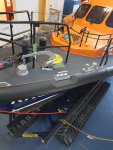
The RNLI have dispensed with Delta on the Shannon Class lifeboats and carry 2 Spade anchors, one on a bracket on the 'foredeck' and one is in a locker.

IMG-20220607-WA0008.jpeg

The new or current Lewmar CQR is manufactured, in China, completely differently to the original drop forged version, made in Scotland.

I understand that many, all? USCG boats carry a Fortress not a Danforth.

Jonathan
 
Status
Not open for further replies.
Top