Anchor setup for serious crusing - anchor size for 25 foot, 2 tons (4500 pounds) yachts

Status
Not open for further replies.
I think there is a lot of misunderstanding of the problem for the OP, perhaps because he introduced the idea of "serious cruising" and highlighted the west coast of Scotland as an area causing him concern about anchoring, which sets some off on their hobby horses.

He is not planning a 2 week cruise - and you can experience severe weather in most of the UK in any 2 weeks of the summer. To do what he wants will take 5-6 months of the summer if he adopts the most common day sails with the odd overnight strategy. As those who have done it will agree there are far more challenging sections than the 8-10 sailing days it takes to get down (or up) the west coast of Scotland, both from the point of view of weather and anchoring/berthing. In reality the only way of achieving it is to plan NOT to anchor, and it is the development of sheltered harbours all round our coast that actually makes it feasible to do it in a small boat in a typical British summer. Hence my remark that one would only choose to anchor in benign conditions as if the forecast is such that heavy weather is likely before you reach your next safe berth you stay where you are.

If you want to take a leisurely cruise, anchoring as much as possible then you need an entirely different plan - and take 2 or 3 summers to do it and how you kit your boat out (and indeed the type of boat you choose!) will be rather different. The OPs boat I suggest would not be the first choice for "serious cruising" - it is a light cruiser racer designed primarily for coastal cruising and club racing. It has very basic anchoring facilities. A small bow roller and a locker just behind with access from the deck for stowing the anchor and the rode, normally a 15lb CQR or Bruce with a mixed 6mm chain (1/4" when they were built!) and 10mm rope. More than adequate for 2 tonne low windage boat. I looked at one again today and there is no way you could easily deploy a 10kg Rocna. No anchor would stow on the roller and how would you get the anchor through the gap between the pulpit and the forestay? yachtsnet.co.uk/archives/sadler-25/sadler-25.htm Pretty sure it would not fit in the anchor locker either. Hence my suggestion right at the beginning of a 6kg Epsilon which is the size recommended by Lewmar. Confident that would hold his boat in the conditions in your last sentence - should he be foolish (or unlucky) enough to get into that situation.

If you want to understand the challenges the OP faces it really is worth reading concerto's account of doing exactly the same last summer. This is the summary forums.ybw.com/index.php?threads/round-britain-summary-of-the-trip-including-costings.588365/ and there is a link at the end to the full account. Note the lack of anchoring never mind in a gale! It is a pity that Daydreambeliever has not joined in here as he has done it more than once in a small cruiser racer - and he never anchors anywhere! A good friend of mine did it, although through the canal 4 or 5 years ago in a Contessa 27, 2 handed with his wife and dog. Took just over 3 months hard sailing and only anchored a handful of times.

It is possible for the OP to do this trip with his current boat, particularly if he has a strong crew that allows longer legs. As you will see Roger in Concerto took 54 sailing days, many of the very long, out of 127 days total but averages well over 5.5 knots. So a Sadler 25 might average 4.5 knots taking well over 70 days and overall probably 150-180 days total. The challenge from the boat point of view is how to equip it to maximise the chances of success and would suggest that the choice of anchor is very low in the list of priorities. Much more important in my view to concentrate on how to get the maximum performance under sail with gear that will last the course. Then a reliable engine as typically at least 25% of the time will be spent under engine. Finally domestic facilities that enable the crew to be as comfortable as possible - warm, well fed and rested when necessary. (Better not start on passage planning and choice of nav gear as that will open up another can of worms!)
Please remind me how many safe all weather harbours there are (especially in strong northerly winds) on the long stretch between Lochinver and Loch Aline on the NW coast of Scotland?
I and others are very familiar with Concerto’s route round Britain - not least as we met for a chat up as he passed through the NW.
But those of us who sail regularly up in the NW seem to be consistently of the view that, to do a round Britain trip:
- from a safety perspective it is imperative to be confident of your ability to anchor in adverse conditions as you may not be able to find a harbour of refuge and with space (often you can, but not always); and
- hopping from pontoon to pontoon can be done for most of the UK, but misses most of the best places.

A trip round Southern Britain, through the scenic Caledonian Canal is perhaps a different matter, and may be more suitable for pontoon hopping (eg Fort William to NI in three day hops) - but again if don’t turn right at Oban then missing the best bits.
 
Please remind me how many safe all weather harbours there are (especially in strong northerly winds) on the long stretch between Lochinver and Loch Aline on the NW coast of Scotland?
I and others are very familiar with Concerto’s route round Britain - not least as we met for a chat up as he passed through the NW.
But those of us who sail regularly up in the NW seem to be consistently of the view that, to do a round Britain trip:
- from a safety perspective it is imperative to be confident of your ability to anchor in adverse conditions as you may not be able to find a harbour of refuge and with space (often you can, but not always); and
- hopping from pontoon to pontoon can be done for most of the UK, but misses most of the best places.

A trip round Southern Britain, through the scenic Caledonian Canal is perhaps a different matter, and may be more suitable for pontoon hopping (eg Fort William to NI in three day hops) - but again if don’t turn right at Oban then missing the best bits.
Och now, just because we've been sailing in these waters for decades, doesn't mean that we know as much as someone who's read a blog written by somebody who passed through on one occasion. ?
I've sailed round the north half, rounding Muckle Flugga. Does that count as a "Circumnavigation"? ?
 
He is not planning a 2 week cruise
I am planning. to be exact, up to 2 months out on my Sadler. Circumnavigation of GB is 'big' goal, although it can be easily changed: we can reach Cornwall/Wales and decide that we would rather to go home, we might divert and take the channel in Fort Williams, or (shame) take the HIAB home.
Good thing about sailing clockwise is that from Essex, until I will reach Cornwall, we will know how well we can take 2 days' passages, there is plenty of pontoon moorings to stop and how fast we can go. If we reach Scotland (that the plan), we can see there what next.
But even for reaching Cornwall, my Bruce and 20 + 20 chain and scope is not enough, and as there is some probability of reaching Scotland, I would rather buy proper gear first. Hope for the best, prepare for the worse.
 
“But even for reaching Cornwall, my Bruce and 20 + 20 chain and scope is not enough, and as there is some probability of reaching Scotland, I would rather buy proper gear first. Hope for the best, prepare for the worse.”
Dump the Bruce and get one with a point. Whenever I see boats dragging around here (Cornwal) they have a claw type anchor. They were originally designed for oil rigs and to be sunk and embeded first. They fit around yachts’ bows nicely but are hopeless in weed.
 
“But even for reaching Cornwall, my Bruce and 20 + 20 chain and scope is not enough, and as there is some probability of reaching Scotland, I would rather buy proper gear first. Hope for the best, prepare for the worse.”
Dump the Bruce and get one with a point. Whenever I see boats dragging around here (Cornwal) they have a claw type anchor. They were originally designed for oil rigs and to be sunk and embeded first. They fit around yachts’ bows nicely but are hopeless in weed.

Most anchors are hopeless in weed. Don't think a sharp toe will improve performance much, some but not enough. If you think Bruce anchors were designed for mud then I'd have a look at the Fortress Chesapeake Bay anchor tests - few anchors offer any reliability in mud (except a Fortress - why else did they choose a mud location) and most anchors, basically, will not offer reliable hold - in thin mud.

The length of rode needed for anchoring does not vary much for the size of the vessel - if you are anchoring in 15m depth it matters not if your yacht is 25' or 50' you still need the same length of rode and use the same scope - the conditions are the same for both the big and small yacht. Arguably you can get closer to shore in the small yacht - but the waves tend to stand up more closer to shore and could be uncomfortable.

The difference is the size of chain you carry - and the size of the anchor (when considering the comparison of a 25' and 50' yacht). Both the big yacht and small can save weight by replacing some of the chain with rope - but if you might anchor where there are sand patches and rocks - then all chain is a better choice. The nice thing about a mixed rode and no windlass is that you can easily and quickly extend the rode. with more rope or a longer rope.

We use 15m of 6mm and 40m of 12mm 3 ply for our spare rode and it is easily managed in a dinghy and hand deployed or retrieved. Its easy to store in a milk crate, with spare shackles attached to the crate. Our anchors are bigger than needed for a 25' yacht and if steel would weight around 15kg - the aluminium equivalents are 8kg each. We have not tied to a pontoon nor been in a marina for at least a decade and would normally look to anchor in 5m depths (we draw 1m). We do carry sufficient spare cordage to run shore lines - which I note are not mentioned - by anyone.

Does no-one use shore lines?

Jonathan
 
Does no-one use shore lines?

Jonathan
Not where I sail and anchor Jonathan. I have long shorelines but they are for harbours and marinas when rafting.
With my shallow draft the average boat using shore lines when at anchor may mean that I snag them as I go into anchor ....
I should add that I have never seen shore lines being used when at anchor on the UK South Coast.
 
I think there is a lot of misunderstanding of the problem for the OP, perhaps because he introduced the idea of "serious cruising" and highlighted the west coast of Scotland as an area causing him concern about anchoring, which sets some off on their hobby horses.

He is not planning a 2 week cruise - and you can experience severe weather in most of the UK in any 2 weeks of the summer. To do what he wants will take 5-6 months of the summer if he adopts the most common day sails with the odd overnight strategy. As those who have done it will agree there are far more challenging sections than the 8-10 sailing days it takes to get down (or up) the west coast of Scotland, both from the point of view of weather and anchoring/berthing. In reality the only way of achieving it is to plan NOT to anchor, and it is the development of sheltered harbours all round our coast that actually makes it feasible to do it in a small boat in a typical British summer. Hence my remark that one would only choose to anchor in benign conditions as if the forecast is such that heavy weather is likely before you reach your next safe berth you stay where you are.

If you want to take a leisurely cruise, anchoring as much as possible then you need an entirely different plan - and take 2 or 3 summers to do it and how you kit your boat out (and indeed the type of boat you choose!) will be rather different. The OPs boat I suggest would not be the first choice for "serious cruising" - it is a light cruiser racer designed primarily for coastal cruising and club racing. It has very basic anchoring facilities. A small bow roller and a locker just behind with access from the deck for stowing the anchor and the rode, normally a 15lb CQR or Bruce with a mixed 6mm chain (1/4" when they were built!) and 10mm rope. More than adequate for 2 tonne low windage boat. I looked at one again today and there is no way you could easily deploy a 10kg Rocna. No anchor would stow on the roller and how would you get the anchor through the gap between the pulpit and the forestay? yachtsnet.co.uk/archives/sadler-25/sadler-25.htm Pretty sure it would not fit in the anchor locker either. Hence my suggestion right at the beginning of a 6kg Epsilon which is the size recommended by Lewmar. Confident that would hold his boat in the conditions in your last sentence - should he be foolish (or unlucky) enough to get into that situation.

If you want to understand the challenges the OP faces it really is worth reading concerto's account of doing exactly the same last summer. This is the summary forums.ybw.com/index.php?threads/round-britain-summary-of-the-trip-including-costings.588365/ and there is a link at the end to the full account. Note the lack of anchoring never mind in a gale! It is a pity that Daydreambeliever has not joined in here as he has done it more than once in a small cruiser racer - and he never anchors anywhere! A good friend of mine did it, although through the canal 4 or 5 years ago in a Contessa 27, 2 handed with his wife and dog. Took just over 3 months hard sailing and only anchored a handful of times.

It is possible for the OP to do this trip with his current boat, particularly if he has a strong crew that allows longer legs. As you will see Roger in Concerto took 54 sailing days, many of the very long, out of 127 days total but averages well over 5.5 knots. So a Sadler 25 might average 4.5 knots taking well over 70 days and overall probably 150-180 days total. The challenge from the boat point of view is how to equip it to maximise the chances of success and would suggest that the choice of anchor is very low in the list of priorities. Much more important in my view to concentrate on how to get the maximum performance under sail with gear that will last the course. Then a reliable engine as typically at least 25% of the time will be spent under engine. Finally domestic facilities that enable the crew to be as comfortable as possible - warm, well fed and rested when necessary. (Better not start on passage planning and choice of nav gear as that will open up another can of worms!)
I cant really agree with your premise Tranona. A number of folk who cruise the nw of scotland regularly have mentioned the need to be able to anchor safely, and that a harbour cannot be relied on. And that last bit is the important phrase. One cannot rely on finding a safe harbour with pontoon berths in that area, they may simply be full, or they may not be sheltered, no point in tying up to a tobermory pontoon in a northerly gale.
There are probably less than 10 marinas between the mull of kintyre and cape wrath, a cruising area as long as lands end to the solent. The solent alone likely has more marinas and sheltered pontoons than the entire scottish west coast. Just because Concerto raced down the westcoast of scotland from harbour to harbour doesnt mean it is always feasible to do so. He has a bigger faster boat and happily sails in strong winds. It is of course entirely possible to day sail around scotland from harbour to harbour, but it is not advisable to rely on being able to do so. The ability and the kit to anchor are invaluable in scotland, and allow one to see the best of it, as well as find the best available shelter in bad conditions. It would be entirely possible, and not even unlikely, to have all the other ducks you mention in a row and then fail because you had inadequate anchoring gear in scotland and were forcing yourself to try and make a harbour.
 
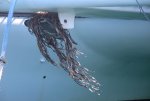
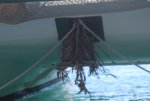
This is why a sharp toe is not the panacea hoped for when anchoring in weed.

The tow may penetrate between the weed but the shank will still collect weed, whether ribbon grass or other, and once you have a neat clump of grass round the shank - it cannot dive and give you the security you desire.

The option is straight forward, do not anchor in weed.

IMG_7557.jpeg

IMG_7571.jpeg

Jonathan
 
It doesn’t matter if the anchor collects weed when weighed. What counts is the fact that it set in the mud/sand and penetrated the weed to get there.
 
If I remember correctly, Eric Hiscock, in his "Cruising Under Sail", claimed that an anchor (presumably his preferred CQR) should weigh at least 30lb if it is to reliably penetrate weed.
 
Hi,
I am doing some reconnaissance regarding circumnavigating the UK. It would be spring probably, so we would be in Scotland in late April I guess. There is plenty of anchorages there but with possible storms, I need proper setup. I am thinking about 10 kg Delta anchor and chain... I know for the size of boat, 6 mm would be sufficient, but maybe 7 or 8 mm? But 6 mm is much lighter, with 8 mm chain I would have to have less (20, 25, 30? meters). I would like to pick brain of people who did that.

In answer to the final question - using 6mm, 7mm or 8mm you will still need the same length of chain. Size, or weight, will make no difference.

At 30 knots, given the amount of chain you can realistically carry, the chain will look as straight as a billiard cue whether it is 6mm or 8mm (and you can replace catenary with elasticity, a mixed rode or a snubber). 6mm will be more than adequate in terms of strength.

The decision you need to make is what length of chain? Its easy to extend the total rode (with more textile).

Which anchors (plural) and what size is independent of the chain length.

Jonathan
 
Anchor threads on here go back years and are subject to derision, agreement, laughter etc.
My own view FWIW..not a lot on here…is that the chain is more important than the anchor in many conditions.
My 28 ft 9 ton boat has a 10kg Delta and 10mm chain. I have an anchor buoy on a pulley system that always sits above the anchor. I can see where the anchor is and in most cases the boat sits to the chain and only gets to pull on the anchor in a blow.
 
If I remember correctly, Eric Hiscock, in his "Cruising Under Sail", claimed that an anchor (presumably his preferred CQR) should weigh at least 30lb if it is to reliably penetrate weed.

A 30lb anchor will not penetrate weed, sand or mud if tension is not applied to the rode.

I think you will find that many use Fortress anchors of a weight factorially lighter than 30lb with success, but NOT in dense weed. You will also find that those with Fortress anchor heavier than 30lb - are unable to have them penetrate weed.

Our aluminium Excel, 8kg and our steel Excel 15kg, same dimensions, set similarly and develop the same hold whatever the sea bed - and blind fold - you cannot differentiate. Our aluminium and steel Spades have the same characteristics - but the sharper toe of the Excel is advantageous. In dense weed 'even' the Excel cannot be relied on.

Its design NOT weight.

Jonathan
 
Most anchors are hopeless in weed.We do carry sufficient spare cordage to run shore lines - which I note are not mentioned - by anyone.

Does no-one use shore lines?

Me.

But then - I can tie knots.

And pick the right kind of trees.....
 
Anchor threads on here go back years and are subject to derision, agreement, laughter etc.
My own view FWIW..not a lot on here…is that the chain is more important than the anchor in many conditions.
My 28 ft 9 ton boat has a 10kg Delta and 10mm chain. I have an anchor buoy on a pulley system that always sits above the anchor. I can see where the anchor is and in most cases the boat sits to the chain and only gets to pull on the anchor in a blow.

I love it!

Someone can be relied upon to come up with this - every time.

Beggars belief.

At 17 knots (is that a bit of a blow?), a 5: 1 scope and 30m of 8mm chain deployed - all the chain is off the seabed. How, precisely is the chain offering any hold - sticky water?

This is a simulation (same numbers as above) , in air, the link furthest away is just 'kissing' the concrete and the tension on the load cell is similar to that developed in 17 knots. I accept not 10mm chain (I don't have enough)
Presentation RPAYC Extract.001.jpeg

Jonathan
 
Last edited:
I love it!

Someone can be relied upon to come up with this - every time.

Beggars belief.

At 17 knots (is that a bit of a blow?), a 5: 1 scope and 30m of 8mm chain deployed - all the chain is off the seabed. How, precisely is the chain offering any hold - sticky water?

Jonathan
Yes I tend to use sheltered anchorages.17 kts is not sheltered.
 
Status
Not open for further replies.
Top