
Tamar
Well-Known Member
I can't, it was a long time ago and our parachute drogue was a liability so we chucked the crate over on a long line. Worked a treat. Remove beer/ milk first of coursePost the testing.

I can't, it was a long time ago and our parachute drogue was a liability so we chucked the crate over on a long line. Worked a treat. Remove beer/ milk first of coursePost the testing.

We are talking beefy UK milk crate, 24 British pint bottles with strong solid barriers between each bottle. A long way from a modern flimsy thing for half a dozen cans.Post the testing.
The anchor on the right is a small stock less anchor as used In bigger versions by ships. I imagine this one was off a workboat. Ships rely on the chain to anchor them, unlike yachts and small craft. The stock less anchor secures the end of the chain. IT DOESNT WORK IN SAME WAY AS A YACHT ANCHOR. Why do t yachts use this technique. Because the size is all wrong. (Go and research it.)Wow, the ships anchor on the right is a real good unbendable, unbreakable storm anchor, that would even function well in mud. If it was in Dorset or along the coast to Southampton area, I might consider making an offer, BUT only if 2 fit chaps can lift it. It could sell as a first class display item after about half a days wire brushing and Zinc primer, with a final couple of coats of Bronze paint.
The one in the middle looks lighter, but is a design that is not so good in mud or sand, as the 2 flukes are rather narrow. The fishermans Hooker is past its use by date, so not of any real value, as it's not the only hooker around the yards!
The Spade is a good choice as a secondary main and a well used one would need the same wire brushing and paint treatment as the old ships anchors, although you would need both silver and yellow topcoats. 3 pots of International 2 component paint, (Steel primer, yellow and silver), will cost around 100 quid, plus VAT and shipping if required.
The Fortress alloy Danforth is a real class act in holding power per pound for mud and sand, alas a rock jam, or even a serious 90 degree veer when set well into hard mud will result in the need for a second one, so it's are real good idea to carry a second one. The lifetime warranty is of no use, as it excludes bending, as do all of the modern new generation anchor warranty terms.
If you comment on the CQR, please post pictures of both sides of the shank, as the vast majority of CQR anchors are either old rusty cast Iron ones, or bad copies that do not have the same weight on the nose as a genuine STEEL CQR.
Oyster yachts are now fitting the new Lewmar stainless CQR as a main storm anchor for their cruising yachts, with an Lewmar alloy Danforth as secondary main. The owners can select a steel Lewmar PGX Danforth if they are concerned about bent anchor issues. The Oyster 69 I sailed may years ago had a genuine stell CQR as main, so it's interesting to see that they are continuing to use the very best anchors available. Owners can select a third anchor from a list of Lloyds/ABS approved anchors, although I'm not sure which deep water fishermans has that approval. The Herreshof or Oscillati Admiralty pattern fishermans might have an approval.
The Oyster design and production team, the anchor experts at Lewmar and of course myself, know nothing about anchors or anchoring system, and none of us have the slightest clue about how useless some cheap mild or stainless steels are. Last time I said the probably cause of an incident that had resulted in a dismasting of an oldish Oyster 72, was that the main spreader stainless steel thru bolt end nut had been replaced with one from a chandlery in London, and that the cheap Chinese nut had not been annealed or treated in any way, I got thrown out of their office and called a clueless idiot!


We are talking beefy UK milk crate, 24 British pint bottles with strong solid barriers between each bottle. A long way from a modern flimsy thing for half a dozen cans.
Yay! Can we talk about why you, your testing regime, your chosen examples and your recommendations are completely wrong - for the NEXT 20 pages?I would love to see a pic. Not a thing in the US in the past 50 years. Became obsolete at that time. I vaguely remember them. But they were big and cumbersome and should work if properly weighted, depending on the boat size.
Though I can't imagine why I would have a milk crate with bafles on a boat, since it serves no other logical purpose, other than holding milk bottles. The ale and other bottle goods go in the bilge in defined spaces.
A parachute drogue is all wrong for steering, and probably for any reason on a mono. They are not sold for those purposes in the US. Possibly for parking a multihull, but it needs to be BIG for that purpose, about 1/2 the length of the boat. A parchute drogues are not useful for speed limiting; too much drag, not stable at speeds about 2-3 knots, and not stable if used near the surface (steering for example). Either turbulence devises (Gale rider, fender/anchor, or even milk crate) or balute drogues (Shark, Sea Brake, Delta Drogue) are much more suitable. I've tested all of these, and the Gale Rider is the best for steering because it is the most stable near the surface and has the greatest range of drag adjustment.
Yay! Can we talk about why you, your testing regime, your chosen examples and your recommendations are completely wrong - for the NEXT 20 pages?
Preferably with lots of baseless drivel repeated ad nauseum? It just wouldn't feel right otherwise.
Yay! Can we talk about why you, your testing regime, your chosen examples and your recommendations are completely wrong - for the NEXT 20 pages?
Preferably with lots of baseless drivel repeated ad nauseum? It just wouldn't feel right otherwise.


It's been published in several sailing mags. You can find it.
I would be the first to say that solutions vary by boat, boat type, and conditions, and that practice is required. Anything anyone says can be all wrong in a different day or in a different place. Like strong weather sail trim; it's a skill that must be practiced. Like anchor testing, there is no one best answer, but there are trends and a few things that can be measured. And like anchors, it's clear that poor anchors can be made to work, and that some are superior.

No, but I have used a metal milk crate as a television aerial ?Anyone used a plastic beer crate as an anchor?
Can we please keep the thread on topicNo, but I have used a metal milk crate as a television aerial ?
but as there has been some drift - we watch using an iPad, no need for a milk crate aerial.
Is it only me who thinks that if you have to worry about the speed at which you’re applying full rudder, then there’s something wrong with your seamanship and/or sailplan. Why have you allowed the situation to deteriorate to such a degree? If you and the boats survival is dependent on applying full lock very quickly, somethings gone wrong somewhereOFF TOPIC
If you are concerned about a steering failure, look up how to convert wheel steering to tiller.
For most yachts under around 50ft LOA, wheel steering is a mistake. In heavy weather it takes far too long to apply full rudder, wheel pilots are expensive, wheels clutter up the cockpit and worst of all have a nasty habit or failing. For serious offshore sailing, I always carry 3 electric tillerpilots, one to use, one spare and one in the post for a warranty claim. The main reason designers select a wheel pilot rather than a tiller, is that most owners drive a car or truck.
My last yacht I did a single handed circumnavigation in had a Hydrovane that can be used as an emergency tiller, alas it's a bit too big and rather expensive for a small boat under around 30 ft. Below that figure I would recommend the Navik I fitted to my first yacht, a 24ft Pacific Seacraft Dana.
Is it only me who thinks that if you have to worry about the speed at which you’re applying full rudder, then there’s something wrong with your seamanship and/or sailplan. Why have you allowed the situation to deteriorate to such a degree? If you and the boats survival is dependent on applying full lock very quickly, somethings gone wrong somewhere
Whilst the fashion for wheels in smaller and smaller boats is something I worry about, above about 36’ LOA a wheel is often desirable or even essential.
Far better it for me to question someone’s ‘round the world in a small boat’ experience, but…
To the OP. Buy a modern generation anchor in accordance with the manufactures guidelines for your boat and plenty of tested and certified chain. Job done. PS there are much better anchor’s available than a CQR (even a new one from Lewmar) no matter what some people claim in boating websites.
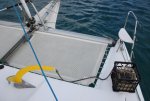
This is a milk crate, the cubic device on the near right.
View attachment 150252
They come with standard dimensions, and are stackable. There are 2 versions. One like the one illustrated and the other version has dividers, I assume as they are (or were) used for glass bottles. They are tough, which is why everyone uses them to store things on a boat. You could lash 4 of them together - if you so desired. Our bow locker takes 6 of them, stacked 2 towers, 3 high. We use one of them for our spare rode, as illustrated (15m of 6mm and 40m of 12mm 3 ply). We attach spare shackles to the obvious locations on the crate.. As far as I am aware the crates are identical whether they come from the UK or Oz (and see later - the US). If you go into a hardware store in Oz you can buy solid ones, without any holes - in which you can store small items (like Lego) and are sold to store whatever - children's toys. They are to the same dimension but less robust.
When I was at school I used to deliver milk. 2 hours every morning. I ran competitively and we delivered at the run. It was excellent exercise. We had milk crates then but they were galvanised steel, to the exact same, or similar, dimension as the plastic ones now. This was late 60s. So plastic crates came in later. We actually delivered the milk in long crates holding 6 pints each side and ran with one long crate in each hand.
Milk delivery, the milk man and milk boys were killed by the supermarket - but milk still comes in 1l plastic bottles and various other sizes, 2l, 4l
Milk cates are manufactured for major players and are embossed into the sides with warnings that the crates are the proper of XYZ Ltd and misuse will result in penalties etc. No-one takes a blind bit of notice.
Every tradesman will use them to store his tools in his ute aka pick up.
Oddly - you never see broken ones - they last for ever.
I vaguely recall someone using one or a number for steering when they lost their rudder (or whatever). There may have been a article in PBO. I recall being told of one bright spark who built his own yacht and designed is lockers round the dimensions of milk crates.
If milk had never existed the sailing industry would have designed something like a milk carte - they are so useful (makes a marvellous low step when antifouling) - and indestructible.
Jonathan
Edit, you can even source them in America.
One of the many designs on this webpage look identical to the one in my photograph.
MILK CRATES - Plastic Crates For Sale | Buy Direct & SAVE
They would make excellent drogues (or whatever) as they are perforated, indestructible, have plenty of attachment points, you will have them on your yacht anyway. You would need to conduct a few trials to find out which and how many attachments points you would need to use and how many you would use to achieve your desired aim. The main attraction is they are on free loan as you will be returning them to the rightful owner.
Sorry but I do not have a close up of a crate - it never crossed my mind there would be a question - to me they are ubiquitous. Note to self - must do better. Second note to self - in my next life do not take an interest in anchors.
J
 ).
).I suspect that the Fortress will get bent fairly quickly in a rocks or heavy debris field. So the final test might be with the UK Spade on one side and the Excel on the other.