Anchor setup for serious crusing - anchor size for 25 foot, 2 tons (4500 pounds) yachts

Status
Not open for further replies.
I currently have 3 plastic milk crates on my commercial passenger boat. Two are used on deck to hold stuff in and one is in the engine room currently being used as a seat I think, saves the old knees when servicing the engine.
 
I should have asked this 19 pages ago…

I intend replacing the Bruce anchor that came with my “new to me” boat, probably with a 6kg Epsilon and 6mm chain.

The boat has no windlass. Considering the views on catenary and scope expressed in this thread and elsewhere with regard to modern anchor designs, what would you consider the minimum amount of chain for a mixed rode?

The boat also came with a Fortress FX7.

Clyde to the Sound of Mull area, 23’ boat, 1.25 metric tons displacement.
 
OFF TOPIC
If yer want to trash a forum in both practical and reputation terms, the best way to do it is with a whole bunch of off topic posts that make it near impossible for a visitor to that thread to read more than the first or last page. There is nothing wrong with off topic posts, but they should be clearly marked as such.

If you look at the top bar of options, the 6th droplet symbol allows you to select a different colour, and the 8th T plus the arrow symbol allows you to select the font size. If you put an OFF TOPIC warning in a reply, put it above the quote marks, as that makes it possible to avoid reading the quoted text.

In general the last 20 pages have been so bad that if some boat owner interested in learning about anchors or finding out what boaters are using for serious cruising, they would not only not read the 20 mostly useless, off topic or incorrect replies, but would be inclined not to bother visiting the YM forum again.

When the replies havebeen on topic, some are just the very common rude or totally daft responses that indicate the poster is either half drunk, or has never used an anchor in a seriously difficult situation as regards bad holding, good holding but with debris, subject to swell or direct wave action from some wind directions, (Big issue in the Pacific or Capes Verdes, as most anchorages are not fully enclosed).

As regards daft replies, this extract of a very recent one is truly nuts and potentially dangerous if you are buying new anchors:
"To the OP. Buy a modern generation anchor in accordance with the manufactures guidelines for your boat ---"


For legal reasons most boat manufacturers do not publish any guidelines about which anchor to use. Very few include more than a one anchor and rode, although the manufacturer of the very first yacht I purchased did sell new ones with 2 anchors in 2 anchor lockers, one at the bow and one at the stern, (Unless you paid the extra for a twin anchor setup for the bow). Pacific Seacraft have an awesome reputation for designing and building serious offshore yachts, so the smaller PS 21, 24, 31 and 34 were sold back in the 80's until very recent times with a genuine steel CQR and a steel Danforth. When the CQR went out of production, they changed to supplying a good copy in the form of a West Marine plow. The steel Danforth was also a WM version.

Most of the new generation or modern modified copies of current or old designs, the Lewmar Delta, Brugal and Danforth in particular, are worse than useless for anchoring in a storm or difficult holding ground like cobblestones, heavy gravel patches, rocks or heavy weed. The bent shank and broken Chinese bolt risk is a no go, and the 180 degree veer test failures that resulted in formal applogies for publishing incorrect articles from several major magazine, was disturbing, as it indicated that most yachting mags are just publising such artilces to help their advertising customers sell more modern anchors. 90% of the published test were of no real use including the recent tes of the Lewmar Epsilon, parlty because they don't repeat test at least 3 times to get both an average and a variance figure. The variance for tests in cobblestones or rocks would be high, as you would get a different response each time, until you try an anchor that was designed for such seabeds, like one of the fishermans anchors.

If anyone was interested in testing anchors for storm use, then once they have ruled out any anchor that bends too easily, they should test in pairs, as using just a single anchor in bad weather is far too risky, paricularly if the holding is Iffy or there is any risk of debris.
I dout if you will beat the performance of a Lewmar Delta, (Or Lewmar CQR), AND a Lewmar PGX steel Danforth set 30 degrees apart. If you don't like Lewmar products for some reason, Force 4 and West Marine make copies of both types.
A test of an Excel or UK Spade and a Fortress of the limiting size in a variety of seabad types would be interesting. Both anchors seem to work well, but the big question is how easily are they bent. I suspect that the Fortress will get bent fairly quickly in a rocks or heavy debris field. So the final test might be with the UK Spade on one side and the Excel on the other.

Are you familiar with the work of Dunning and Kruger? It might help.
 
I should have asked this 19 pages ago…

I intend replacing the Bruce anchor that came with my “new to me” boat, probably with a 6kg Epsilon and 6mm chain.

The boat has no windlass. Considering the views on catenary and scope expressed in this thread and elsewhere with regard to modern anchor designs, what would you consider the minimum amount of chain for a mixed rode?

The boat also came with a Fortress FX7.

Clyde to the Sound of Mull area, 23’ boat, 1.25 metric tons displacement.

We use 15m of 6mm and 40m of 12mm 3 ply. 38' x 7t cat. I cannot say it is the optimum but we have not had any issues. Modern anchors, includes your choice, will engage and set without any chain at all if you do not try to set with your yacht moving quickly. However the rode nearest the anchor can suffer from abrasion, as it is likely to be on the seabed - and 15m 'seems' about right. When I'm testing quite often use only 30cm (1') of chain and the rest textile - modern anchors are not challenged.

Our chain to rope is a simple eye splice (and shackle), not a long splice.

15m of 6mm does not weight much and you will not find hand deployment and retrieve onerous.

If your local chandler sells Rocna/Vulcan anchors or CMP Titan chain they should also sell Titan Black pin shackles. These shackles are better than 'standard' shackles and better than Titan Yellow pin shackles - but not as good as Crosby shackles. But Crosby does not make sizes smaller than 3/8th" and the Black pin are your best bet.

When you buy your chained anchor check which shackle actually fits both, bow through anchor slot, pin through chain link.

This yacht uses 6mm chain and they have sailed from France, round Cape Horn to Australia and are currently in South Africa with a 'plan' to cross the Atlantic.
Resizer_16316682173575.jpeg

Jonathan
 
Can someone please tell me where I can buy a UK RNLI spade please.

Also the RNLI have never carried Danforth anchors on any of their fleet apart from the Waveney Class l
 
Thinwater - you are very unlucky to have had 'several' steering failures....? Or you are very old :)

Jonathan

The Chesapeake Bay is very shallow, contains a lot of submerged debris after the spring floods, and I've done a lot of fast sailing in very lightweight boats. With a slow sturdy boat in deep waters, probably none.

1. Bent rudder shaft of PDQ by striking submerged tree. Disconnected crossbar and finished cruise.
2. Stiletto. Universal failed on cross bar day sailing (hidden wear, poor design). Disconnected and sailed home.
3. F-24. Rudder cassette developed cracks that I noticed while swimming. Raised and motored home. Not technically a failure, but I wanted to eliminated further damamge. This is common condition of age with these boats and just developed.

My point was that these were not related to tiller/wheel choice.

And I am very old. Just ask my kids.
 
Only a neophyte would use a Fortress in rocks, they would jamb the flukes and destroy the ability of the anchor to reset in a change of tide/wind. Both Spade and Excel have been tested for shank strength - its does not need repeated.

Just check the tests in Practical Sailor. We carry both - no anchor is perfect - they compliment each other - it is not either, or. Similarly we also carry 2 x Fortress (FX16 and FX37) - the 4 models offer a decent cross section covering most seabeds. All are aluminium alloy - and we anchor in 'the Roaring Forties' using 6mm chain (38' cat x 7t) - I think our long term field tests are satisfactory.

Jonathan

In the real world of serious crusing, it's fairly common to finish up using what you know might be the wrong type of main or secondary in rocks or heavy weed, and the main reasons are lack of room in the main anchorage area forcing you to anchor in a greater depth or in an area with a seabed that is problematic. There are many other reasons why a crusier can finish up trying to anchor in bad holding or too deep for their normal main and secondary to function. In a real bad case it happens after they dragged, or because the rig or engine failed and they started to drift in a dangerous direction.

Practical sailor is a good mag, but they lack the time to repeat the tests often enough to be accurate in both average and variance terms. They also fail to use a baseline anchor as a standard to compare to. Oddly enough the Fortress, (Lewmar do make alloy Danforth style anchors), outperforms all of the new generation anchors in mud and sand in weight terms, and is just as good as any of them when compared in size terms, (Some boats can't use big light anchors due to mounting or storage issues).

If you anchor in an area with consistent trades or in the roaring Fourties, or even screaming 60's, it's very unlikely your anchor will be subject to 90 or even 180 degree veers that are a regular event in the tropics, due mostly to thunderstorms, or local valley winds. In the Western Pacific and Northern Caribbean you can also get dry cold fronts that cause a series of very interesting wind shifts before they finally pass. Very problematic in a crowded anchorage.

Questions: Which Fortress works best with a 2 to 1 rope rode ?? I know they do start to function as I've used a steel Danforth with a 2 to 1 rode after an engine failure in a canal, and which one is recommended for heavy weed or cobblestones ?? For a race or weight critical boats, the Fortress or Lewmar alloy Danforth are both very good choices, if you ignore the rocks and deep water short scope requirement.

Bent shanks are only part of the problem if you get forced into, or unintentionally use a weak anchor in rocks, wrecks or heavy debris. I've seen several alloy and even a steel Danforth with a shank that was straight, BUT one of the flukes was badly bent down before is was recovered. The alloy Danforth, (I did not get close enough to see if it was a Fortress or not), was missing one entire fluke. Not sure if the bolt had pulled out or it had failed due to metal fatigue. Oddly enough it was still functioning when recovered, although the conditions were good.

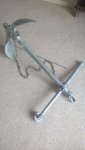
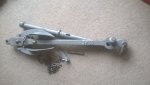
I always recommend that any boat that is involved in seroius crusing carry a fishermans anchor of some type and a real long rope rode or set of Panama canal lines tied together. The fully folding one I have is easy to store, but not really strong enough for a serious rocks and wrecks anchor. Pity I can't find a used Herreshof version.

I'm working on replacing the daft rusty steel chains that retain the cross bar locking insert and the main pin at present, but stuck waiting for some very small SS shackles that along with the chain prevent the pin or croos arm locking bar from being declared MIA.
 

Attachments

  • thumbnail.jpg
    thumbnail.jpg
    245.8 KB · Views: 3
  • Anchor 5 kg closed.jpg
    Anchor 5 kg closed.jpg
    190.5 KB · Views: 3
OFF TOPIC
If yer want to trash a forum in both practical and reputation terms, the best way to do it is with a whole bunch of off topic posts that make it near impossible for a visitor to that thread to read more than the first or last page. There is nothing wrong with off topic posts, but they should be clearly marked as such.

If you look at the top bar of options, the 6th droplet symbol allows you to select a different colour, and the 8th T plus the arrow symbol allows you to select the font size. If you put an OFF TOPIC warning in a reply, put it above the quote marks, as that makes it possible to avoid reading the quoted text.

In general the last 20 pages have been so bad that if some boat owner interested in learning about anchors or finding out what boaters are using for serious cruising, they would not only not read the 20 mostly useless, off topic or incorrect replies, but would be inclined not to bother visiting the YM forum again.

When the replies havebeen on topic, some are just the very common rude or totally daft responses that indicate the poster is either half drunk, or has never used an anchor in a seriously difficult situation as regards bad holding, good holding but with debris, subject to swell or direct wave action from some wind directions, (Big issue in the Pacific or Capes Verdes, as most anchorages are not fully enclosed).

As regards daft replies, this extract of a very recent one is truly nuts and potentially dangerous if you are buying new anchors:
"To the OP. Buy a modern generation anchor in accordance with the manufactures guidelines for your boat ---"


For legal reasons most boat manufacturers do not publish any guidelines about which anchor to use. Very few include more than a one anchor and rode, although the manufacturer of the very first yacht I purchased did sell new ones with 2 anchors in 2 anchor lockers, one at the bow and one at the stern, (Unless you paid the extra for a twin anchor setup for the bow). Pacific Seacraft have an awesome reputation for designing and building serious offshore yachts, so the smaller PS 21, 24, 31 and 34 were sold back in the 80's until very recent times with a genuine steel CQR and a steel Danforth. When the CQR went out of production, they changed to supplying a good copy in the form of a West Marine plow. The steel Danforth was also a WM version.

Most of the new generation or modern modified copies of current or old designs, the Lewmar Delta, Brugal and Danforth in particular, are worse than useless for anchoring in a storm or difficult holding ground like cobblestones, heavy gravel patches, rocks or heavy weed. The bent shank and broken Chinese bolt risk is a no go, and the 180 degree veer test failures that resulted in formal applogies for publishing incorrect articles from several major magazine, was disturbing, as it indicated that most yachting mags are just publising such artilces to help their advertising customers sell more modern anchors. 90% of the published test were of no real use including the recent tes of the Lewmar Epsilon, parlty because they don't repeat test at least 3 times to get both an average and a variance figure. The variance for tests in cobblestones or rocks would be high, as you would get a different response each time, until you try an anchor that was designed for such seabeds, like one of the fishermans anchors.

If anyone was interested in testing anchors for storm use, then once they have ruled out any anchor that bends too easily, they should test in pairs, as using just a single anchor in bad weather is far too risky, paricularly if the holding is Iffy or there is any risk of debris.
I dout if you will beat the performance of a Lewmar Delta, (Or Lewmar CQR), AND a Lewmar PGX steel Danforth set 30 degrees apart. If you don't like Lewmar products for some reason, Force 4 and West Marine make copies of both types.
A test of an Excel or UK Spade and a Fortress of the limiting size in a variety of seabad types would be interesting. Both anchors seem to work well, but the big question is how easily are they bent. I suspect that the Fortress will get bent fairly quickly in a rocks or heavy debris field. So the final test might be with the UK Spade on one side and the Excel on the other.

For legal reasons most boat manufacturers do not publish any guidelines about which anchor to use.


Who said recommended by the boat manufacturer? Anchor makers give guidelines about what size boat. Usually length/weight although some people argue windage cross section might be also be used.
eg Spade Anchor UK
Fitment Guide - Rocna Anchors

Lewmar don’t make a Danforth Anchor. They make a ‘Danforth style’ anchor. Be careful of your wording or the patent holder for Danforth might come knocking.

Stop making silly claims about new design anchor shanks bending easily. ALL anchor shanks will bend when abused. Even your beloved CQR one. You keep trotting out this nonsense as if it trumps all other arguments.

Your claim that modern designs are merely developed old designs reveals a stubborn inability to understand or comprehend what modern anchor designers have achieved. Many are a step change in holding power and resetting ability.

The old saw that it’s necessary/essential to use a fisherman’s style anchor in rock and weed is a myth. Some of the new generation anchors are excellent in rock and weed.

Obviously you are welcome to your opinions but with respect your blunt assertions that your advice is the only safe and correct solution is nonsense.

The answer to the OP is to carry a couple of anchors chosen in accordance with the anchor manufacturer’s recommended size for his/her boat. Best anchors: 8 new generation designs suitable for every boat - Yachting Monthly Add at least 50 metres of chain for the bower and 20 metres plus nylon rode for the kedge and he will be fine for where he’s going.

And for transparency: our 12 metre 12 tonne boat has a Spade anchor with 90 metres of 10mm chain as a primary anchor. The kedge is a Fortress with 30 metres of chain and 50 metres of nylon rode. We also carry an enormous amount of extra line that can be used in extremis. I sleep very easily at night when at anchor.
 
I should have asked this 19 pages ago…

I intend replacing the Bruce anchor that came with my “new to me” boat, probably with a 6kg Epsilon and 6mm chain.

The boat has no windlass. Considering the views on catenary and scope expressed in this thread and elsewhere with regard to modern anchor designs, what would you consider the minimum amount of chain for a mixed rode?

The boat also came with a Fortress FX7.

Clyde to the Sound of Mull area, 23’ boat, 1.25 metric tons displacement.


10 to 15 metres is often talked about to give you a fair chance of an horizontal pull on the anchor. With the new anchor and 6mm chain, pulling the thing up is not a problem and a lot of people might go for 30m + of chain and an optional length of nylon to be shackled on as required. This has a few advantages:

1) A lot of the time the chain will be sufficient on it's own, which is nice and easy.
2) You don't have to always wrestle with fetid, wet rope, which festers in a well or cockpit locker.
3) You don't have to fuss with a permanent splice, where there is commonly corrosion in the chain.
4) The length of nylon can then be available for other mooring uses - very useful on a small boat.

Set against this the chain will be heavier and, if you have no anchor well or hawse pipe, you won't want to be lugging lots of chain back to the cockpit.

.
 
A test of an Excel or UK Spade and a Fortress of the limiting size in a variety of seabad types would be interesting. Both anchors seem to work well, but the big question is how easily are they bent. I suspect that the Fortress will get bent fairly quickly in a rocks or heavy debris field. So the final test might be with the UK Spade on one side and the Excel on the other.
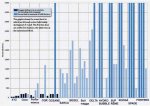
Excel was not introduced when this very practical test was carried out in three different seabeds. This is the results sheet of the 2006 testing by Yachting Monthly, Sail Magazine and West Marine. Probably the most comprehensive anchor test ever carried out. All anchors were 35 lb models except the Fortress, which was purchased far too large in error.
Well worth noting that it pretty much contradicts all that you say. Concave anchors out-performed convex by a huge margin. Delta was notably better than CQR. All were at 5:1 scope, also demonstrating that what you tell us about the requirement for good setting of the CQR is untrue.
You can probably find the full text somewhere on-line, which I recall details the repeated attempts they made to set and hold the CQR.
YM test table.jpg
 
Excel was not introduced when this very practical test was carried out in three different seabeds. This is the results sheet of the 2006 testing by Yachting Monthly, Sail Magazine and West Marine. Probably the most comprehensive anchor test ever carried out. All anchors were 35 lb models except the Fortress, which was purchased far too large in error.
Well worth noting that it pretty much contradicts all that you say. Concave anchors out-performed convex by a huge margin. Delta was notably better than CQR. All were at 5:1 scope, also demonstrating that what you tell us about the requirement for good setting of the CQR is untrue.
You can probably find the full text somewhere on-line, which I recall details the repeated attempts they made to set and hold the CQR.
View attachment 150276
Here’s the complete article. http://svsoggypaws.com/files/Yachting_Monthly_2006_Anchor_Test.pdf

IMHO Anyone still thinks CQR anchors are better than other new generation anchors needs to have a long hard think. (That’s my polite version.)
 
SLIGHTLY OFF TOPIC

Can someone please tell me where I can buy a UK RNLI spade please.
Also the RNLI have never carried Danforth anchors on any of their fleet apart from the Waveney Class l

Look inside the anchor locker of the offshore boats, as they are not stored on deck in some boats. The Admiralty fishermans was on deck clamped against a stanchion, but I was in their yard yesterday and that anchor and fitting have been moved someplace on one boat.

I can assure you that the RNLI will be very willing to sell you one of their used Spade anchors for a suitable donation to the the TNLI who are just up the road from our main HQ in Poole, BUT have been spotted recently in our restaurant and bar !!

Once your check has cleared, I will go around to the offshore production facility and half inch, (Pinch in Cokney), a used one that is a bit rusty and missing some of the yellow paint.
UMM , thinking about it, I'm not allowed by UK law to accept cash or any other type of monetary transfer, so a brand new small Bronze Herreshof would be of real value. Like my folding fishermans it does provide a certain amount of holding power in light sand or mud, (Not much, but far more than common cheap bar versions).

Herreshof dinghy anchor and other German anchors, plus all the usual daft new generation anchors:
Anchors | Anchors & Accessories | Anchoring & Mooring | Toplicht

A little light reading about various type of fishermans anchor and their long history:
The Herreshoff Three-Piece Stock Anchor | WoodenBoat Magazine

NOW THIS IS INTERESTING, but be careful as the so called tests do inlude light weight easily bent alloy and other anchors that were not designed for rocks, heavt weed or cobblestones, or for use in deep water short scope situations.
Anchor Reset Tests - Practical Sailor (practical-sailor.com)

This is the part that helped convince me that carrying a 3 piece bronze Herreshoff is a real good idea, as it performed far better than any other deep water or rocks & weed anchor:
The Herreshoff Bronze was a surprise. This very handsome new version of a very traditional anchor set quickly, in 2′, and broke out and reset itself in 3′. In sand, its weak point is holding. It dragged at 300 lbs., 100 lbs. short of the 400-lb. requirement. It essentially is a rock anchor.

BUT, if you are in need of a real deep water emergency anchor, (Don't forget that a sea anchor is also worth considering), that works well with a 2 to 1 rope rode in any type of holding, it would knock the socks off any other anchor that would fail to set in most cases. Those that do set in 2 to 1, like the grapnels are worse than useless in sand or mud.
For the pontoon posers, the lovely bronze Herreshoff made by JM REINECK & SON will steel the show or selfie if mounted correctly.
 
Are you familiar with the work of Dunning and Kruger? It might help.

The opposite of the Peter Principle and Dunning-Kruger effect is the imposter syndrome

The 5 types of impostor syndrome are:
  • #1: The Expert.
  • #2: The Super Woman/Man.
  • #3: The Perfectionist.
  • #4: The Soloist.
  • #5: The Natural genius
Now we're deep into 'thread drift' country!

:oops:
 
HOPELESS SET OF TESTS designed to sell new anchors, the Fortress and Rocna in particular.

Note the Fortress is like most alloy anchors as the tests have shown that is is one of the easiest to bend in a serious 90 degree veer.
The Rocna is dangerous in a 180 degree veer, just look way back for all the links and official appologies, after they caused too many incidents in the real world.

The USCG do use a Fortress for their smaller boats, BUT it is not a bolt together kit version. Not sure if you can buy one or not. I would not be surprised if the shank was a special order Monel one. Not much heavier than normal alloy, but 4 times stronger. So, very good version of a Danforth, BUT you do need to check if the shank of the Lewmar alloy Danforth is stronger, or if they do special orders for the real thing.

THE TITLE OF THE THREAD IS ANCHORS FOR SERIOUS CRUISING, not anchors for serious bending and nasty surprises.

In the real world dry sand tests have been shown to be very different from wet sand, so are of no real interest. The test was of little interest as it was only with one very rare type of bottom that plows don't like, (Soft over hard sand). The CQR does take longer to set than most, BUT once set with a 5 to 1 all chain scope it has been shown to be a real star when you look at the different types of bottom, rather than just one. When Lewmar put the CQR back into production, they did it for very good reasons that relate mostly to how strong it is and its very good performance figures after it is set. In reality it is not an anchor suitable for a less expierienced sailor who does not pay enough attention to correct setting or the amount of scope. The steel Danforth is far better in that respect, BUT the big issue in safety terms is how it works incredibly well when used as a pair with a steel Danforth in a storm.

What we need to discuss more and get tests results for, is the classic correct way of using 2 different anchors set at least 30 degrees apart. I'm convinced that a combination of a Herreshoff and a steel Danforth might be worth looking at if there are any rocks, debris, weed issues.
For serious cruising, you do need to accept that some of the anchorages are not good in holding terms, and often have a lot of different types of sea bed, including debris and scattered rocks, with patches of weed.


Alas all the daft anchor tests and advertising have convinced most new boaters than anchor X is the only one they should use, or even bother to carry aboard their pride and joy. That lack of equipment has resulted in fatal accidents in areas where shouting Mayday results in no reply, or the local marine vultures leaving port to see if they can save the boat in a money up front deal. I did a few towing jobs myself where the boat concerned had to give his credit card details first, and was then chained to the pontoon in one case when it was declined. The gin palace involved did not have a deep water anchor.
 
Last edited:
I intend replacing the Bruce anchor that came with my “new to me” boat, probably with a 6kg Epsilon and 6mm chain.

The boat has no windlass. Considering the views on catenary and scope expressed in this thread and elsewhere with regard to modern anchor designs, what would you consider the minimum amount of chain for a mixed rode?

The boat also came with a Fortress FX7. Clyde to the Sound of Mull area, 23’ boat, 1.25 metric tons displacement.

Geoff Wode, your intention seems about right to me, given your 'stamping ground'.

I've sailed an ever-so-slightly larger Hurley 24/70 without a windlass, and recovered anchor hand-over-hand without issues. Except.... in New Grimsby Harbour/Scillies, the Fortress Fx-16 I used into sand after a couple of days was VERY firmly deep-set - and that in only moderate breeze/no use of engine. The well-known harbourmaster there helpfully lifted the anchor by 'under-running' the warp over his bow and using the wave-induced 'lift' for a while to weaken then release the hold. He was surprised, as was I, when the 'lightweight' anchor emerged.

I would think either of your Fx-7 or 6kg Epsilon will do a good job for you in most 'West Hielan' anchorages... except perhaps in the thin black soup of Puildhobhrain, where one might be better served by digging the anchor deep into the peat of the adjacent grassy bank!

As Jon Neeves suggests, a short length of chain suffices to avoid abrasion on the bottom debris, and I'd have thought about 20' would do.
 
Last edited:
HOPELESS SET OF TESTS designed to sell new anchors, the Fortress and Rocna in particular. They have failed do do enough tests for an average or variance figure and did the usual tests of a CQR with far too short a scope. Plows do not work well on a short scope.

Note the Fortress is like most alloy anchors as the tests have shown that is is one of the easiest to bend in a serious 90 degree veer.
The Rocna is dangerous in a 180 degree veer, just look way back for all the links and official appologies, after they caused too many incidents in the real world.

The USCG do use a Fortress for their smaller boats, BUT it is not a bolt together kit version. Not sure if you can buy one or not. I would not be surprised if the shank was a special order Monel one. Not much heavier than normal alloy, but 4 times stronger. So, very good version of a Danforth, BUT you do need to check if the shank of the Lewmar alloy Danforth is stronger, or if they do special orders for the real thing.

THE TITLE OF THE THREAD IS ANCHORS FOR SERIOUS CRUISING, not anchors for serious bending and nasty surprises.
So what you’re basically saying is that a group of sailors from the leading yachting magazines in the world didn’t know what they were talking about. You also continue with your spurious and snide allegations about weak anchor shanks.
You also claim that they used the incorrect rode length for the CQR. (Perhaps you didn’t notice that they used 5:1 for all tests. )
You're also questioning the independence and integrity of a whole load of professional people.
I think anyone with the patience to read this thread will see through your fixations.
 
Status
Not open for further replies.
Top