Anchor connection strength

Contrast with France. Not only are all shops other than bars and restaurants closed, we are not allowed to create any noise, so grass cutting, use of compressor, grinding, hammering etc might lead to visits from the authorities.
I'm all in favour of respecting the culture and ways of the locality. In parts of the West Highlands and Islands, the Sabbath is still observed. I wouldn't want to do anything which might upset people.
 
I'm all in favour of respecting the culture and ways of the locality. In parts of the West Highlands and Islands, the Sabbath is still observed. I wouldn't want to do anything which might upset people.
I don't have a problem with the principle but it can raise considerable inconveniences. When our house was being re-roofed recently the weather on Sunday was superb with the whole of the following week forecast to be wet.
 
I have Maillon Rapide links on both ends of the length of chain that I use with whichever second anchor that I use.
 
I don't have a problem with the principle but it can raise considerable inconveniences. When our house was being re-roofed recently the weather on Sunday was superb with the whole of the following week forecast to be wet.
Bummer!
 
I do like the idea that business is so good they close on Sundays? :( . Our local chain of chandlers in Oz take on extra staff for weekends, Maxwell have support staff on call, covering Oz and NZ where someone is on call 24/7 - including holidays - as they figure that's when many of the customers are able to use their yachts. Funny old world.


Jonathan
?????
180F4EFA-3C7C-4A4C-87DD-39912AC2157F.png
 
I had never heard of a Maillon , but Mr Google suggests that it is the trade name for something I would think of as a carabiner. (Just to save anyone else from having to look it up.)

A Maillon Rapide is not the same as a carabiner. A Maillon has a threaded hexagonal sleeve to close the gap, a carabiner has a sprung gate.
 
Shackles fail through a number of mechanisms, including user errors (not locking the shackle pin with mousing wire or Loctite.

When tested they shear at the thread where the shackle pin has been screwed into the eye of the shackle, relatively tightly. The thread extends slightly and the pin is slightly thinner than the shank - and the failure occurs at the point that is thinner - simple stuff.

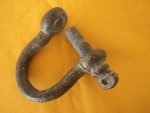
Shackles do fail because they are side loaded (and of inadequate quality). This shackle failed, probably because it is of unknown origin and this nefarious, but it was side loaded and the pin simply pulled out - the mousing wire is still intact. The owner lost his new anchor.
IMGP2663.jpeg

This how a 316 shackle might fail. The 'steel has yielded, deformed. The pin is recessed with an Alan slot in the head. But the pin has pulled through the eye, the head and the eye have both deformed. Its not very clear but the thread has also failed and is pulling out of the other eye. This shackle was rated at 4t - it failed at 3.5t. I suspect that if you did not point load the shackle, as has been done here - it would have met its specification.

IMG_7538.jpeg

Personally I prefer alloy shackles from reputable manufacturers, Crosby, Peerless, Campbell, Yoke where for a 3/8th" shackle the WLL is 2t and MBS is 10t (all metric)


I generalise but don't get paranoid about rode failure - just take the advise. Shackle failure is simply not common - but maybe the majority of owners use good shackles having taken on board the consistent advice on this forum (and other forum). Those that have not taken on board the advise maybe don't anchor too often - but reports are simply few and far between. Equally chain failure seems to be historic - I have not read of a chain failure for at least 10 years (and I think YBW members represent a decent cross section of the market) - if you use the recommended sized chain from a reputable supplier and you don't use rusting chain - you are good to go. Similarly reports of 'almost any' modern anchor failing and dragging are now a function of bad luck or operator incompetence - reports of modern anchors dragging seem restricted to catching something 'foreign' in the toe - a swim suit, a crab pot - and are not the fault of anchor design. I do know of anchors dragging where they are used inappropriately - not using a Fortress in thin mud - but such reports are exceptional. There were horror stories of some anchors clogging - but those reports appear to have disappeared - over the last 10 years.

Take care, stay safe

Jonathan
 
You had better explain that to our climbing colleagues who believe there are such things as screwgate carabiners.

The screw sleave blocks the gate from opening, but unlike a screw link, the locking screw is NOT a structural element. The load is carried by a pin or key lock in the gate. That said, they are as strong as they are rated and far better tested than most screw links.
 
Read the bottom right hand corner - their experts and thus advise is not available on Sundays.

Jonathan
So they don't answer the phone on a Sunday. I seem to remember rocking up in Townsville after an 8 hour bike ride from Charters Towers on Good Friday in 30+c and all the pubs were closed . Far more egregious in my eyes.
 
The screw sleave blocks the gate from opening, but unlike a screw link, the locking screw is NOT a structural element. The load is carried by a pin or key lock in the gate. That said, they are as strong as they are rated and far better tested than most screw links.

Its Thin's final sentence that is the worry.

Many, hopefully all, shackles sold in the lifting industry are rigorously tested, climbing equipment is rigorously tested. There is too much evidence to suggest that sailing equipment is not rigorously tested. Now I may be wrong - but I'm interested if anyone can quote me third party testing of cordage for yachts, chain for yachts, shackles for yachts, tethers for yachts etc. The last, freely available, 3rd party testing of anchor chain for UK sourced chain was conducted by Vyv, maybe 10 years ago, Thin tested a tether hook - but only after a man died when the same tether hook failed ..... to me - not good enough. The large importers Plastimo, Lewmar, Jimmy Green - may test chain and cordage etc - but it so they are very reticent in offering the details.

Jonathan
 
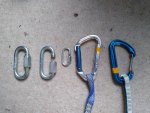
Maybe of interest if you've not come across them.
krabs.jpg

The three on the left are mailons (pronounced may-yon) the left one partially done up and the others undone. The big ones are rated at 35 KN longitudinally and 10KN laterally.
The small one is 4mm and not rated.
The two on the right are karabiners (krabs), the difference being in design and strength. The silver on is rated 23 and 7 KN and the blue on 24 and 8 KN. (That surprised me as I used, when hanging 40m up a cliff, to prefer to see something solid to rely on rather than two bits of wire.)

As you can see, they are all rated, batch marked and various other markings except the novelty, small one.

The yellow tapes are possession markings; at the end of the day I can find my gear in the amnesty jumble!

Hope that's helpful
 
The screwgate is a locking mechanism, nothing to do with the opening. But I'm sure you're clever enough to understand that.
I don't know why I'm engaging in such a petty squabble, but I do know that in the dim and distant past, when I had to wear a safety harness at work, I was only too pleased that the spring opening carabiners had a screw locking sleeve for extra security.
 
Maybe of interest if you've not come across them.
View attachment 126524

The three on the left are mailons (pronounced may-yon) the left one partially done up and the others undone. The big ones are rated at 35 KN longitudinally and 10KN laterally.
The small one is 4mm and not rated.
The two on the right are karabiners (krabs), the difference being in design and strength. The silver on is rated 23 and 7 KN and the blue on 24 and 8 KN. (That surprised me as I used, when hanging 40m up a cliff, to prefer to see something solid to rely on rather than two bits of wire.)

As you can see, they are all rated, batch marked and various other markings except the novelty, small one.

The yellow tapes are possession markings; at the end of the day I can find my gear in the amnesty jumble!

Hope that's helpful

Should you want to use climbing carabiners (in the US climbers call them "biners" for short) on the boat (handy for many utility uses, but not any rigging function), use the wire gate sort. They will not stick with corrosion, the way the conventional gate sort do. Mostly, I use them to secure kayaks and hold trolling lines.

Triva for non-climbers. Wire gates were introduce in climbing carabiners to eliminate gate lash. When slaped hard against a cliff face during a fall, the momentum of the gate can cause it to snap open just a fraction of an inch for a split second, but that is enough to reduce the strength from ~ 22 KN to 6-8 KN because the gate misses the latch. The wire gates are lighter and not subject to lash. That was the original reason for wire gates. But they are also less prone to jamming with desert grit.
 
The trouble with all of these devices is that there are now many copies (this includes shackles), that look to be identical to the originals. Some of them might be excellent.

It is quite possible to buy 1,000 shackles, carabiners or maillons with there being no quality control conducted or, at best, every one in 10,000 tested. These are available, commonly, in hardware stores. I suspect the shackle I show in Post 28 is one of them. Buying a decent crab or shackle demands some extra effort, mail order or an exceptional visit to a climbing equipment store. You can then buy branded equipment from a reputable manufacturer. I'm sure everyone here uses shackles and carabiners from reputable sources :) - some obviously do not, see Post 28, again.

Just because your hardware store or chandler stocks an item does not mean it is good or bad - but if it has a reputable brand stamped on the side - you have a chance it is what is says on the box. If it has no brand or says made in 'country of origin' - just wonder why the manufacturer is not happy to build up a reputation as a reputable source.

I know I'm right because I see this sort of thing too often - people don't care. It might cost all of stg10 to correct this.

IMG_0121.jpeg

Jonathan

Metric 8mm G30, a common chain specification in Europe (with a slow migration to G40) has a 3t MBS (G40 is 4t MBS). and 750kg/1t WLL respectively. A common, rated, 3/8th" shackle will have a MBS of 6t but a WLL of 1t. Side loaded that WLL of the shackle will be reduced to 3t with a 500kg WLL. At this point the shackle becomes the weak link. So you have 100m of 8mm G30 chain with a WLL of 750kg joining chain to anchor with a shackle which has WLL of as little as 500lg - makes no sense - buy a G80 shackle (they cost peanuts) it will have a WLL of 2t, reducing to 1,000kg is side loaded, comfortably in excess of the 8mm G30 chain. As long as you mouse the shackle pin and or use Loctite - your rode is sound - made more sound if you use a decent snubber.

The shackle in the anchor, above, is grossly undersized and thus under strength - you can tell - just by looking at it. I don't know about the stainless shackle - if might be a good Witchard shackle (or equivalent) but I doubt it (if I take into account the shackle at the anchor).

But don't worry - this picture was taken in an American marina - members here will not by guilty of such practice. But unless your stainless shackle (or whatever) is not of a size equal to the size of the chain, or greater - I might think again (about the choice of shackle). Stainless, 316, has a low yield and though the strength might be similar to a hardware store shackle - it, the stainless shackle) will deform much earlier and become unusable (long before it actually fails) - note the stainless shackles, marked 316, in my earlier post.

If you want to use stainless shackles then the Cromox range (Ketten and Waelder) is the way to go - available from Andersen (I think that is the name) in Newcastle. Sadly they are slightly more expensive than a Crosby G80 shackle Crosby® 209A Alloy Screw Pin Anchor Shackles - The Crosby Group (available from Tecni in the UK and I am sure other sources).
 
Last edited:
Out of interest, how do you lock a maillon link so it can't come unscrewed. I've got several of them but have always resisted using them in anchor chain applications because of this. Or did I miss this in the thread somewhere?
 
Out of interest, how do you lock a maillon link so it can't come unscrewed. I've got several of them but have always resisted using them in anchor chain applications because of this. Or did I miss this in the thread somewhere?
I've used as maillons for years on board.... warp to anchor chain, adding extra chain to rode for occasional deep anchorages. Even adding kedge warp to main rode etc.The small ones are also really handy as they don't catch on things as normal shackles do. I don't use on chain to anchor as they can snag with a sideways load on my Spade. I have never had one come loose... In most applications there is no torque on the threaded part.. unlike a shackle pin on a chain link for example. For extra security one can always loctite.
 
Top