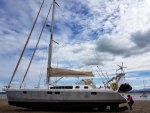
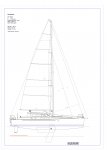
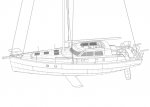
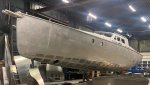
Aluminium Centreboard Boats?

There is something about aluminium boats that encourages the designer to pack them full of interesting and innovative features. Every time I see one close up I can spend some time just looking at the various ideas.

I would be worried dropping a 2p piece which would find it's way into the bilges and then just lie there corroding the hull leaving a 2p sized hole !
 
We are lucky to have a choice of boats for Pan Pacific sailing. The first is a Boreal Hull 10 years old and a self fit out inside, the other is a 1990 Ovni, factory fitted and in fair condish. Which do we go for as similar in price. We will spend a few sheckels getting tech up to speed.
 
I have just sold our Ovni 385, purely because the kids have suddenly become enormous teenagers with friends who are also enormous teenagers, so we have bought a Moody 46 to accommodate everyone.

But the Ovni is one of the best boats we have ever owned.

I love the whole Aluminium/Centreboard concept.

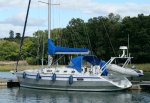
Ovni 385 For Sale jryachts.jpeg
 
Last edited:
I have just sold our Ovni 385, purely because the kids have suddenly become enormous teenagers with friends who are also enormous teenagers, so we have bought a Moody 46 to accommodate everyone.

But the Ovni is one of the best boats we have ever owned.

I love the whole Aluminium/Centreboard concept.

View attachment 103754
Nice to hear yet another endorsement of Ovnis by an experienced circumnavigator. I bought a 395 this year and am very pleased with the first 2000 miles.
traeth.jpg
 
Last edited:
I've always found these interesting would anyone give an impression on how rewarding the Ovnis etc are to sail -Ive never really been able to make judgement on their underwater profile with those chines and rudder arrangement - heavy ish cruiser, quite spritely or do they get near cruiser racer Elan 333/Bene 1st etc
 
I've always found these interesting would anyone give an impression on how rewarding the Ovnis etc are to sail -Ive never really been able to make judgement on their underwater profile with those chines and rudder arrangement - heavy ish cruiser, quite spritely or do they get near cruiser racer Elan 333/Bene 1st etc

They are intended for different sorts of sailing and are not really comparable. They have much smaller SA/D so are not quick in light airs, and the unballasted centreboard is not as efficient as a deep fin keel for going up wind. Where they win is downwind trade wind sailing where the flat spreaders mast-head rig is an advantage, and the centreboard can be lifted to reduce drag. They are also more comfortable and safer in heavy weather because they generally have a nice movement and the centreboard can be lifted to allow the boat to slide in breaking waves.

If you want to see how comfortable these boats can be in very bad weather have a look at the "Sir Ernst" videos on youtube of a French crew sailing to high latitudes in their Boreal 47. There is one film of them eating dinner with plates and glasses on the saloon table with 40knots of wind outside.

If you want to read a lot more about the concept there is a lot of very useful information on Morgans Cloud. It is paywall but only $24 per year. They make a fairly in depth comparison of Boreal 47 and Garcia Adventure - the Boreal comes out winner on most counts.
 
Re centre board cruisers: A friend of ours has a Boreal both he and I were surprised by the relatively low angle of ultimate stability. The same goes for the Ovnis and it is my understanding that the Boreal 43 was modeled on an Ovni hull. The Boreal yard was fairly reticent to discuss it with him and simply told him it was a "dynamic concept", whatever that may be.
These are not light displacement boats. With all internal ballast they need a fair amount of it for stability.
 
The Boreal was not modelled on an Ovni hull - they are actually quite different. The Boreal has a deeper forefoot (to avoid slamming) and is much narrower at the waterline at the stern (to reduce wetted area when heeled and improve tracking in a following sea), it has a profiled centreboard (most Ovnis except the new 400 have an unprofiled flat slab of aluminium), it has a different rudder arrangement (Ovni has a rather clumsy folding rudder, Boreal has a short rudder augmented with dagger boards for better directional stability), Boreal also has ballast much lower concentrated in a sort of long sausage along the bottom of the boat. and better weight distribution because engine and chain locker are more central. They are not really same at all.

The AVS of all centreboard boats is lower than fin keelers because the ballast is not as deep - but this does not mean they are more liable to capsize - indeed the contrary is true. Most capsizes of fixed keel boats occur in breaking waves or in strong following seas where the boat trips over its own keel. This cannot happen with centreboard boats because you can just lift the board and let the boat surf. This is what he meant by "dynamic concept".
 
What? That’s a bit poor on such a premium boat. Does a flat slab of aluminium create any lift?

Perhaps surprisingly, a flat plate does create lift if you subject it to an angle of attack in a fluid.
Try carrying a sheet of plywood on your head in a breeze, and if you angle it correctly you will probably take off (if you can hang on to it).

If you have an appetite for maths, here is some theory behind it.
http://brennen.caltech.edu/fluidbook/externalflows/lift/flatplateairfoil.pdf
 
The Boreal was not modelled on an Ovni hull - they are actually quite different. The Boreal has a deeper forefoot (to avoid slamming) and is much narrower at the waterline at the stern (to reduce wetted area when heeled and improve tracking in a following sea), it has a profiled centreboard (most Ovnis except the new 400 have an unprofiled flat slab of aluminium), it has a different rudder arrangement (Ovni has a rather clumsy folding rudder, Boreal has a short rudder augmented with dagger boards for better directional stability), Boreal also has ballast much lower concentrated in a sort of long sausage along the bottom of the boat. and better weight distribution because engine and chain locker are more central. They are not really same at all.

The AVS of all centreboard boats is lower than fin keelers because the ballast is not as deep - but this does not mean they are more liable to capsize - indeed the contrary is true. Most capsizes of fixed keel boats occur in breaking waves or in strong following seas where the boat trips over its own keel. This cannot happen with centreboard boats because you can just lift the board and let the boat surf. This is what he meant by "dynamic concept".
Just a few notes.
I have no attachment to the heritage of the boreal hull design, merely passing on what an owner told me.

In regards to boat behaviour in heavy seas: having run off in 50kt + conditions in the open sea and in boats of various (keel) design I am inclined to attribute a tendency to tripping to an imbalanced design of the ends and an inadequate steering and rudder design, but especially a lack of buoyancy in the bow. The IOR in particular produced a crop of boats that had a good deal of problems in that department.

I have extensively discussed, with my friend and owner of the Boreal, the notion of being able to hoist up ones keel appendage, whether keel or centre board, to allow the boat to sideslip in severe conditions and thus escape the capsizing impact of a breaking wave. In this regard, tests in wave tanks have shown that vessels with no or little saliant keel to dampen roll, are at a much greater risk of capsize in beam on breaking sea condition. In such conditions, wide beam causes the hull to conform with the wave slope and it is the deck edge that creates a tripping edge, the lever of which is accentuated by beam. At these angles of inclination, when the deck edge immerses, a keel or centre board has very little effect to contribute.
So much for theory. I used to own a 50' lifting keel cutter. With a raised keel she had and AVS of 110 degr. versus 135 degr keel down; the boat was quite beamy. In a seaway and with the keel up, her rolling was very pronounced. This stopped the moment it was lowered. In other words, a keel has a significant dampening effect on boat motion.
Before owning the Boreal my friend owned a Southerly. This boat has excellent AVS angles, even with a raised keel. He cruised this boat extensively and as far as the Lofoten islands. On one of his cruises he was caught out in a severe storm and because of the risk of a lee shore he was obliged to take the seas on his beam. At this point he decided to give the dynamic concept a try. He raised his keel partially, then completely. Far from experiencing the benefits of slipping harmlessly to leeward when impacted by the seas, he suffered two terrifying knockdowns in short order. After lowering his keel again the boat steadied up and he had no further incidence. N.B. even with the keel fully raised the Southerly's AVS is superior to that of the Boreal; apart from the latter's dagger boards, the underwater profiles are fairly similar.

Comments in regards to the Boreal's performance. She has to be sailed fairly upright, he told me, to keep leeway to a minimum and weatherhelm in check. Without a bow thruster she is difficult to maneuver in the small Dutch harbours. While he was, initially quite happy with her performance, he related to me, with some surprise, how he was bested by a traditional racing Lemsteraak, a 250 year old design with gaff rig and lee boards. The Lemster was out-pointing and out-footing him to weather. Feeling competitive, he took some measures as he said, but he never did catch up with her and when the lay of the coast allowed them to bear off, the Lemster pulled away with ease and basically disappeared over the horizon.
 
I've not sailed either type but got to know several owners well and one thing I really liked about the Boreal was the doghouse helm / nav station seat facing forward. This is very practical for cruising, but (at least on the one I was on) it meant the main halyard was at the mast (not my preference).
 
As to performance, these boats are in a different world: we (41', 35yo jeanneau) sailed together with some friends' Boreal 47 during a few weeks in CV islands, the question from my friend's wife was "how come Roberto with one sail, is faster than we are with two sails".
Apart from that, really excellent go-anywhere boats. FWIW, IMHO Boreal is in a different league altogether from OVNIs, though of course both are "4x4 of the seas".
Garcia 45 -always imho- is more a marketing product, not sure how many units have been made but the significant number of them on sale just after a couple of years might tell something; now try finding a 2nd-hand Boreal.
 
As to performance, these boats are in a different world: we (41', 35yo jeanneau) sailed together with some friends' Boreal 47 during a few weeks in CV islands, the question from my friend's wife was "how come Roberto with one sail, is faster than we are with two sails".
Apart from that, really excellent go-anywhere boats. FWIW, IMHO Boreal is in a different league altogether from OVNIs, though of course both are "4x4 of the seas".
Garcia 45 -always imho- is more a marketing product, not sure how many units have been made but the significant number of them on sale just after a couple of years might tell something; now try finding a 2nd-hand Boreal.

Can you clarify please:

What you are meaning when you say "Garcia 45 -always imho- is more a marketing product,..."

What is it you imply that causes you to say; "but the significant number of them on sale just after a couple of years might tell something"

Thanks
 
There is something about aluminium boats that encourages the designer to pack them full of interesting and innovative features. Every time I see one close up I can spend some time just looking at the various ideas.

I would be worried dropping a 2p piece which would find it's way into the bilges and then just lie there corroding the hull leaving a 2p sized hole !

I wonder exactly what mix of metals aluminium boats are made of because the aluminium used on Land Rovers once the outer skin has been compromised just turns to white powder and develops holes in no time. I don,t understand how ali boats survive, they should all sink within a year being in contact with salt water from what I am used to despite there being no electrolysis in action! Odd! Does anyone know?

Sent from my iPad
 
Zagato, they are built using marine grade aluminium - often 5083 grade.
A Guide to Understanding Marine Grade Aluminum -

The 15 metre power cat in my avatar photo is now 20 years old, and all of the hull shell plating is 5083 grade, and it is all still in good condition, with no corrosion apparent.
One advantage of marine grade aluminium is that you do not have to paint it - my avatar cat has no paint on the hull between the deck and the waterline. Leave it alone and it will just go a dull grey colour.
 
re the comments about the dropped 2p piece hole in the bilge ,, judging by the prices of these boats i cant see it being a problem as i doubt that most people would have a 2p piece left over after purchase .
 
Top