Alternator excitement

in irons

New Member
Joined
25 Feb 2017
Messages
22
Visit site
I wonder if anyone with an understanding of electrics could shed light on the issue I have?
My boat has a Bukh DV20 fitted.
I have replaced the alternator but when I start the engine there is no alternator output and the charge light on the control panel stays on.
If once the engine is running I briefly make a connection between terminals 4 & 8 on the control panel distributor plate ( the ones linked by the 68ohm 3watt resistor) the alternator starts to produce output.
I have replaced the diodes and large resistor on the distributor plate and cleaned the terminals on the plate and the harness connector. But still have the same symptoms.
When checking I noted that with ignition switch in on position from terminal 61 on the alternator (exitor) to ground I got a reading of just over 2 volts. When I disconnected the wire from terminal 61 and measured the voltage from the wire to it to ground I got 12.6v.
I have been puzzling over the circuit diagram but am none the wiser.
I am wondering if it would be ok to put a push switch wired between terminals 4&8 on the distributor plate.
Or would that be likely to do harm?
Would the regulator in the alternator be able to sense voltage correctly or could it overcharge?
I did have to manually excite it when I picked the boat up and brought her home but was hoping to resolve the situation before launching again.
 
Does your rev counter work? I had similar symptoms when fitting a new alternator to a Bukh DV36, all sorts of odd electrical strangeness. Turns out the new alternator had an insulated return, the old alternator had a non insulated return. If I remember right, an extra wire from the -ve terminal led back to the block fixed the issue ( recommended by the company I bought the alternator from).
 
Does your rev counter work? I had similar symptoms when fitting a new alternator to a Bukh DV36, all sorts of odd electrical strangeness. Turns out the new alternator had an insulated return, the old alternator had a non insulated return. If I remember right, an extra wire from the -ve terminal led back to the block fixed the issue ( recommended by the company I bought the alternator from).

No rev counter fitted on mine.
Just the control panel with key, buzzer and warning lamps.
The current alternator is a Cargo which replaced a Prestolite.
I wonder if I somehow messed up on the wiring of that. I remember finding the different terminology for the same terminals a bit confusing.
The Cargo had B+, D+, B- that I could connect to plus there is a wire joining B- to D-
 
The voltage that you’re measuring at the alternator seems to be a bit low. I’m not sure what it should be but it should be high enough to energise the field. The voltage that you measured with the wire disconnected would appear correct i.e battery voltage.
The initial field supply current from the battery is limited by the resistance of the charge warning lamp. Has this bulb been inadvertently replaced with an incorrect bulb? It should be 12V, 3 Watt.
Mike.
 
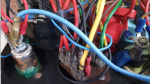
i had the same issue after rewiring my boat the 61 terminal needs to be connected otherwise the alternator does not work , if your stuck i took pics of the back of the control panel and no exactly what needs connecting where.
 
The voltage that you’re measuring at the alternator seems to be a bit low. I’m not sure what it should be but it should be high enough to energise the field. The voltage that you measured with the wire disconnected would appear correct i.e battery voltage.
The initial field supply current from the battery is limited by the resistance of the charge warning lamp. Has this bulb been inadvertently replaced with an incorrect bulb? It should be 12V, 3 Watt.
Mike.

Those voltage readings had me puzzled too. I repeated it a couple of times to confirm.
The warning lamp is an original. I did check the resistance on it but cannot recall the figure now but at the time I thought it in order.
My understanding is that the 68ohm 3 Watt resistor between terminal 4 & 8 is to do with the excitation.
i freely admit that I had no idea of the wiring on alternators until I initially had to investigate it after dropping the hook after a long day at 2am and found the batteries totally flat.
We all slept amazingly well with the Bukh still thumping away. It had been a long day and I did not want to attempt a hand start for the first time with flat batteries.
 
i had the same issue after rewiring my boat the 61 terminal needs to be connected otherwise the alternator does not work , if your stuck i took pics of the back of the control panel and no exactly what needs connecting where.
From what I understand on the alternator I have fitted the terminal D+ is the equivalent of 61 and that goes up to terminal 8 on the control panel distributor plate.
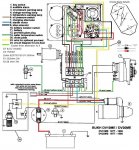
Attached is a modified image with what I have with some annotations I put on to help my attempt to figure this out.
Note that on the attached the Green/Yellow and Green wires in the engine harness to the control panel have been transposed at some time in the past. I added the colours to match what I actually have before me. The black wire on the diagram is in actual fact the White feed wire - for some stange reason it disappeared from the page if I coloured it white.
I have no pre heat fitted.

Bukh DV 20 ME wiring.jpg
 
Not being familiar with your particular installation, I don’t think I can be of further help. But looks as though Rylsailer99 may have your solution.
Mike
 
the green wire needs to be connected and the other wire b+ to the connection to the positive on the battery and it will charge ive found. i tried to attach a pic but i hate windows 10 and cant resize the image
 
Last edited:
the green wire needs to be connected and the connection to the positive on the battery and it will charge ive found.

So to confirm you have the green wire from terminal 61 on your alternator permanently connected to the positive of your battery and that has sorted the alternator not charging and not caused any other issues?
Does your charge warning lamp function correctly like that?
I ask because I have found that when I briefly connect 4 to 8 to initiate charging on the alternator although I can see 14v at the battery terminals the charge light stays on.
Edit sorry i think i may have misread.
I have the green from alternator going to 4 on distributor plate. Battery positive and ground connected to the respective alternator terminals.
 
control.png
where the green wire is i connected it straight to 61 on the alternator. i was a bit silly as i used my red and black tinned wires that was left over from a boat rewire to replace all the coloured wires and it got very confusing oops and i messed the alternator up. Without the green wire connected to 61 i had no charging on the batteries. my engine is also a bukh dv20
 
View attachment 112784
where the green wire is i connected it straight to 61 on the alternator. i was a bit silly as i used my red and black tinned wires that was left over from a boat rewire to replace all the coloured wires and it got very confusing oops and i messed the alternator up. Without the green wire connected to 61 i had no charging on the batteries. my engine is also a bukh dv20

From your photo it appears that the green wire goes from terminal 5 on the plate. Interesting.
I know there were a couple of versions of the plate.
All food for thought. Thank you.
I shall do some more head scratching when I get back down to the boat on Monday no doubt.
 
From your photo it appears that the green wire goes from terminal 5 on the plate. Interesting.
I know there were a couple of versions of the plate.
All food for thought. Thank you.
I shall do some more head scratching when I get back down to the boat on Monday no doubt.
I found the bukh diagrams confusing and i was gutted last week when i decided to start my boat and realised the battery was not charging. As soon as i connected that green wire connector to the 61 on the alternator the voltage when upto 14v on the readout which told me its now working so i left it at that.
 
Happy days then.
I don't think it helps that they had a reasonable length production run, with a few small changes. Finding circuit diagrams that are actually clear enough to decipher seems a bit of a challenge as well!
I encountered the issue when I brought the boat home and once out replace d components on the distributor plate but with lockdowns I was unable to try starting the engine to see if it worked until today.
It will all come right in the end.
 
Good for you.
I had some time on furlough and could only get frustrated about not being able to get on with any of the jobs on the boat.
I booked a few days off this past week so I could start playing catch up.
Back to work Tuesday though, with some unfinished business no doubt.
 
I believe I have the answer!
I got down to the boat this morning and after double checking the connections were all as should be I connected a 5w lamp between terminals 4 & 8 on the distributor plate.
The lamp illuminated with ignition on and went out once engine started.
I checked voltage at batteries and I had the long awaited 14v.
So the alternator had been excited!
I was pretty excited myself too!

It seems to me that the charge lamp on the panel does not pass enough current to allow for excitation.
There is a 68ohm 3 watt resistor in parallel which I thought was there to ensure enough current passed to ensure excitation.
I am wondering if I attached another resistor with the same resistance as the test lamp minus the resistance of the charge lamp that I took out of circuit for testing whether that would sort it out to use the original charge lamp.
Does that sound right?
I admit electrics are not a strong point of mine I sort of muddle through so a confirmation or otherwise from anybody with more knowledge on the subject would be much appreciated.
 
Well done! Progress indeed. It would appear that there is an unacceptable impedance in the wiring between the start switch and alternator’s field connection. Measuring voltages along the route doesn’t always tell the true story as to be meaningful the test should be carried out under dynamic conditions i.e with a current flowing. However, are you able to measure the resistance the resistance in the wiring between the start switch and the field terminal (with the terminal disconnected from the alternator? it should not be significantly more than the resistance of the bulb.
Mike
 
Top