Alternator drive belt tensioning.

tjbrace

Well-Known Member
Joined
8 Mar 2007
Messages
622
Location
West Mersea, UK
Visit site
I know that the adjuster screw/nut/bolt needs to be very tight but how about the alternator pivot bolt?
It’s a Yanmar 3GM30F and it has already stretched my recently fitted new drive belt.
I’m trying different options to avoid having to adjust it so frequently or to make the adjustment easier.
TIA.
 
If its stretching your belt so quickly - then something is not right.

Maybe you have a substandard belt ... too tight tension .... slightly out of alignment pulleys .... higher amp alternator on standard belt ..... ???

Most people will go years without ever adjusting belts ... like on your car ... only ever touching it at end of life.... or recc'd replacement intervals.
 
If its stretching your belt so quickly - then something is not right.

Maybe you have a substandard belt ... too tight tension .... slightly out of alignment pulleys .... higher amp alternator on standard belt ..... ???

Most people will go years without ever adjusting belts ... like on your car ... only ever touching it at end of life.... or recc'd replacement intervals.
Thanks Refueler. I too think your first sentence is correct.
The belt is a Yanmar part from the local main dealer as was the previous belt. That too suffered stretching as noted in my earlier post this year but it lasted several years. The pulleys haven’t been altered and it is the same alternator which leaves the tensioning. I will try less tension although I did try to follow the recommendations.
How about the pivot bolt, would you tighten that completely?
 
I know that the adjuster screw/nut/bolt needs to be very tight but how about the alternator pivot bolt?
It’s a Yanmar 3GM30F and it has already stretched my recently fitted new drive belt.
I’m trying different options to avoid having to adjust it so frequently or to make the adjustment easier.
TIA.
These bolts do not need to be very tight, although I appreciate that is a relative term. However, if you are concerned about the potential difficulty in undoing them, you are overtightening them. You need only a little more than "nipping up". I could give torque settings but if you don't have a torque wrench then that's not much better.

They should all be nipped+ up to a similar amount if they are the same size.

The outside top flat surface of the belt should be flush with the outside edge of the pulleys, and especially the alternator pulley. If the belt is below that level it is incorrect or has worn. If the Yanmar belt is not cogged (i.e. toothed) then ditch it and buy a Gates toothed belt.

I ditched my Yanmar belts and went for the Gates cogged versions and they rarely need adjusting.

Richard
 
As far as I am concerned ... as per RichardS ... all bolts should be tightened to retain position. Their purpose is to not only mount the alternator - but to also position it so it does not move / twist or mis-align during use as well as set correct tension.

The matter of belt level with outer rim of pulley ... has two effects :

1. It is then design RPM of that pulley ... I know its only a small difference - but its there.
2. It is immediate indicator of worn belt ..

BUT ..... I can say that my 4-107 has run on same belt for 15+yrs and it is not level with pulley outer rim ... it does not slip .. its always been like that ... as its actually the same alternator / belt that was on the previous 4-99 that the 107 replaced - and it was like that then.

The last time I adjusted the belt was in 2007 - I know for a fact as I had alternator checked out after a twit on board (me) turned to 0 - the 3 way switch when engine running. The boat then came to Baltic ......
 
These bolts do not need to be very tight, although I appreciate that is a relative term. However, if you are concerned about the potential difficulty in undoing them, you are overtightening them. You need only a little more than "nipping up". I could give torque settings but if you don't have a torque wrench then that's not much better.

They should all be nipped+ up to a similar amount if they are the same size.

The outside top flat surface of the belt should be flush with the outside edge of the pulleys, and especially the alternator pulley. If the belt is below that level it is incorrect or has worn. If the Yanmar belt is not cogged (i.e. toothed) then ditch it and buy a Gates toothed belt.

I ditched my Yanmar belts and went for the Gates cogged versions and they rarely need adjusting.

Richard
In that case I have overtightened them, very hard to loosen them. I do have a torque wrench so I could use the numbers. As for size, the front hexagon on the pivot bolt is 14 mm, the rear is 13 mm, and the adjuster is 12 mm. These are the spanner sizes, no idea what the thread sizes are.
The belt I originally removed was toothed and it was present when I bought the boat in 2006. It went on for several years more before it began to fray.
At layup I have always removed the 2 belts so they do get disturbed each year.
 
In that case I have overtightened them, very hard to loosen them. I do have a torque wrench so I could use the numbers. As for size, the front hexagon on the pivot bolt is 14 mm, the rear is 13 mm, and the adjuster is 12 mm. These are the spanner sizes, no idea what the thread sizes are.
The belt I originally removed was toothed and it was present when I bought the boat in 2006. It went on for several years more before it began to fray.
At layup I have always removed the 2 belts so they do get disturbed each year.
I would try something like 10 Nm for the smallest bolt diameter and 15 for the largest. That should be sufficient but keep an eye on it at first.

Richard
 
I would try something like 10 Nm for the smallest bolt diameter and 15 for the largest. That should be sufficient but keep an eye on it at first.

Richard
Is that what is specified in the workshop manual? They are M8 and M10 threads and if they are typical 8.8 grade fasteners the torques would be in the order of 28 and 58Nm respectively.

Www.solocoastalsailing.co.uk
 
Is that what is specified in the workshop manual? They are M8 and M10 threads and if they are typical 8.8 grade fasteners the torques would be in the order of 28 and 58Nm respectively.

Www.solocoastalsailing.co.uk

Personally - I do them tight with thought that I will not need to return to it for next few years ........... for me tight is tight with reasonable force and no more movement of spanner.
 
Is that what is specified in the workshop manual? They are M8 and M10 threads and if they are typical 8.8 grade fasteners the torques would be in the order of 28 and 58Nm respectively.

Www.solocoastalsailing.co.uk
I've no idea what's in the manual as I've never consulted a manual or used a torque wrench for adjusting an alternator. I just reckon that 15 Nm would be sufficient but would be happy to go to 20 or 25 if 15 didn't feel tight enough. 58 Nm would be far too tight.

Richard
 
The matter of belt level with outer rim of pulley ... has two effects :
1. It is then design RPM of that pulley ... I know its only a small difference - but its there.
2. It is immediate indicator of worn belt ..
BUT ..... I can say that my 4-107 has run on same belt for 15+yrs and it is not level with pulley outer rim ... it does not slip .. its always been like that ... as its actually the same alternator / belt that was on the previous 4-99 that the 107 replaced - and it was like that then.
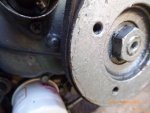
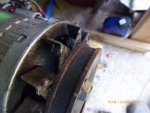
On my 1GM 10 the belt is just proud on the crankshaft pulley and low on the alternator. This a photo of another 1GM which is exactly the same.
1628780797051.jpeg 1628780839470.jpeg
I was never happy with it as it seems to be a manufacturing fault and belt wear and the associated mess of black dust is worse than I would expect.
 
Checked today. Belt is level on the crankshaft and water pump pulleys but is low on the alternator pulley.
seems to have stopped stretching currently, but I shall replace it next fit out.
Thanks to all.
 
My alternator had a tendancy to slip on the adjusting arm. So I set it to the position then I noticed that there was still some exposed slot in the arm. My solution was to put a nut & bolt in the slot, push it to the alternator then tighten it really tight. This stops the alternator from sliding & I do not have to overtighten the alternator bolts. The nut & bolt needs to be a socket cap head bolt as it is round & has to turn against the face of the alternator & a hex head cannot be rotated.
 
My alternator had a tendancy to slip on the adjusting arm. So I set it to the position then I noticed that there was still some exposed slot in the arm. My solution was to put a nut & bolt in the slot, push it to the alternator then tighten it really tight. This stops the alternator from sliding & I do not have to overtighten the alternator bolts. The nut & bolt needs to be a socket cap head bolt as it is round & has to turn against the face of the alternator & a hex head cannot be rotated.
That’s a great idea. I will check if I can do the same. Thanks
 
I tighten my alternator bolts as tight as I can using a ring spanner of standard length for the size of the nut. As for tension, go look at your car, if it's a V belt look to see how much movement there is on the longest section and use that as a guide compared to your boat belt. If your longest section is half that of your car, adjust boat belt to have half the movement.
This method isn't accurate, but it will put you in the ballpark.
 
I replaced the alternator belt on my Volvo D1-30B the week before last and the recommended torque setting for the bolt that fixes the position of the alternator is 50Nm. I am guessing the size of the bolt but probably M10.
 
Top