Advice please..... sealine 27 ft, 30 year old boat with 2 petrol engines

I would also add that there is website that explains much of what I have written...... when looking for another suitable head from a breakers yard I opened another can of worms because the Volvo engine block went through many iterations over the lifetime of the engine, many changes in the head and cam shaft area to suit different power outputs plus carb and fuel injection options .
I obtained from the net a list of part numbers of head that would fit my block, this became my bible for the search , but none of course had the steel ring re reinforcement so I spent about £1k on the head and machining. about 18 months ago.
 
I was able to removed the head and the exhaust manifold whilst the boat was in the water just stuffed rag down the exhaust pipe to the outdrive and got on with it...!!!

I don't understand why your engines are at different angles on the assumption that these power out drives which would be identical. Both engines should be angled the same, to the manufacturers recommendations. any misalignment to the outdrive can cause extra wear on the moving joints to the drive.
It was something the engineer mentioned but they might be the same, but it appears one engine sat differently to the other. We are not at the boat currently to inspect it! It’s terribly confusing and as we are not engineers it’s difficult to know where the fault lies. However everyone’s feedback has been really helpful so far.
I guess the question is can we fix it or is it just worth scrapping/getting rid of......?!
 
I was able to removed the head and the exhaust manifold whilst the boat was in the water just stuffed rag down the exhaust pipe to the outdrive and got on with it...!!!

I don't understand why your engines are at different angles on the assumption that these power out drives which would be identical. Both engines should be angled the same, to the manufacturers recommendations. any misalignment to the outdrive can cause extra wear on the moving joints to the drive.
I think what the OP means about the angle is that the engine head is at an angle.
 
Hi yes they are AQ151. We have had the top of the engines taken off and cleaned with new exhaust valves put in. A new manifold etc. The cylinders are still in okay condition so thankfully we don’t need to amend that. The engine is currently in parts so we cannot step on the boat at present.

Can any of this be checked without taking the boat out of the water? We did have the boat out of the water during lockdown but obvs this was not any issue at that point as the engineer could not test anything so was unaware of the problems at the time I guess?! Also do you know if we can buy these parts still? The boat had been sitting on the river prior to this and not really used for 4 odd years! And I don’t know much of it’s history prior to that either!

If you have any problems with inside or helm switch panels, and depending on age split charge system give us a shout, we supplied them to Sealine.

Brian
 
I was able to removed the head and the exhaust manifold whilst the boat was in the water just stuffed rag down the exhaust pipe to the outdrive and got on with it...!!!

I don't understand why your engines are at different angles on the assumption that these power out drives which would be identical. Both engines should be angled the same, to the manufacturers recommendations. any misalignment to the outdrive can cause extra wear on the moving joints to the drive.
Hi, can you explain to me where you able to fix the water issue
I would also add that there is website that explains much of what I have written...... when looking for another suitable head from a breakers yard I opened another can of worms because the Volvo engine block went through many iterations over the lifetime of the engine, many changes in the head and cam shaft area to suit different power outputs plus carb and fuel injection options .
I obtained from the net a list of part numbers of head that would fit my block, this became my bible for the search , but none of course had the steel ring re reinforcement so I spent about £1k on the head and machining. about 18 months ago.
what is the web site called please that explains everything you have written?
 
Hi, can you explain to me where you able to fix the water issue

what is the web site called please that explains everything you have written?
How much have you spent with VJ, and when the boat was out of the water , did you have any work done on the legs .
 
Passing thought, the 255 was single or twin engine, someone has not done a DIY twin engine install from a single engine boat? hence funny engine situation.

Brian
 
The block does not sit vertically upright , it is installed and angled to the left as you view from the front , same in the cars , 144/244 series .
 
Hello everyone. I’m J - husband of T . Thank you for all the responses to T’s initial post and the thinking you‘re putting into it.

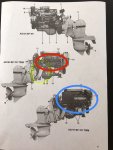
I‘ve uploaded a photo from the manual, so that we can all see the same thing, and refer to the same ‘parts’. As I understand it, there is a high riser on the AQ171, but not on the AQ151 (which is our engine).

Correct me if I’m wrong, but I think the outdrives are basically the same model. Also, when someone refers to ‘legs’ I am assuming that’s a synonym for outdrive?

The problem started when the P/engine kept misfiring and overheating when we ran the boat out (which we’ve only managed to do 3 times so far).

Therefore, we compression-tested the engine. We found a leak (an air leak?), which prompted removal of the cylinder head and head gasket.

The gasket was intact. It has, weirdly, been sealed in with some kind of mastic. I’m no engineer but I know that‘s odd. I believe you seat the gasket properly and screw the head down onto it to seal it? Anyway, mastic was an indicator something’s wrong.

We found seawater crystallisation in valves 4, 3 and 2. Nothing in 1.

We found that the pistons were sitting okay in the cylinders. And we found that the (exhaust?) valve on No 4 was not seated okay. It wouldn’t close fully. Which is where I think we’re losing pressure?

The working assumption is that seawater is coming up the “exhaust yoke outdrive riser” - that’s what I’ve seen it described as - and into the exhaust manifold. Does that even make sense?

If stepping on to the boat at the stern, or it’s trim otherwise, isn’t causing seawater to come up the riser, as we had erroneously thought, then where could the seawater be coming from? What are the possible causes of seawater crystallisation in the exhaust manifolds?

If purely a design flaw, I don’t know why the S/engine seems fine and the P/engine knackered.

I suspect that the head on the P/engine is off a car, because we have found an automotive sender on it too.

Twin engines: Volvo AQ151 140 petrol
 

Attachments

  • 5BEF9D47-958A-47AE-9DA8-13C5E12D876A.jpeg
    5BEF9D47-958A-47AE-9DA8-13C5E12D876A.jpeg
    160.3 KB · Views: 20
They don’t have risers fitted .
We’ve seen the part referred to as the “exhaust yoke outdrive riser”. To us it looks in the manual photo simply like a pipe running from the exhaust manifold to the outdrive. We’re assuming the exhaust comes out of a hole in the outdrive.
 
Hi, can you explain to me where you able to fix the water issue
yes my problem was the original head had rotted a way a new head from the breakers and some machining put it all back together and it ran perfectly and I hope will continue for many years to come, or until the corrosion gets bad once more..

However I am a trained engineer so my time was free you on the other hand are paying for an expert to fix it.. therefore you must judge how much you can afford to spend balanced against the value of the boat. weighing that against selling the boat as is and moving on. These are joys of boat ownership!!!

what is the web site called please that explains everything you have written?

Some info on head swapping and part numbers here
Volvo B18 engine - Wikipedia
405 head? [Archive] - Turbobricks Forums
AQ 131 A275 Cylinder Head exhaust port
Obstruction in #4 cylinder

remember Volvo Penta did not have a fix for this and eventually stopped supplying this engine -- sad to say when you have fixed the first one you may have problems with the second - be prepared..

My overall advice when you get it running sell it on and buy something more modern with diesels!! don't fall into the trap of replacing the engines in this hull it will never make financial sense.
 
We’ve seen the part referred to as the “exhaust yoke outdrive riser”. To us it looks in the manual photo simply like a pipe running from the exhaust manifold to the outdrive. We’re assuming the exhaust comes out of a hole in the outdrive.
yes thats exactly right! and if you picture your drawing and the proximity of the transom its a big engineering job to create a new manifold with a riser........ price would be telephone numbers!!
 
Hello everyone. I’m J - husband of T . Thank you for all the responses to T’s initial post and the thinking you‘re putting into it.

I‘ve uploaded a photo from the manual, so that we can all see the same thing, and refer to the same ‘parts’. As I understand it, there is a high riser on the AQ171, but not on the AQ151 (which is our engine). correct

Correct me if I’m wrong, but I think the outdrives are basically the same model. Also, when someone refers to ‘legs’ I am assuming that’s a synonym for outdrive? correct

The problem started when the P/engine kept misfiring and overheating when we ran the boat out (which we’ve only managed to do 3 times so far).

Therefore, we compression-tested the engine. We found a leak (an air leak?), which prompted removal of the cylinder head and head gasket.

The gasket was intact. It has, weirdly, been sealed in with some kind of mastic. I’m no engineer but I know that‘s odd. I believe you seat the gasket properly and screw the head down onto it to seal it? Anyway, mastic was an indicator something’s wrong. if I remember the head gasket has a mastic stripe on one side

We found seawater crystallisation in valves 4, 3 and 2. Nothing in 1.

We found that the pistons were sitting okay in the cylinders. And we found that the (exhaust?) valve on No 4 was not seated okay. It wouldn’t close fully. Which is where I think we’re losing pressure?

The working assumption is that seawater is coming up the “exhaust yoke outdrive riser” - that’s what I’ve seen it described as - and into the exhaust manifold. Does that even make sense? yes I think this happens when you stop the engine

If stepping on to the boat at the stern, or it’s trim otherwise, isn’t causing seawater to come up the riser, as we had erroneously thought, then where could the seawater be coming from? What are the possible causes of seawater crystallisation in the exhaust manifolds? I think I have read that as the engine cools after a run its possible to get sea water re entering the exhaust manifold maybe as steam in small amounts and over time lots of time it creates issues, unless you are carrying a lot of weight in the stern or your boat is sinking , I don't think water can enter up the riser.

If purely a design flaw, I don’t know why the S/engine seems fine and the P/engine knackered. probably because some body repaired your starboard engine in the past this is a very common problem see the links in my other posts, these issues started in the late 80/90s as the engines aged and also the internet meant people could share information and issues.

I suspect that the head on the P/engine is off a car, because we have found an automotive sender on it too.

Twin engines: Volvo AQ151 140 petrol


expand my post above to see my answers
 
Top