Advice please..... sealine 27 ft, 30 year old boat with 2 petrol engines

Trudy

Member
Joined
11 Aug 2020
Messages
23
Visit site
I wonder if anyone can help or advise please....
We have inherited a boat with little service history, she has 2 petrol Volvo Pentax engines and is 30 years old. The starboard engine is working well but the port engine is below the water line and so when you step on the back of the boat, water goes in to the exhaust, this has caused a bigger issue and meant that the engine has had to be stripped and cleaned. The cylinders are working well but we have had to have a new manifold and exhaust value replaced and there was salt water build up in parts of the top engine. (I am not mechanical at all). We have been told she should have risers on it, but there have never been risers in the past that we know of and we cannot find risers for these engines currently. Can anyone shed any light on how a 30 year old sealine 28 would have stopped water going up the exhaust in the past, as surely there must have been work around?
Any advice would be much appreciated.
 
Hi, and welcome to forum.
Merely stepping on the boat has nothing to do with it.. :)
You have been getting half cocked conflicting advice by the sound of it.
All engines both petrol and diesel will have a system of mixing the engine cooling water with the extremely hot exhaust gases to reduce the exhaust gas temperature and allow the result to be pumped safely out of the boat.
Sometimes directly through a fitting in the boat hull or in the case of outdrives back into the outdrive leg and out via a hole in the bottom of your outdrive.
This clever little device is called all sorts of things but is normally known as a RISER.
It is usually made out of cheapo cast iron and has a clever collection of ducts and channels inside to mix the the water and gas.
They have a notorious reputation for failure and are suposed to be replaced every few years. This very rarely happens.

The design of the Riser is supposed to keep the water and gas seperate until the last moment and prevent water getting back into the engine under any circumstances, , but, the channels inside the casting corrode allowing water to get back inside the engine with expensive results..

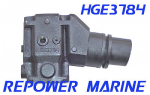
It will look something like this or similar.
1597129839916.png

Normally they would have replaced as a pair and are not that expensive , but they can be pain to change and as a result the next owner gets lumbered with the resulting problems.

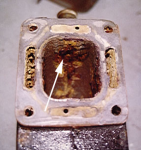
Whats goes wrong !
1597130443854.png

Exhaust Risers - Marine Engines : Boats and Yachts Maintenance, Repairs and Troubleshooting :
 
Last edited:
Hi and thank you for your reply, we have been told we need a RISER but supposedly because our boat is old and petrol engines they are hard to come by, as in our engineer has not found any yet. Would you know anyone who might be able to help us find one please?
 
Hi rise exhausts are available for some engines. (We have one fitted in place of the standard water injection exhaust on our sailing yacht engine.

if your engines are very old, new or replacement hi rise exhausts may not be available off the shelf. If that were the case I’d be looking at having some fabricated. Not a particularly difficult job for a small workshop. I’d have them made in stainless but other materials are available.
 
Hi and thank you for your reply, we have been told we need a RISER but supposedly because our boat is old and petrol engines they are hard to come by, as in our engineer has not found any yet. Would you know anyone who might be able to help us find one please?


Try Ebay ?

Exactly what engines are in the boat. Are they four cylinder or six cylinders. Presume they are painted Red .
The engine must already have a riser of some description , suspect your engineer simply cannot find any replacements at the moment.
Aftermarket is cheapest but they almost certainly should be available from Volvo Penta.

2x Volvo 4.3 225HP.

Might be somebody on here with your particular engines who can advise in more detail.
As both engines as at exactly the same height above/below water level, mystified by the.....
"The starboard engine is working well but the port engine is below the water line" ?
 
Last edited:
Hi, and welcome to forum.
Merely stepping on the boat has nothing to do with it.. :)
You have been getting half cocked conflicting advice by the sound of it.
All engines both petrol and diesel will have a system of mixing the engine cooling water with the extremely hot exhaust gases to reduce the exhaust gas temperature and allow the result to be pumped safely out of the boat.
Sometimes directly through a fitting in the boat hull or in the case of outdrives back into the outdrive leg and out via a hole in the bottom of your outdrive.
This clever little device is called all sorts of things but is normally known as a RISER.
It is usually made out of cheapo cast iron and has a clever collection of ducts and channels inside to mix the the water and gas.
They have a notorious reputation for failure and are suposed to be replaced every few years. This very rarely happens.

The design of the Riser is supposed to keep the water and gas seperate until the last moment and prevent water getting back into the engine under any circumstances, , but, the channels inside the casting corrode allowing water to get back inside the engine with expensive results..

It will look something like this or similar.
View attachment 96491

Normally they would have replaced as a pair and are not that expensive , but they can be pain to change and as a result the next owner gets lumbered with the resulting problems.

Whats goes wrong !
View attachment 96494

Exhaust Risers - Marine Engines : Boats and Yachts Maintenance, Repairs and Troubleshooting :
Yes our engine looked like that picture in part. Where would you go to talk to someone about getting a part like this?
 
Hi rise exhausts are available for some engines. (We have one fitted in place of the standard water injection exhaust on our sailing yacht engine.

if your engines are very old, new or replacement hi rise exhausts may not be available off the shelf. If that were the case I’d be looking at having some fabricated. Not a particularly difficult job for a small workshop. I’d have them made in stainless but other materials are available.
 
Exactly what engines are in the boat. Are they four cylinder or six cylinders.Presume they are painted Red .
Might be somebody on here with your particular engines who can advise in more detail.
As both engines as at exactly the same height above/below water level, mystified by the.....
"The starboard engine is working well but the port engine is below the water line" ?
4 cylinder, painted red. They are both at the same height but angled differently so the water is more accessible in to one than the other?! So we have been told!
 
4 cylinder, painted red. They are both at the same height but angled differently so the water is more accessible in to one than the other?! So we have been told!
Hi rise exhausts are available for some engines. (We have one fitted in place of the standard water injection exhaust on our sailing yacht engine.

if your engines are very old, new or replacement hi rise exhausts may not be available off the shelf. If that were the case I’d be looking at having some fabricated. Not a particularly difficult job for a small workshop. I’d have them made in stainless but other materials are available.
We have a Sealine 255 and the engines are twin Volvo AQ151 140 petrol engines.
 
4 cylinder, painted red. They are both at the same height but angled differently so the water is more accessible in to one than the other?! So we have been told!

Both engines were the same height when built, assuming a Sealine 270, they normally had Volvo's on outdrives, should we start at square one, what boat /model and what drive ?

Brian
 
Both engines were the same height when built, assuming a Sealine 270, they normally had Volvo's on outdrives, should we start at square one, what boat /model and what drive ?

Brian
Sealine 255 engines are Twin Volvo AQ151 140 petrol engines
 
Sounds Like they are AQ151 or AQ171, you can post pics on here .

Your problem is normal for that engine but has been accelerated probably because it’s been left to rot .

the exhaust elbow at the back has corroded quite normal for that model , if caught in time you can save the engine , sounds like it’s not been to the point water enters the boat when you step aboard , quite dangerous so it needs to come out the water before you loose it .

The exhaust pipe from the transom shield rots away at the top underside the rubber joint , it could be this but without professional inspection it’s all a big guess.

I hope you can take this on , I will warn you professional services are expensive but as it’s a free boat it’s got to be worth investing .

where is it located ?
 
Sounds Like they are AQ151 or AQ171, you can post pics on here .

Your problem is normal for that engine but has been accelerated probably because it’s been left to rot .

the exhaust elbow at the back has corroded quite normal for that model , if caught in time you can save the engine , sounds like it’s not been to the point water enters the boat when you step aboard , quite dangerous so it needs to come out the water before you loose it .

The exhaust pipe from the transom shield rots away at the top underside the rubber joint , it could be this but without professional inspection it’s all a big guess.

I hope you can take this on , I will warn you professional services are expensive but as it’s a free boat it’s got to be worth investing .

where is it located ?
Hi yes they are AQ151. We have had the top of the engines taken off and cleaned with new exhaust valves put in. A new manifold etc. The cylinders are still in okay condition so thankfully we don’t need to amend that. The engine is currently in parts so we cannot step on the boat at present.

Can any of this be checked without taking the boat out of the water? We did have the boat out of the water during lockdown but obvs this was not any issue at that point as the engineer could not test anything so was unaware of the problems at the time I guess?! Also do you know if we can buy these parts still? The boat had been sitting on the river prior to this and not really used for 4 odd years! And I don’t know much of it’s history prior to that either!
 
Hi yes they are AQ151. We have had the top of the engines taken off and cleaned with new exhaust valves put in. A new manifold etc. The cylinders are still in okay condition so thankfully we don’t need to amend that. The engine is currently in parts so we cannot step on the boat at present.

Can any of this be checked without taking the boat out of the water? We did have the boat out of the water during lockdown but obvs this was not any issue at that point as the engineer could not test anything so was unaware of the problems at the time I guess?! Also do you know if we can buy these parts still? The boat had been sitting on the river prior to this and not really used for 4 odd years! And I don’t know much of it’s history prior to that either!

it’s located at Mercury marina on the Hamble!
 
In my experience there are no risers on these engines and your problem is a known fault , Acknowledging the failures VP modified what as a car cylinder head to try and cope with the presence of water.
The exhaust port in the head nearest the transom has a specially made steel ring cast into the alloy head to cope with corrosion that arises from water ingress from the exhaust when the engine is stopped. Steel lasting longer than alloy.
This steel ring eventually rots away causing the cylinder head exhaust port to leak gases. When this happens often the head is usually a write off . because of the lack of marine spec heads or cost they are typically replaced with a new head from a car that does not have the steel insert and will fail even quicker.. hence the boat is usually sold on quickly. It was my misfortune to buy a boat with this failure, it had been bodged up with car filler and ran well and long enough for me to purchase the boat and failed later. hence I became an unwitting expert of the VP head problems.
 
I was able to removed the head and the exhaust manifold whilst the boat was in the water just stuffed rag down the exhaust pipe to the outdrive and got on with it...!!!

I don't understand why your engines are at different angles on the assumption that these power out drives which would be identical. Both engines should be angled the same, to the manufacturers recommendations. any misalignment to the outdrive can cause extra wear on the moving joints to the drive.
 
Top