Advice on beaching and grounding exploring estuarys

When we got to Ravenglass we headed for the sea but it was out! Walking down the street was like being in one of those old Westerns, I swear there was tumbleweed blowing past.

That's Ravenglass for you. We stayed in one of the Pullman cars owned by the railway. It seemed like a good idea beforehand, but it's like spending a week in a car park. Probably because it is spending a week in a car park. The only good thing about the place was the superb slow cooked lamb shank they serve in the pub in the old station. And the narrow gauge railway, of course, which has the great merit of getting you out of bloody Ravenglass.

We've stayed in Boot as well, and that's much, much nicer.
 
Last edited:
We used to regularly dry out our old boat.
On harder sand and larger round stone beaches the stub of your keel is able to take the ground but you inevitably end up heeling over a bit.
We used to have some big balloon fenders that could be rigged up on a line under the hull to both help protect it from any sharper objects and keep her more upright held in place until boat dried out by a continuous line drawn all under the hull and held in place.

We preferred to be heeling slightly up any gradient for obvious reasons!

We never ever planned to dry out in Surf conditions!

We did find that drying out mid tide when you lose and regain the water quickest was the most comfortable to avoid any potential hull pounding on harder surfaces.

I have now equipped our new boat with Drying out legs that help the wing fin keel to keep the boat rock steady and upright on harder surfaces.
 
What a lovely place.(I had an elderly relative who lived there) However the tide comes in, in one flow. The hooter sounds and the Water floods in from Morecambe bay and comes up the estuary on a bore. Come to think of it, I'm certain I have never seen a sailing boat at Arnside.

My father's side of the family used to sail from there, it's been a while since I last visited but I remember there being some day boats or small cruisers on swinging moorings just upstream from the lifeboat station.

However all of the sailing we did when I visited as a child was on Lake Windamere!
 
I ground bow in motoring dead slow perpendicular to my estimation of the slope. As she touches I note any sideways cant and plumb both sides with an old dome tent pole to check for gullies. Once happy I give som e revs to plant her asap. I'd not reverse on to depart bows out as the inboard prop would be vulnerable. Once dry, I walk out and plant the kedge in the direction of departure.
My vote for Ravenglass is positive!
That loose rope at Roa sounds like my old mooring there....
 
Poor old Ravenglass seems to be getting a lot of stick. It's got three pubs (all selling real ale), some very well-preserved Roman ruins, a working water mill, a narrow gauge railway plus a main line station, an internationally famous garden estate just up the road - and mooring is free. Not a bad list of attractions for such a small village.

Muncaster Mill used to be a really good place to visit, but alas has been closed to the public for years. You forgot to mention the shop - as classic an example of a damp, poorly stocked, expensive village shop as you could care to find. The shop at Eskdale Green is far better, and just a short train ride away.


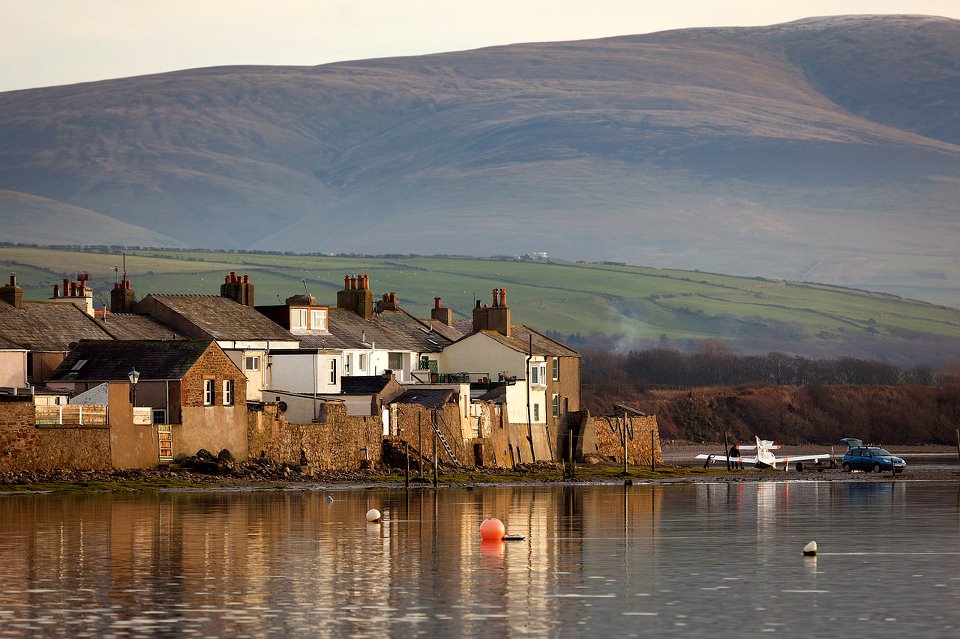
Any idea what an aeroplane's doing on the beach?

1-ravenglass-jf280112.jpg
 
Any idea what an aeroplane's doing on the beach?

I would expect that when the tide goes out there is enough of a flat seabed exposed to use as a runway.
 
I suppose if one judges the tide ' landing strip ' it's great for a pose...

Just when I'd bought my racy 30' Carter, chum and I were posing for all our worth - in case of passing girlies - when a git in a microlight with floats appeared.

Circled, landed, taxied up to the Folly pontoon, cast a casual line ashore and disappeared into pub.

Later emergerged surrounded by adoring females, taxied off, turned and took off.

Circled pub waving to adoring fans.

If I'd only had a shoulder launched Stinger...
 
tip--- if walking on mud---take a bucket to use as a third "leg"----spread your weight by always having 2 "legs" on the mud at the same time
 
tip--- if walking on mud---take a bucket to use as a third "leg"----spread your weight by always having 2 "legs" on the mud at the same time

Yes back to reality that is an excellent idea, I wrote a story about a little girl using a basket to help stabilise on mud so should have thought to mention it !

Also use the bucket / basket for maybe sensible shoes if you make the pub, but above all a protected waterproof mobile / VHF and torch.
 
Thanks everyone, some great tips there. I read an account of a wayfarer trip once, I'm sure they came from Arinside and mentioned a sailing club? They stopped at barrow for a few days to wait out crap weather but then went blasting off down to Holyhead before going out to Isle of Man then back to Cumbria.
Dylan, thanks, just a heads up but that link says video not available. Dunno if it's cause I'm on the iPad, will try again from work of tomorrow.
 
Thanks everyone, some great tips there. I read an account of a wayfarer trip once, I'm sure they came from Arinside and mentioned a sailing club? They stopped at barrow for a few days to wait out crap weather but then went blasting off down to Holyhead before going out to Isle of Man then back to Cumbria.
Dylan, thanks, just a heads up but that link says video not available. Dunno if it's cause I'm on the iPad, will try again from work of tomorrow.

sadly the no show of films on ipad is getting worse

If you use music in a film then the film belongs to the music publisher(invaribaly VMG and sony) and google of course - as video makers we agree to giving it to them when we tick the 20,000 word contract.

the music publishers often prevent their music from being shown on what they consider to be a portable device - as in your ipad.

I guess because they want you to buy the music on itunes.

it came in with IOS 8 I beleive

Just one more lump on the road placed by google et al

D

does it play straight in youtube rather than as an embed?
 
.
Lots of good questions and lots of good answers here.

One thing to watch is where there is a channel winding out to sea the banks may be very steep and if you dried out on the side of one of these even though it may only be say 8ft deep the boat could roll onto its side and the incoming tide flood it before it floats off.

Maurice Griffiths gave himself a fright in the Thames Estuary that way once -- only saved his boat by building up the cockpit coamings with floorboards to keep the tide out until she floated.

If you ever find yourself grounding on an unknown slope that you can't get off because of the falling tide, first take soundings with your boathook or whatever all around the boat. Do that straight away. Then if you find you're on a slope hang a weight (an anchor or two, for instance, or a bucket of water) from the end of the boom and swing it out 'uphill' to help make sure that's the way you're heeling when she's fully grounded.

Mike
 
Do they really do that? which ones?

with a bilge keeler, I would never sail without a Fishfinder to check the bottom: even the basic entry level ones will witha little practice give a good idea of what is below you. I have had mine long enough now to even be able to see and measure the density of Garrick-Maidments eelgrass in Studland, which he says isnt there any more - though it doesnt spot seahorses. Ooops! sorry, forgot there arent any of them either - maybe thats why I havent seen one!

Seriously though, I use a basic colour screen model which gives a very clear return which changes according to the type of seabed. It doesnt take long to learn to recognise the different returns from mud, weed , sand or shingle. A bit of circling around soon shows up any humps and hollows or rocks to avoid. Dodging steep banks needs a little bit of skill in interpretation as the bottom trace records only what you have just been over, so will inevitably show a slope as you move in to shallow water, but again a bit of circling round soon allows you to get an idea of whats down there.

Checking before you jump out: I learned the hard way when i ran the nose of a 17 foot day boat up a beach in a Welsh Estuary. Hard aground at the bow, I jumped off over the stern - into 8 foot of water!

For 3 + times the cost of a simple fish finder you can get one that gives a full 3d picture of the bottom. A big improvement as you can see what is all round and ahead of you, not just what you didnt hit! Next to the GPS plotter, I would say its the most important and most used electro-gadget aboard. Adds quite a lot of interest for youngsters too!
 
Last edited:
with a bilge keeler, I would never sail without a Fishfinder to check the bottom: even the basic entry level ones will witha little practice give a good idea of what is below you. I have had mine long enough now to even be able to see and measure the density of Garrick-Maidments eelgrass in Studland, which he says isnt there any more - though it doesnt spot seahorses. Ooops! sorry, forgot there arent any of them either - maybe thats why I havent seen one!

Seriously though, I use a basic colour screen model which gives a very clear return which changes according to the type of seabed. It doesnt take long to learn to recognise the different returns from mud, weed , sand or shingle. A bit of circling around soon shows up any humps and hollows or rocks to avoid. Dodging steep banks needs a little bit of skill in interpretation as the bottom trace records only what you have just been over, so will inevitably show a slope as you move in to shallow water, but again a bit of circling round soon allows you to get an idea of whats down there.

Checking before you jump out: I learned the hard way when i ran the nose of a 17 foot day boat up a beach in a Welsh Estuary. Hard aground at the bow, I jumped off over the stern - into 8 foot of water!

For 3 + times the cost of a simple fish finder you can get one that gives a full 3d picture of the bottom. A big improvement as you can see what is all round and ahead of you, not just what you didnt hit! Next to the GPS plotter, I would say its the most important and most used electro-gadget aboard. Adds quite a lot of interest for youngsters too!

or a pea stick

http://www.ebay.co.uk/itm/Bamboo-Ca...807141?hash=item35e812b665:g:bQUAAOxykMpTIGgb
 
Last edited:
Top