Advice about my anchor and chain please - see photos

Crinan12

Well-Known Member
Joined
6 Mar 2019
Messages
606
Visit site
Hello all me again I have a question about my anchor and chain and I would be grateful for some assistance please.
I have a 30ft 4 tonne sailing yacht and I am very new to both sailing and boat ownership.
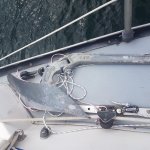
I have 40 metres of 8mm chain. The chain is joined in 2 places so it seems to be different batches - the amount of rust varies. I also have a 9kg anchor which i understand to be a CQR anchor- it has 'HKG' marked on it as well.

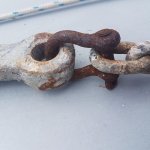
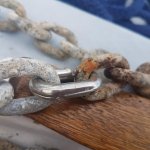
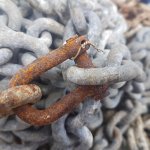
I suppose my question is does any of the chain look dodgy ? I have read about getting the chain re galvanized. Does mine looks like it needs done ? I've take photos of the worst bits. A lot of it looks okay.

Also if anyone would like to comment on the suitability of the anchor that would be useful. My boat will only ever be used in the west coast of scotland. I have never anchored before but I know I will be more of an anchoring type of person than a marina person. When I get more confident and experienced sailing I suspect I will be doing it a lot. Therefore I wouldn't mind investing in some better equipment if it was worthwhile. But if my existing equipment is suitable then that's great.

I have read a lot about anchors on this forum and one that came up that seemed very good value is a kobra 2.

Thanks very much
Douglas
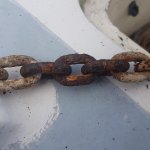

20190715_110913.jpg20190715_110923.jpg20190715_110931.jpg20190715_111059.jpg20190715_111135.jpg20190715_110913.jpg20190715_110923.jpg20190715_110931.jpg20190715_111059.jpg20190715_111135.jpg
 
That chain is pretty rusty but probably within the guideline 10% loss of thickness. This will be at the joints between links, look ok to me but I suggest you measure. The shackle is bad: definitely change that now for a good one, Crosby would be ideal (see later). The C-link you have now looks like a U-ship 316 stainless one. It has about half the strength of new galvanised grade 30 chain.

As a minimum I would change the shackle and the C-links, tecni-lift will supply them mail order, details on my website.

However, in view of the condition of the chain I would replace it and have no C-links if you can afford it.
 
(Light blue touch paper and stand well clear)

Ditch the CQR.

You will sleep far better with any new generation anchor.
 
I wouldn't pretend to the same level of expertise as VC, so I'd follow his recommendations - change shackle and C-link immediately and save your pennies for a new lump of chain.

My next suggestion will have a few people up in arms but, unless the area you sail is has a particularly abrasive bottom, you could use a mixed rode: a length of chain then rope - octoplait is WAY better than 3 ply as it's far less likely to twist and tangle. This allows you to have the ability to put more scope out and/or anchor in deeper waters with less, or at worst no more, weight than your present setup. If you have a windlass, this may not work for you as I understand many windlasses struggle with rope.

Finally the anchor. Did I read 7KG on the shank? If so, it's definitely on the small side according to Lewmar. I won't presume to tell you the best anchor to buy, because I don't think there is one (ducks incoming :)) but many years ago, I remember someone here asking the question "How do I know if my anchor's big enough?" One, only slightly tongue in cheek, reply was, "When everyone else in the marina's laughing at you". I have a 10KG Delta on my Snapdragon 24, which occasionally provokes mirth, but when the wind gets up and the laughing stops, I still sleep well at anchor. I prefer to have a lighter rode and a bigger anchor than a heavy rode and lighter anchor for the same weight.

One option if you do haven't got a windlass is to use a higher grade 6mm chain; as strong as 8mm - and certainly stronger than what you've got now with the iffy connectors, but less than 2/3 the weight. Add a good lump of rope on the end and you can sit pretty in 20m of water and still lift it all by hand! You could do the same if you have got a windlass, but you'd need to change the gypsy.
 
Vyv thank you - I have came across a few of your articles when researching anchor stuff and they have been very useful. I'll do what you suggest as an interim.

Graham - from reading many other posts that was what I am leaning towards. A kobra 2 14kg anchor is around £180 and seems to get good reviews. I would have thought something like that would be good value.

Stemar it's a 9kg anchor. And yes I have thought about something like 30m of 6mm chain and then 30m of rope. I don't have a windlass.

It would seem to me paying to get chain re galvanized might not be that cost effective ? Chain doesn't seem horribly expensive- please correct me if I've got this wrong.
Thanks
 
The old anchor won't stop working just because there are better ones. I would scrap everything else, try the anchor, and if I don't like it keep it as a kedge and get a new one.
 
I had chain that was less badly corroded than yours regalvinised and it really only lasted one season.

Suggest you have a look at Jimmy Green for chain - over the years I've found them fairly reliable.

Shackles - fit 'green pin' shackles which are a bit stronger than the bog standard generic galvanised shackles of unknown manufacture.

Anchor- many on the west coast of Scotland happily use a CQR, however it is an old design and you may like to consider the 'new generation' models. Not wishing to get into another best anchor thread, but Delta's are quite well regarded by the owner's of your type of boat (I have a Rocna, but with a significantly larger/heavier boat).
 
The old anchor won't stop working just because there are better ones. I would scrap everything else, try the anchor, and if I don't like it keep it as a kedge and get a new one.

+1. Obviously it's been used a bit, so it may well be fine. I had a CQR when I bought Jissel and it was great. I lost it when it hooked on something and I couldn't free it, so I got another genuine one from a boat jumble and it just refused to set, so I started using a Delta I was storing for a liveaboard friend and it's never let me down, though even it took two tries to get a hold in the churned up soup that is much of the bottom of Newtown Creek the other day.
 
+1. Obviously it's been used a bit, so it may well be fine. I had a CQR when I bought Jissel and it was great. I lost it when it hooked on something and I couldn't free it, so I got another genuine one from a boat jumble and it just refused to set, so I started using a Delta I was storing for a liveaboard friend and it's never let me down, though even it took two tries to get a hold in the churned up soup that is much of the bottom of Newtown Creek the other day.

Hi Steve, why would the same anchor perform differently for you do you think?Thanks
 
Comments on galvanizing (from a galvanizer)
The life expectancy of galvanizing for a specific environment is proportional to thickness of the zinc coating, and is consumable. That is, the coating is a sacrificial one, and slowly erodes (in preference to the steel corroding - that's the "sacrificial" bit) until it's all consumed, and then the steel starts corroding. At this point of depletion of the zinc, you can expect some parts of the steel item, (links of the chain) to have brown on then - the first signs of rust. It won't all go uniformly though as it didn't all get the same exposure to seawater. (you rarely use the last metre or so).
There are two systems of galvanizing chain, and the main difference is the thickness of the resulting coating (and therefore the life expectancy). The most common for new chain, is spin (or centrifuge) galvanizing. This arranges the chain to be pun in a centrifuge straight out of the molten zinc. You get a thinner coating, smoother, and all links are free of each other, not "welded" together with zinc. Only a few galvanizers have this process, but chain manufacturers who also galvanize their chain do it all that way.
The other system is closer to jobbing galvanizing how general fabrications are processed. After emerging from the zinc, the chain is vibrated, rattles or shaken to get the worst of the surplus zinc off before it solidifies (freeze) in place. Some links will be a little welded together but easily knocked apart.

The ISO standard for materials over 6mm thick calls for a coating of 85 microns minimum average. (That's 85 thousandths of a mm). But in practice you'll get more with standard galvanizing, perhaps 100-120 microns, and less with centrifuge galv.

There's little to no difference between one galvanizers coating and another's other than thickness. Some people think that the galvanizer has a lot of control of the quality, the thickness and the shininess. They don't. The most important factor in determining thickness is the steel's chemistry, followed by immersion time followed by temperature. Temp isn't able to be altered much for technical reasons, immersion time is kept as short as possible to keep productivity up, so that leave steel chemistry, in particular Silicon and phosphorous.

Shine of galvanizing is a real distraction. There's no difference in corrosion protection terms between bright mirror silver and dull grey. It's purely aesthetic difference, and after all after a couple of uses most anchors will be dull grey anyway. But people (like magpies) think shiney must be better! It's not. Its the same. Shine is influenced by immersion time in the zinc, and many galvanizers add a little aluminium to the zinc (typically 0.001%) to creat some shine, only because people like it, for no other good reason.


If the galvanizing on a chain last only a short while (like a season mentioned above), then either it was really thin to start with (see above, centrifuging), or the conditions it encountered were really aggressive. Galvanizing is eaten rapidly by acids, and such as for example peaty water is acidic.


Re-galvanizing has no appreciable effect on the strength of the steel. I've done research on this, and that demonstrated a tiny improvement in tensile strength, but no statistically significant. There's more variation from one batch of chain to another than there is before and after re-galvanizing.
To re-galvanize a chain a galvanizer will firstly remove any remaining zinc. Galvanizing is an alloying reaction between chemically clean steel and molten zinc. It won't happen between old galvanizing and zinc, nor between rusty steel and zinc. The same acid that strips off the old remaining zinc also cleans the rust off the steel. In fact the pre-treatment in galvanizing is the complicated time consuming part, dipping in zinc is easy and quick.

Another wearing aspect of an anchor chain is abrasion. In fact this is really the only reason to use any chain. How much chain to use (in a mixed rode) depends on factors such as conditions encountered? Coral? sharp rocks, abrasive sandy bottom? and practical apsects such as windlass gypsy fit. A rode can be all rope quite adequately for short periods, and many racers do that to save weight. At the other end of the spectrum, most cruiser use all chain. Weight is less of a worry, but the convenience of a rode of all the same material is high.
 
A lot depends on how serious you are about anchoring, if you spend nights at a time sitting out strong winds then replace the lot.
If you just anchor for lunch breaks and occasional overnighter in calm conditions, then what you have is adequate (after taking Vyv's advice).
If you keep your chain, the chain that can be seen in Pic 5 looks to be in fairly good nick, I would put that next to the anchor.
 
Regarding regalvinising ,i had my done a few years ago from the peeps in birmingham,sailed round the uk couple times spent 2 years(not seasons ) sailing the med none stop bar xmas and first three months this year,and still looks great,anchor 90 % of the time
 
Thanks all - and Geoff thanks for the detailed info about galvanising
Vyv had said to replace the shackles and c links. Presumably I can just replace the c links with shackles ?
Vyv I read the article about galvanising on your website. V useful thanks. I'll see if there is somewhere in Glasgow that does galvanising. I can't see it would be economical or worth the hassle to start shipping the chain it about the country.
 
Thanks all - and Geoff thanks for the detailed info about galvanising
Vyv had said to replace the shackles and c links. Presumably I can just replace the c links with shackles ?
Vyv I read the article about galvanising on your website. V useful thanks. I'll see if there is somewhere in Glasgow that does galvanising. I can't see it would be economical or worth the hassle to start shipping the chain it about the country.
I think Geoff is not that far from you
 
I have a 30ft 4 tonne sailing yacht ...
I also have a 9kg anchor which i understand to be a CQR anchor ...

...more of an anchoring type of person than a marina person.
... I will be doing it a lot.

If you want to anchor overnight, I strongly suggest you get a modern scoop-type anchor, with rollbar if you can fit one, or without if not. That means Mantus, Rocna, Manson Supreme, Spade, Vulcan (or Ultra if you find a sock with cash stuffed under the mattress). Go one size up from the recommended if you expect to be anchored in bad weather, or some recommend as big as you can reasonably fit the boat.

If you just want to dip your toes into anchoring, have a go with the CQR at first. You can always upgrade later. While the Kobra is probably a fair bit better than the CQR, it's still an outdated design and doesn't make sense to buy new anymore - the money is better spent on one of the above. And nothing will help you justify spending money than your anchor alarm going off in the middle of the night in a sudden strong wind and you having to re-anchor in the dark because the bloody thing didn't hold or failed to reset in a change of direction :)

Lastly, it's well worth the time reading this enourmous thread on CF - it has tons of pictures of various anchors and excellent advice on how to use one properly: http://www.cruisersforum.com/forums/f118/photos-of-anchors-setting-126073.html
 
Hello, 'crinan12'.

There's sound advice above - Stemar and Minchsailor are about spot-on - and there's nowt wrong wi' your CQR. Like many others on here, I spent decades using them successfully and, while the New Generation Anchors are certainly better in manyt respects, they're all a d*** sight more expensive. There's room for argument over what constitutes the 'best bang per buck'.....

Here's my tuppence worth.....

Certainly 'deep six' those rusty shackles. As Viv Cox agrees, they are by far the most likely point of failure. Get some decent-quality replacements. As you're hand-hauling, they don't need to fit through anywhere awkward.

Next, I'd encourage you to learn all you can about the lore of setting an anchor. It's worth it. Far too many Southern Softies believe what they've been told by the Solent Salesmen, that it's just as simple as 'putting the handbrake on'. No it ain't!! And the choice of 'where' matters a lot. So ask - sort the wheat from the chaff - and learn. It's to your advantage.

Next, after half a lifetime believing 'the best anchor is the heaviest one I can hump about the foredeck' and that all-chain is the ONLY way to go - in my dotage I've learned better.

You - and I - don't need all-chain. The actual mechanics of what goes on tells us - eventually, when we're willing to listen and think - that a length of chain next to the anchor followed by a good rope warp is optimal.... and especially so when you're hand-hauling the lot up. Yes, it works fine.

So I'd recommend you aim at having a chain-rope setup. You'll thank me for it - mine's a pint - and keep your 'redundant' length of chain for use with a SECOND anchor. And warp. That's just good seamanship.

I've anchored successfully in a number of corners the length of the West Coast, and a few other corners as well. There are places like Phuildhorain, south of Oban, that are so ploughed-up that the substrate is like Baxters Soup. Your best bet there is to tie lines to the rusty ould tractor or do a Scandinavian Moor - or go somewhere else if anything above a F3 is forecast ( it is very flat and open to the SW and W, but the pub is close by ). The best bet for that sort of really soft substrate is a Fortress anchor, which isn't cheap. Those things stick like keich to a blanket in soft stuff. They are The Best.

I have three of them ( ? ) and my boat is similar to yours. All of them were bought real cheap, through 'For Sale' websites like the one on here. I first saw them on very expensive, no-expense-spared Oysters I was delivering, and reckoned that there must be something about them - so I checked them out. They are as good as they say - especially so when a quarter of retail!

Don't - do not - be conned into spending good beer tokens on chi-chi posh anchoring kit when what you have is already - with a couple of simple changes - wholly adequate .
 
Geoff declined the opportunity to sell you a new generation Scottish made and galvanised anchor, it is called Knox after the designer and is very highly thought off, have a look at the website.
 
The photos you provide given no indication of the amount of rusted chain and the amount of good chain. Some of the chain looks very ordinary and some looks almost as if it has never been used.

Chain appears to rust preferentially where it meets another, different ,metal - like a shackle. This is normal and one would cut those few links off and simply carry on. In your case you also have rusted shackles and the 'C' links.

It now depends on how much good chain you have, how much is superficial corroded (and could be saved by regalvanising) and how much is corroded and eroded such that you need to dump it. File the rust off and if the metal has lost 10% of diameter - dump it (or re-use it for shore lines)

If you have a decent length of good chain - do as Zoidberg suggests and splice on sufficient rope and use a mixed rode. If you actually have little good chain left then use it to build a second, spare rode, and invest in new chain. I vote you seriously look at 6mm - it will be adequate for your size weight of yacht and your back will than you for your investment. Keep any other short lengths of good chain - you can use them round trees or rocks for shore lines.

You need more than one anchor - people lose anchors more frequently than you think - so you need a spare. No anchor is perfect and some do better in some seabeds than others - Zoidberg points out that Fortress reign supreme in thin mud - and that if you keep your eyes open you can buy them second hand - try eBay. Here is an article, more below, on why you might think of a Fortress:

https://www.practical-sailor.com/issues/37_50/features/Anchoring-in-Squishy-Bottoms_11619-1.html

The article illustrates a number of factors, one being Fortress is good in thin mud (and that the competitive anchor makers simply prefer to not mention inadequacies :( ). But similarly Fortress is not much good in weed or pebbles. Its horses for courses.

Genuine CQR's embossed 'Made in Scotland' on the shank served people for many decades and people still swear by them. By all means invest in a new anchor - but if the CQR works it can be one of your spares. If you find a genuine Bruce in a boat jumble, eBay and its the right size - think of buying it.

Be careful of of the link provided - the photographs are excellent the comments questionable.

If people make bold statements - ask them to quantify and justify what they say and claim - invalid results do not become more valid by constant repetition :) - constant repetition simply results in incorrect information being constantly repeated - take care.

Rocna, Supreme, Knox, Spade, Kobra, Fortress all have a good reputation (and different prices) they may or may not be easily available where you are located.

Geof, the galvanising expert, cannot be far from you, I think the factory is in Cumbernauld (and another up near Inverness). He also sells Knox anchor - an excellent product and supporting Scots industry. Most other anchors you see in chandlers are now made in China except for Spade (Tunisia) and Supreme (NZ) and Fortress USA. There is nothing wrong with product from China - if quality control is in place. Lewmar have some new steel anchors 'in the wings' maybe released at the end of the year, maybe not - they might be cheaper when first released - and if from Lewmar they should be adequate. But ring Geoff - he might, or might not, do you a deal - far flung though I am - I have tested the Knox - great product (I'd carry one - but it will not fit)

Beware copy anchors - they often do not work as well as the originals, think copy CQRs, copy Bruce, copy Deltas. Beware, as you have alternatives, of anchors that have never been tested for holding capacity - Vulcan and Mantus. Take measured advice - people spend a lot of money on anchors - they are going to be very forgiving of their choice - they will not want to be thought of as fools. So listen to a cross section of comments.

Jonathan

I'm going to add some links for you

This first one is a bit dated - but is one of the best tests and is still valid

http://rocna.cmpgroup.net/sites/default/files/downloads/press_0612_wm_ym_testing.pdf

There are some good tests conducted by or for Voile et Voileurs and published in Yachting Monthly and slightly more recent, sorry but I thought I had provided enough :)

https://www.sailmagazine.com/diy/know-how-ground-tackle

https://www.sailmagazine.com/cruising/anchor-snubber-tips

https://www.sailmagazine.com/diy/how-to-dealing-with-snatch-loads-in-an-anchorage

http://rocna.cmpgroup.net/sites/default/files/downloads/press_0612_wm_ym_testing.pdf

https://www.practical-sailor.com/issues/37_17/features/anchor_testing_rode_loads_10784-1.html

https://www.practical-sailor.com/issues/37_26/features/Anchor-Resetting-Tests_10981-1.html

The above articles tend to be a bit American centric. Vyv's articles and website is much more UK focussed.

Plenty to get your teeth into. There are many more equally valid articles by a number of authors, google will help you.

Any questions and you simply need to ask - it might be better if they are focussed questions - start a new thread.

Any questions - there are a range of opinions here - you will need to sort them out yourself. There is no one right answer, there is no one right rode and there is no one right anchor.

But bear in mind - before the electric windlass and our (the public at large) greater wealth small yachts were common, mixed rodes were very common and the CQR (or even Fisherman and steel Danforth) were the only anchors. This changed in 1970 (when Bruce was introduced and 1990 when the aluminium Fortress and steel Delta came on the market - and the big change came in 2006 with that 'holding capacity test - link above. Before 2006 there were many heroic passages to far flung places - using mixed rodes and anchors that people sneer at today.

Don't rush off and spend your money too quickly - take a moment - and few nights using as much of what you have that is safe - and then make a decision.

Jonathan
 
Last edited:
My tuppence worth - I've got a Kobra and it's been great, it's the folding one, which I'm in the process of getting welding in a permanently open position as the bar that it folds over has come away from the stock.
I've also just replaced our 30mtrs of chain, which was 8mm with 6mm, as it was a lot worse than yours. I was working on Vyv's advice, the percentage corrosion.
 
Top