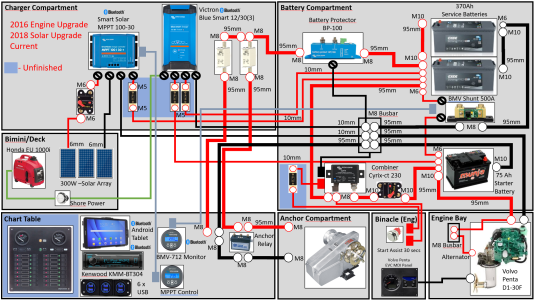
Adding Lithium capacity to our existing setup

For most yachts, adding more solar is generally a better answer than increasing battery capacity, but in this case, I think your idea of adding more battery capacity is a reasonable approach given the modest requirements of only managing 3 days at anchor, dual alternators with a combined 135A output, an engine that is run "a fair bit" and I presume a UK location.

The next question is how to achieve the increased battery capacity. Combining lead with lithium in the one bank can be done but has some issues. I would be inclined to replace the house battery bank with all lithium. Your current 220Ahr AGM has a useful capacity of around 110 Ahrs (when new), so around 300Ahrs of lithium would produce a substantial extension in your ability to live comfortably between plugging into shore power.

You can retain one AGM as the start battery.

These days, 300Ahrs of lithium is not expensive. However, you will likely need a DC to DC charger and some other peripherals.
 
Last edited:
I have one 110Ah lead acid leisure battery and a small starter motor battery.

With my folding and lightweight 120Ah solar panel from Photonic Universe, I run a compressor fridge 24*7 when afloat and run and charge many other electrical devices. I can go for days on end like this.

When I first got the panel I thought it wasn’t working as no charge was going into the battery in the morning. In reality, the early morning summer sun had topped up the batteries before I crawled out of bed.

I do understand your concern about shading from the boom. My solution is to have an extender cable for the panel and park it between tbe mast and the pulpit. As the built in legs angle the panels towards the sun, and you can rotate the panels towards the sun, they can work very efficiently. Just rent to turn the panel through 180° before you go to bed (or turn appropriately if you are at anchor).

My setup is unobtrusive even on my May sub 30’ boat. When you want to move on, fold the panels towards in half and rest it against a bulkhead die below.
 
Another way forward with the kids and their gadgets is to pick them up a decent sized power bank (ie a pocket-sized lithium battery) each and tell them that's their ration.

Four of us camping last summer - in not brilliantly sunny weather - managed to keep our phones going through a combination of plugging into a portable 100w panel directly and using it to top up a powerbank when we weren't. It charged quickly enough most days. Didn't cost a huge amount and we've been able to use it at other times too, not just camping. At the time I can remember thinking it'd work fine for us if/when we buy a basic boat.
 
Having read the advice above (thanks all!) and had a think, I’m going to replace the existing lead acid house battery setup with LFP, and install a larger 100w solar panel.

Just wanted to sense check the setup before I start making purchases. The plan is:

New Equipment:

2 of these Renogy 100AH batteries.
This 100w solar panel
This (75/15) Victron MPPT controller
This Victron DC-DC charger

Retain:
Victron Blue 12 | 24 mains charger
Lead acid engine start battery

Rough configuration:

Engine alternator and mains charger charge the lead acid engine start battery only.

Connect the new MPPT controller to the new LFP battery bank directly.

Connect the DC-DC charger to the lead acid engine start battery and the new LFP battery bank.

Is this roughly the right thing to do? If so, are there any subtleties that I’m missing? E.g. should there be fuses at certain points?

Any help or pointers greatly appreciated as always. 🙂
 
Last edited:
Can you fit a single 200Ah battery? It just simplifies things a bit, and means you can use the BMS as your battery monitor, if you're looking for places to save money.
 
Fuses yes! It’s a highly debated topic and your expected usage will affect the choice of fusing. We don’t have an inverter so our maximum draw is probably little more than 30 amps if everything was turned on at once and so have fused accordingly, both in rating and type.
 
Can you fit a single 200Ah battery? It just simplifies things a bit, and means you can use the BMS as your battery monitor, if you're looking for places to save money.

At present these 2 x 100Ah batteries are cheaper that any 200Ah unit I can find from a reputable brand. Also I have two separate battery box compartments so one huge battery is not ideal - depends on dimensions.
 
Are your shore power battery charger and your alternators set up to charge AGM batteries? AGM’s need a slightly different charge regime to get the best in and therefore out of them.
 
Fuses yes! It’s a highly debated topic and your expected usage will affect the choice of fusing. We don’t have an inverter so our maximum draw is probably little more than 30 amps if everything was turned on at once and so have fused accordingly, both in rating and type.
This is incorrect for battery fuses and potentially dangerous for Lithium, which require specific fuse types, irrespective of your expected usage. You should use appropriate wiring and fuse for that, using the correct type of fuse for the type of battery. As you step down in cable size you reduce the fuse ratings.
 
This is incorrect for battery fuses and potentially dangerous for Lithium, which require specific fuse types, irrespective of your expected usage. You should use appropriate wiring and fuse for that, using the correct type of fuse for the type of battery. As you step down in cable size you reduce the fuse ratings.
Is there enough info in post 24 for you to give some pointers on what kind of fuses to use and where to put them @PaulRainbow ? We won’t have an inverter, just the usual fridge, autopilot, VHF, stereo, lights etc. Max output of the DC-DC charger appears to be 30W.
 
Is there enough info in post 24 for you to give some pointers on what kind of fuses to use and where to put them @PaulRainbow ? We won’t have an inverter, just the usual fridge, autopilot, VHF, stereo, lights etc. Max output of the DC-DC charger appears to be 30W.
The key thing is to have a master fuse with a high enough 'interrupt capacity' or AIC. Most people use a class T but they're expensive.
You can go down a bit of a rabbit hole with fuses, it's arguable that on a small system the MRBF provides sufficient protection. I know that Paul disagrees with this. With so much at stake, I'd be inclined not to cut corners.

I assume you mean 30A for the DC-DC. You can just use ANL or mega fuses for this.
 
Having read the various fuse threads it sounds like I would be better off going for a single 200Ah battery (despite the increased cost), in order to keep things simpler. Will do some measuring and see if it will fit in one of the existing slots.
I don't like those Renogy batteries, not sure who's cells they use and the BMS is cheap, with no Bluetooth. I mostly assemble my own packs using grade A EVE cells with a JK BMS, with Bluetooth. If it has to be "drop in" i'd use Fogstar batteries, which also use EVE cells and a Bluetooth BMS (but not JK). Fogstar prices are not much more than Renogies budget range.

As for fuses, i generally fit battery cables to the isolator rated higher than the BMS, with a fuse at or very slightly higher than the BMS cuttoff. Class T or NH fuses for me. After the isolator, if you step down with the cable sizes, step down with the fuses too.
 
Last edited:
This is incorrect for battery fuses and potentially dangerous for Lithium, which require specific fuse types, irrespective of your expected usage. You should use appropriate wiring and fuse for that, using the correct type of fuse for the type of battery. As you step down in cable size you reduce the fuse ratings.
Ha! I can see how what I wrote could be misinterpreted. So far as fusing and cabling go, 60amp 10ka mrbf fuses direct to battery terminals with 25mm cable to bus bar followed by a 110 amp t-class up to the isolator switch.
 
Coming back to this as I got sidetracked with other projects for a bit.

Following the advice that what I really need is more solar, my current plan is:

Keep my existing 2 x 110Ah AGM domestic batteries for now.

Upgrade the 30W solar panel to this 100w Renogy item, with a pole / tilt mount.

Replace the existing MPPT controller with this Renogy combined MMPT controller and DC-DC charger.

Connect that to the domestic bank, engine battery and solar panel, using 60A mega fuses for the batteries and a 10A inline fuse between the panel and the MPPT controller.

Upgrade my existing Victron mains charger to a 20A IP22 with Bluetooth (I hate the fact I can get zero info from the current one).

Connect that mains charger to the engine battery (with a 80A mega fuse), and rely on the DC-DC charger charging the house bank when there’s not enough sun and the boat’s plugged in.

My thinking is this will allow me to drop in Lithium batteries when my AGM ones wear out.

Can anyone see any major flaw(s) in the plan? All advice gratefully received as always. :)
 
Coming back to this as I got sidetracked with other projects for a bit.

Following the advice that what I really need is more solar, my current plan is:

Keep my existing 2 x 110Ah AGM domestic batteries for now.

Upgrade the 30W solar panel to this 100w Renogy item, with a pole / tilt mount.

Replace the existing MPPT controller with this Renogy combined MMPT controller and DC-DC charger.

Connect that to the domestic bank, engine battery and solar panel, using 60A mega fuses for the batteries and a 10A inline fuse between the panel and the MPPT controller.

Upgrade my existing Victron mains charger to a 20A IP22 with Bluetooth (I hate the fact I can get zero info from the current one).

Connect that mains charger to the engine battery (with a 80A mega fuse), and rely on the DC-DC charger charging the house bank when there’s not enough sun and the boat’s plugged in.

My thinking is this will allow me to drop in Lithium batteries when my AGM ones wear out.

Can anyone see any major flaw(s) in the plan? All advice gratefully received as always. :)
I'd fit everything Victron, except the solar panel. Be a better setup when you go Lithium.
 
I'd fit everything Victron, except the solar panel. Be a better setup when you go Lithium.
I like Victron but you have to admit the Renogy DC-DC/MPPT would save a fair chunk of money so it's tempting, if you're starting from scratch. Do you have any experience of them?
 
I like Victron but you have to admit the Renogy DC-DC/MPPT would save a fair chunk of money so it's tempting, if you're starting from scratch. Do you have any experience of them?
And space also. I think @PaulRainbow isn’t necessarily too keen on the Renogy stuff but it’s a small area with a lot of gear in so it would be a good solution from that POV.
 
Top