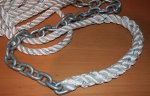
Adding anchor warp to existing chain

RJJ

Well-Known Member
Joined
14 Aug 2009
Messages
3,159
Visit site
Hi all - grateful for some advice, please.

Our new-to-us boat (44ft, c.11 tons) has 50m of 10mm chain on an Aries Quick windlass. Seems to work well but I am minded to extend with 50m of rope - we want to go long-distance cruising and being able to anchor confidently in c.20m depth rather than c.10m seems desirable.

So looking at the windlass:

1. I can see inside the gypsy there are some serrated teeth - can I take it that'll be for gripping rope?

Then in order to be strong, secure and also able reliably to pass the windlass

2. What type and thickness of rope is recommended, and how should it be spliced?

3. Is there any reason a non-branded nylon or polyprop line on eBay wouldn't be up to snuff compared to apparently the same article (with same stated breaking strain) from famous chandlery friends?

4. Any recommendation on a ropework book that will cover this sort of thing and make it really idiot-proof?

Many thanks in advance.
Richard
 
I'd have a look at the Jimmy Green website for starters. The site provides a lot of practical advice on the description tab.

1. I can see inside the gypsy there are some serrated teeth - can I take it that'll be for gripping rope?

They are probably for gripping the chain. Could you post a photo?

2. What type and thickness of rope is recommended, and how should it be spliced?

Looking at the website I mentioned above, I believe they suggest something like 16mm three strand. The splice would depend on the type of rope used, Octoplait or Three strand.

3. Is there any reason a non-branded nylon or polyprop line on eBay wouldn't be up to snuff compared to apparently the same article (with same stated breaking strain) from famous chandlery friends?

100m of Liros 16mm three strand is about £50 from Jimmy Green, that's not a lot for piece of mind.

4. Any recommendation on a ropework book that will cover this sort of thing and make it really idiot-proof?

I'd recommend the RYA Knots Splices & Ropework. For three strand it's just a back splice.
 
Last edited:
I had exactly this same conversation with a representative from English Braids. He recommended:

1. 3-strand not 8-plait as the windlass is probably designed for that
2. use polyester not nylon. This is because stretch is actually bad for chafe and nylon hardens in a very short time whereas polyester is still good after a decade
3. On no account to use floating rope like polypropylene as you'll inevitably get caught up in it somehow

I add my own 4th point which is to use the correct splice. It's not a back-splice but rather more elegant. Look at the rigging handbook by Brion Toss: https://www.amazon.co.uk/Rigging-Ha...-Traditional/dp/0713669187/ref=dp_ob_title_bk

You pass only two of the three strands through the last link of the chain. This is just as strong because the load is shared between 4 strands, but is much less lumpy than a conventional back-splice. In tests it performs at about 97% of the full BS of the rope.
 
Last edited:
You need to look at the specification of the windlass and gypsy. It is very likely your windlass will take both chain and rope (most newish ones do), but I'd check, and the size of rope is usually specified. The specification will also comment on the 'type' of rope and usually gypsies take both 3 strand and plait - but only the specified size. If you do not have a specification look at the Quick website and/or contact the Quick distributor and ask them.

Most windlass will accept a range of different gypsies, yours might accept an 8mm and 12mm chain - take the gypsy off and somewhere there will be a coding - that will determine which gypsy it is (and whether it will take rope). you will need this information when you contact Quick or the distributor.

If your gypsy will not accept rope new gypsies are usually extortionate.

Plait will store in the locker much more easily than 3 strand, plait is tactile. They perform similarly in use - accepting some of the comments made by JDC.

If you follow your intentions try, when you retrieve, to keep the rope separate from the chain. The rope will hold water, seawater, and a chain sitting on wet rope is a recipe for corroded chain. Retrieve the rope try to coil and hang on a hook in the locker - have the chain simply sitting on the fibreglass of the locker. Alternatively put a baffle in and retrieve the rope into one side and the chain into the other.

Jonathan
 
I used a tapered back-splice 14mm 3-braid rope to 8mm chain ...

TaperedBackSplice.jpg

... it was enough to kedge a grounded 50 footer into clear water using an electric windlass.

This is my spare spade anchor, I would personally want to go all chain for my main anchor.

I'm sure someone will be along in a minute and tell me I'm going to die if I anchor using the above splice. ;)
 
I used a tapered back-splice 14mm 3-braid rope to 8mm chain ...

View attachment 77928

... it was enough to kedge a grounded 50 footer into clear water using an electric windlass.

This is my spare spade anchor, I would personally want to go all chain for my main anchor.

I'm sure someone will be along in a minute and tell me I'm going to die if I anchor using the above splice. ;)

Very tidy indeed. I find the biggest problem with a rope to chainsplice is that once wet the rope remains so for a long time and rusts the chain. Not something that happens quickly but regular inspection is recommended.
 
I've pondered the same as the OP - a little bit more scope would be nice, but not quite 60+m of new chain nice.

For those of you with rope / chain rode, does your rode pass through the windlass then down the chainpipe into the locker or do you have an open chain locker. I cannot quite get my head around getting the rope fed through the chain pipe smoothly in such a way to avoid a tangle when I come to use it.
 
Very tidy indeed. I find the biggest problem with a rope to chainsplice is that once wet the rope remains so for a long time and rusts the chain. Not something that happens quickly but regular inspection is recommended.

Thanks, fortunately, it's on my spare anchor, so not used very often. Gets a freshwater flush and is left to dry in the sun on the foredeck before packing it away.
 
I've pondered the same as the OP - a little bit more scope would be nice, but not quite 60+m of new chain nice.

For those of you with rope / chain rode, does your rode pass through the windlass then down the chainpipe into the locker or do you have an open chain locker. I cannot quite get my head around getting the rope fed through the chain pipe smoothly in such a way to avoid a tangle when I come to use it.

You are correct, and that is the biggest problem with mixed rodes. Particularly as we are currently using our anchor, stern-to with 45 metres out. Trying to push rope into the locker, or worse down a pipe, would be a nightmare while simultaneously keeping clear of other boats and ensuring we do not trip somebody else's anchor.
 
I had the same conundrum and laboured to splice anchorplait on to our 10mm chain. It wasn’t the right solution of course as the chain to rope joint is unmanageable through the winch/deck/chain locker. So we swapped out the 10mm chain for uprated 8mm and had a much longer chain, with greater strength but only a small additional weight penalty. It’s expensive but it’s the way to go, the proper fix that you’ll be pleased you did.
 
I pay no attention at all to the join when using the windlass: the transition is completely smooth and the gypsy grips the rope just as well as the chain. I simply don't have to worry about it. In start contrast to the previous splice between 8-plait and the chain which was stiff (and rotted the chain) and always jammed up in the hawse pipe or gypsy.

I think the big difference is to use thin enough rope (it's easily strong enough) and to use a splice which causes little extra thickness - as I suggested.
 
Last edited:
Thanks folks, I took a photo of the windlass teeth (it's an Aries Quick but I couldn't see any obvious markings on the gypsy itself). And I can't work out how to post the photo so that's another bit of advice required!!

Agree polyester not floating line, my mistake

Cost-wise I was looking at this in 16mm.
Just under half the price from Mr Green. Stated breaking strain is the same at 5000kg. £130 saving is worth giving some thought to, surely? Any reason not to?

https://rover.ebay.com/rover/0/0/0?mpre=https://www.ebay.co.uk/ulk/itm/272717451162

Anyway, given its quite a big ticket item, I might buy or borrow a couple of metres to see if the windlass likes it.
 
15 minutes! Sorry, watched 1 of them, learned nothing and gave up.

+1

I din't even bother looking (though not strongly motivated) - but a very common problem in most sailing vids. My attention span is that of a 16 year old.

Interestingly cooking videos, or some of them, are very short and get to the salient points immediately. There might be a lesson in there.

Jonathan
 
I had the same conundrum and laboured to splice anchorplait on to our 10mm chain. It wasn’t the right solution of course as the chain to rope joint is unmanageable through the winch/deck/chain locker. So we swapped out the 10mm chain for uprated 8mm and had a much longer chain, with greater strength but only a small additional weight penalty. It’s expensive but it’s the way to go, the proper fix that you’ll be pleased you did.

+1

We went from 50m of 8mm to 75m of 6mm - its all positive. There are, very sadly, some cost implications - considerably larger than the cost of a bit of nylon. New gypsies are extortionate, new windlass more so and of course there is the cost of the chain - none of which are minor amounts. But, if you are motivated, its one solution. The best time to consider downsizing chain is when you 'order' a new yacht (when you might actually save money - you will save power), when you need a new windlass or when you need a new chain.

Our spare, or second rode, is mixed, 40m of nylon and 15m of chain, same 6mm. The rope is neatly coiled round the inside perimeter of a milk crate and the chain sits in the resultant empty space in the middle - it all gets a good fresh water wash when ever possible and sits on the foredeck in the sun to dry. The milk crate keeps it all aired and allows everything to dry..

The OP might like to consider an extra length of chain and a 'C' link - for long distance cruising the extra chain would be the better bet - though 10mm chain is very, very, heavy - and I'd look seriously at the downsizing option (depends on the impact of weight on the yacht - and the priority for funds).

Jonathan
 
Last edited:
Rota Marine sound like a decent company, you could always ask if anybody has dealt with them before. The only thing I would say against that particular rope is that splicing Multiplait can be a bit of a challenge if it is you have not done it before.
 
I did this last year using a “chain/warp” splice.

https://www.bluemoment.com/pix/warpchain4.jpg

8mm chain to 16mm three strand leaded warp as used by commercial fishermen. Advantage over a back splice is that it does not add much additional width and therefore runs directly through the windlass and down the hawse pipe. Tested in a force 6 overnight last year and all held well.

Works a treat on my Anchorman vertical manual windlass. I think that the vertical windlass helps because the 180 degree turn to the hawse pipe means that the warp is gripped better in the windlass teeth. Example below off a different boat but same set up:

http://geminicats.com/images/IMG_0371.jpg
 
Last edited:
Don't agree with the comment about splicing with only two strands it's wrong, I use two strands one way and the third strand backwards through the same link then a tapered long splice. Two strands only reduces the strength by a third.
I had exactly this same conversation with a representative from English Braids. He recommended:

1. 3-strand not 8-plait as the windlass is probably designed for that
2. use polyester not nylon. This is because stretch is actually bad for chafe and nylon hardens in a very short time whereas polyester is still good after a decade
3. On no account to use floating rope like polypropylene as you'll inevitably get caught up in it somehow

I add my own 4th point which is to use the correct splice. It's not a back-splice but rather more elegant. Look at the rigging handbook by Brion Toss: https://www.amazon.co.uk/Rigging-Ha...-Traditional/dp/0713669187/ref=dp_ob_title_bk

You pass only two of the three strands through the last link of the chain. This is just as strong because the load is shared between 4 strands, but is much less lumpy than a conventional back-splice. In tests it performs at about 97% of the full BS of the rope.
 
Don't agree with the comment about splicing with only two strands it's wrong, I use two strands one way and the third strand backwards through the same link then a tapered long splice. Two strands only reduces the strength by a third.

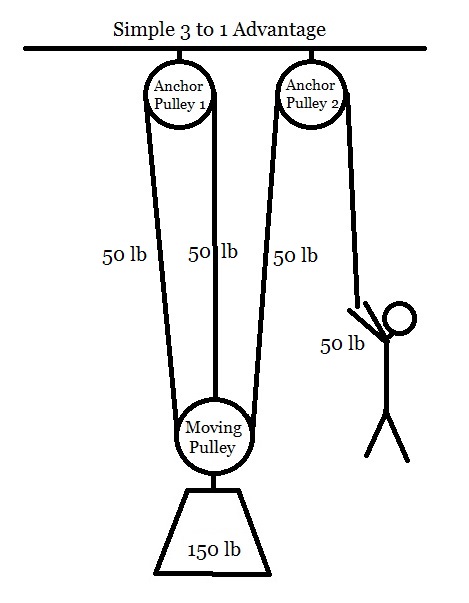
3-to-1-Two-Pulleys-up-Top.jpg


If the string in the picture has a breaking strain of 50lb you can still use it to lift 150lb if it is trippled up .... any single strand still has a breaking strain of 50lb.

With a 3-strand splice on a link, with all 3 strands used you have doubled up to 6 strands on the link itself, so the attachment at the link is stronger than the rope - even though the double-back on the link weakens the strands (and why for a really strong splice you would use a thimble.)

Because it is a splice, it tapers back to 3 strands of the original rope - the 3 strand rope remains the weakest link, not the splice.

If you only use 2 strands, then that is doubled up to 4 in the splice so it is still pretty much as strong as the rope itself which is only 3 strand. With the doubled-back strands weakened, it appears to be 97% as strong as the original rope - which is close enough to be considered workable.

That is the theory behind the 2-strand claim, I don't particularly like it and used all 3 strands on my splice, but it appears correct.

Perhaps someone more knowledgable can provide clarification.
 
Last edited:
Top