A thought

In my youf, we used a Seagull Silver Century in a well as the auxilary on the 27ft cruiser racer. It also did duty on the dinghy, but we were on a mooring and usually sailed on and off it. Nav was by compass and chart (tried Consol once, but bit vague..) Graduated to a Seafix. But my best was Sardinia to St T. with a school atlas and a compass, helped by a Walker log.
Nowdays, mostly eyeball and chart. But have aquired a Yeoman for fun and I like charts, rather than a plotter.
Of course, marinas make an engine with reverse obligatory. Last year, the reverse quit going into Minimes, so visiters pontoon and rib towed us to berth.
 
A few days ago I was reading a survey on outboard type and use on the Cornish Shrimper Owners Association website. 5 or 6 hp models being the norm with a few smaller.

One owner had gone for the heady power of an 8hp engine only to find that the tiller would not clear the engine cover.
Inboard Shrimpers usually have a 1GM10, so 9hp..
I swopped out a 2GM20 for a Beta 16. Not a lot of difference since the Yanmar is about 18hp and the Beta actually 16hp. Much better and quieter..
 
...my best was Sardinia to St T. with a school atlas and a compass, helped by a Walker log. Nowdays, mostly eyeball and chart. But have aquired a Yeoman for fun and I like charts, rather than a plotter.
I crossed from Chichester Entrance to Seaview despite mist obscuring both sides from the middle, by basing our direction on a study of the small-scale AA road atlas which was not kept aboard. That was not this century. ;)

No experience, no brain, no fear, but I did the same thing again and again without incident in the months that followed. The less tech we have or habitually rely upon, the more readily resourceful I think we find ourselves to be.

Of course in 2024 it's prudent to have helpful electrics aboard for woolly moments (to tell one what one might last century have guessed, or could with some effort have calculated), but habitually not even setting off until the plotter screen is glowing, is too much like blindly obeying satnav on a very dull drive.

Considering most (even very mature) yachtsmen seem to see it entirely the other way round, I wonder why they persevered with going to sea, if they now gladly avoid the involving necessity (and rewarding habit) of judging and dead-reckoning their passage.
.
 
Of course in 2024 it's prudent to have helpful electrics aboard for woolly moments (to tell one what one might last century have guessed,
It was early this century, entering a land locked anchorage by a very narrow drying channel and Mk1 eyeball put me mid channel. Electronic toys showed me on the edge of the green shading just outside the yellow shading. No blue shading until the anchorage opened up.
 
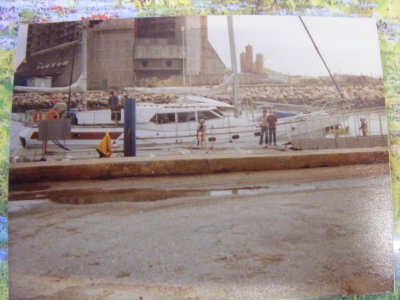
Way back, the company yacht was fitted with an early Satnav, a curiosity back then, it took quite a while to get a fix and just as I waved them off to the USA, it went blank. Skipper had learned Astro, but was a bit rusty. It did cheer up and after a day or two was reliable-ish.2024_0925sigma0002.JPGSlightly rough pic of her. Mahogony carvel conventional construction, built in Italy around '74 for a RTW. 'We' found her parked in Athens ten years later.
Two Detroit 140hp gave about 12knts, same under sail if pushed.
 
I crossed from Chichester Entrance to Seaview despite mist obscuring both sides from the middle, by basing our direction on a study of the small-scale AA road atlas which was not kept aboard. That was not this century. ;)

No experience, no brain, no fear, but I did the same thing again and again without incident in the months that followed. The less tech we have or habitually rely upon, the more readily resourceful I think we find ourselves to be.

Of course in 2024 it's prudent to have helpful electrics aboard for woolly moments (to tell one what one might last century have guessed, or could with some effort have calculated), but habitually not even setting off until the plotter screen is glowing, is too much like blindly obeying satnav on a very dull drive.

Considering most (even very mature) yachtsmen seem to see it entirely the other way round, I wonder why they persevered with going to sea, if they now gladly avoid the involving necessity (and rewarding habit) of judging and dead-reckoning their passage.
.
Ours is always on because it’s the instrument repeater when on port tack.
 
I understand - and I suppose nobody needs to defend using a plotter they already have, for the same reason it wouldn't make sense to keep a lifejacket in its locker as you drown. If one went aground unguided because one chose not to switch on an accurate, reliable, ever-ready GPS device, one would look culpably daft.

But, given that we sail for fun, don't you enjoy interpreting only the raw sensations of sailing without referring to the instruments that repeat on the plotter? Even if, or because it requires acute perception of how much windforce is too much, likely more critical aboard a multi than a monohull.

Everyone's experience of sailing is only their own, so the bother or delight of processing updated incoming navigational and instrumentational variables, which might stress or bore the trousers off one skipper, may entrance and thrill another...

...for myself with a dinghy cruising background, the yacht-owner's enormous theoretical advantage of electronic charting and positioning, possibly radar, likely fridge, (endless list and endless tangled wiring) seems to cost as much in lost elementary joy of sailing at entry level (which got most of us interested in the first place) as it does in money.

Right now I've still got my Tohatsu but no vessel (discounting ageing Avons) so in a total reversal of the Pardy perpective, I hope to ensure my engine has a boat...

...but that (along with ballast to remove the capsize denouement, plus a cabin roof for shelter and a heater to make the cabin dependably habitable) is nearly all I want. I refuse to be cold, but after that, the more basic and salty it is, the better I'll like it. ;)
.
 
I like basic sailing, but I also enjoy having access to relevant data, which means having the plotter on, because its GPS feeds the rest, giving me the options of true wind and SOG. As it happens, my plotter is inside, with the data only available on a cockpit repeater, so that I feel that I have the best of both worlds. In home waters I don't need a course to steer. Away from home I will almost always set up a route, if only to refer back to. Needless to say, on a cross-tide leg I don't stick to the course line but quite a lot of coastal sailing is up or down tide, and my course then depends on whether I want to take the straight or the scenic route.
 
I have both. A boat all teched up, and one where electronics of any kind, including depth sounders, are forbidden in class rules. No phones or gps on watches either. If you don’t go aground sometimes, you’re not trying hard enough. Eddie Warden-Owen went aground yesterday. Ok maybe he wasn’t on the boat but still, I doubt his mates are numpties.
 
I have both. A boat all teched up, and one where electronics of any kind, including depth sounders, are forbidden in class rules. No phones or gps on watches either. If you don’t go aground sometimes, you’re not trying hard enough. Eddie Warden-Owen went aground yesterday. Ok maybe he wasn’t on the boat but still, I doubt his mates are numpties.
In Chichester the keel boats use a cane,sounding along the mud against the flood tide…
 
Top