12v circuit refit - ideas/refinements?

That assumes that "maximum flexibility" is the most important goal.

For a boat with a fixed configuration of equipment and always used in one particular mode (in my case, day-sailing with occasional night passages, rarely plugged into mains but also rarely sitting still for multiple days) there isn't that much need for great flexibility. I would rather prioritise ease of use.

I turn the boat on when I come on board, turn it off when I leave, and otherwise don't have to think about electricity at all.

GHA has a legitimate need for more options than me, but his situation is relatively rare.

Pete

Fair enough - I have a couple more turns to do as I change what I'm up to but it's super simple. My other boat has 3 toggle switches - the neutral is shared - it's also easy to switch engine battery on to start and off after stopping but I hate the complexity of all the boxes and wires behind the switches (but admit nothing has gone wrong in 7 years)
 
Unfortunately, you see little to be gained in any suggestions, you had already made your mind up before you posted. If you were a little more open indeed you would see that some of the suggestions made will be much simpler and more reliable, whilst still offering all of the functionality that you require, even the more "unusual" things.
That's not actually the case, your last suggest was drawn up & I've been mulling over it. Don't really like it though ;).

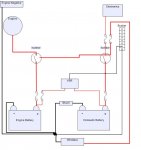
Hope this is what you meant :-
J4YjNzu.png


Why I don't really like it very much, in no particular order :-

Why involve the 2nd bank to start the engine? Only downside I have at the moment is the VHF restarting, which isn't a big deal, half the time it isn't even turned on when the engine starts. I much prefer the idea of having a separate battery, fully 100% charged, living most of it's life unconnected ready and waiting should it be needed. I can see the possibility that there are benefits of separating the engine and other loads, just can think what those benefits might be. ;) Maybe worth mentioning again, this boat has had 1/2/B with everything on the common & each bank on 1 or 2 since I bought it, always has been run on just one bank which has worked flawlessly. Starter battery may have been used now and again, but it so it was never any surprise waking up to a dead bank.
Doesn't mean there isn't a better system but does mean on this particular boat with me onboard it works well so any changes must bring benefits with them.

Alternator doesn't see the windlass. Unless you're set to 1 or both on the switch. I don't like the idea or both, best avoided IMHO, so lifting the anchor you need to go turn a switch, plus to get any benefit from the alternator it should be connected to the main bank.

2nd bank is getting high volts from the alternator, something like 14.6v from memory. No problem for the trojans, and probably no problem for a generic either really but why stress it if you don't have to.

It's just too complicated! Maybe not to wire, but in operation you need to think what's where, with a simple 1 or 2 that's it, everything goes in/out of one battery or the other. Ignoring both which I don't really see much of a point of in the real world. Even dog tired it's easy. Plus you should never need to touch it, other than battery maintenance battery 2 just stays standing by fully charged, give it half an hour once a week solar if it needs it otherwise never touch a switch.


I can't grasp why you think this is not a good idea.


I can't grasp why it is a good idea?? ;) Where is the benefit?

When the engine is running it charges both banks,
Hmm, wonder if if drawn it right? As said before, not a fan of paralleling banks. Can that work without both banks being connected to each other?
 
I can't grasp why it is a good idea?? ;) Where is the benefit?


Hmm, wonder if if drawn it right? As said before, not a fan of paralleling banks. Can that work without both banks being connected to each other?

Don't think you did draw it correctly. You can charge both banks with the VSR.

I'll knock a drawing up and see it that makes it any clearer.

I'll be back.................
 
I think it would be better designing this system with fusing considerations already from the start.

Given your choice, as I understand it, to have two batteries/banks that could alternate to act as one 'do-all' battery, to keep the two 1-B-2-off-switches and to not separate the engine starting/charging circuit, I would think along these lines:

Each battery positive post would have two connections: One thick cable, fused at 200A or so, and one thinner cable, fused at perhaps 40A (depending on charger output/domestic loads).
The two thicker cables would lead to one 1-B-2-off-switch with the engine and windlass on the COM-terminal (100A breaker on windlass cable).
The two thinner cables would connect to the other 1-B-2-off-switch, with domestic loads (including fridge), solar controller and 240V charger led to the COM-terminal, via a bus bar.

This does not solve your wish to be able to isolate one or the other battery for load testing from a chosen source, but I would suggest this to be done manually at the bus bar on these occasions (shouldn't be too difficult if preparations where made).
Sort of but not quite, the plan is to have solar, mains and everything else as individually switchable to either or both banks.
This is based on :-
"For maximum battery life it is very important to get to 100% full charge as often as possible. Every few days would be a good idea. This takes ages! "

So on a cloudy week/month it will be possible to switch one bank out of service and let solar get it right back up 100%
Means cycling the other bank a bit deeper but better than having 2 banks which never get to 100% if it's cloudy.
So commoning domestic with solar won't work, solar needs to be able to be the only thing attached to a battery.

Genny of engine isn't really an option as it takes so long.
 
Don't think you did draw it correctly. You can charge both banks with the VSR.

I'll knock a drawing up and see it that makes it any clearer.

I'll be back.................

Thanks!

VSR, ah yes, missed that, not really on the shopping list... ;)

Any thanks all for the input, might not seem like it but it does cause a much deeper look into it all. :cool:
 
Never underestimate the ingenuity of fools. :)

But I'm not a fool - as apart from writing neutral instead of negative.

In the process of selling the boat though to people who have chartered but never owned a boat before and that switch is the only thing I've been worried about enough to give detailed instructions.
 
GHA.jpg


Hopefully this makes it clearer. I left the solar wiring out for clarity. Wasn't sure if you had a shunt, but i included one anyway, if you don't have it just use a straight cable. All of those negatives are connected to a post, a stainless bolt is fine. Also left the mains charger off, but that's simple.

In normal use the domestic switch is on or off. The engine switch is on (1) when you want to use the engine. Both circuits are isolated, both banks charged by the alternator via the VSR. Starting the engine will not cause voltage drops on the domestic circuit. There are no changes to the current starter/alternator cable, charging goes to the load terminal of the engine switch, if you have to run the engine from the domestic bank the alternator will still charge.

The 1-2-both switch allows you to select (1) for normal use, (2) if the start battery is dead flat or knackered, or (both) if it's just a wee bit flat.

If the domestic bank suffered a catastrophe, isolate it and select (both) on the engine switch.

Domestic bank to isolator breaker circa 240a (may need to upgrade the cable to the switch). Windlass breaker, whatever it needs, but less amps than the one from the battery. Switch to domestic busbar whatever you need. This arrangement overcomes the previous fusing concerns, such as the windlass tripping all of the domestic circuits.

Oh, your VHF won't go off when you start the engine :encouragement:
 
This is based on :-
"For maximum battery life it is very important to get to 100% full charge as often as possible. Every few days would be a good idea. This takes ages! "

Some truth in that, but also the increased depth of discharge on the other battery (the one in service) will affect over all battery life time.
Don't know who you are quoting, but to aim for 'maximum battery life' when you are living away from mains power seems a bit over ambitious to me. I would have thought '100% full charge' every ten days or so should be a good step towards reasonable battery life.
 
Some truth in that, but also the increased depth of discharge on the other battery (the one in service) will affect over all battery life time.
Don't know who you are quoting, but to aim for 'maximum battery life' when you are living away from mains power seems a bit over ambitious to me. I would have thought '100% full charge' every ten days or so should be a good step towards reasonable battery life.

Bit of the black arts, batteries.... ;)

But getting really properly full as often as possible is generally regarded as a "very good thing", cycling slightly deeper for a week or so now again I would guess as small change over the gains to be made by consistently being able to get back to 100%.

There was a paper published ages ago now unfortunately no longer available but with bits in some US RV forums which had test results indicating charging over 15v in a 12v cycling PV setup would benefit battey life as the chance of getting to 100% would offset any downsides from such a high charge voltage.

Sort of what the snippets on the web suggested anyway. I never set a float voltage for solar regulators, absorption all the time.

Wonder how many cruising boats actually get back to full charge regularly as opposed to "went on float, must be charged". Probably not that many, takes ages.
 
Last edited:
View attachment 67615


Hopefully this makes it clearer. I left the solar wiring out for clarity. Wasn't sure if you had a shunt, but i included one anyway, if you don't have it just use a straight cable. All of those negatives are connected to a post, a stainless bolt is fine. Also left the mains charger off, but that's simple.

In normal use the domestic switch is on or off. The engine switch is on (1) when you want to use the engine. Both circuits are isolated, both banks charged by the alternator via the VSR. Starting the engine will not cause voltage drops on the domestic circuit. There are no changes to the current starter/alternator cable, charging goes to the load terminal of the engine switch, if you have to run the engine from the domestic bank the alternator will still charge.

The 1-2-both switch allows you to select (1) for normal use, (2) if the start battery is dead flat or knackered, or (both) if it's just a wee bit flat.

If the domestic bank suffered a catastrophe, isolate it and select (both) on the engine switch.

Domestic bank to isolator breaker circa 240a (may need to upgrade the cable to the switch). Windlass breaker, whatever it needs, but less amps than the one from the battery. Switch to domestic busbar whatever you need. This arrangement overcomes the previous fusing concerns, such as the windlass tripping all of the domestic circuits.

Oh, your VHF won't go off when you start the engine :encouragement:

Thanks, looks really good. Thanks for drawing it up.

Looks great for most boats, but don't think it's quite the right setup for the way this boat gets used.

Watching the VHF go off and on again now and again isn't quite the great motivator for change ;)
 
But I'm not a fool - as apart from writing neutral instead of negative.

You sail single-handed then?

I think those who sail with crew all have crew who cover a broad spectrum of common sense. Even when you know the ones that need extra careful briefing and watching like hawks, they can still sometimes slip through the net, so better not to leave booby traps for them to discover. I have a little panel of coloured LEDs that is visible from the wheel and tells me when they've messed with a switch somewhere. With your 1-2-Both switch your equivalent is a blown alternator or a flat battery.

Good luck with the sale.
 
You sail single-handed then?

I think those who sail with crew all have crew who cover a broad spectrum of common sense. Even when you know the ones that need extra careful briefing and watching like hawks, they can still sometimes slip through the net, so better not to leave booby traps for them to discover. I have a little panel of coloured LEDs that is visible from the wheel and tells me when they've messed with a switch somewhere. With your 1-2-Both switch your equivalent is a blown alternator or a flat battery.

Good luck with the sale.

On this boat, yes almost always single handed but the crew never touch the battery switch or start or stop the engine. On the other ex charter boat we often have guests and encourage involvement so the ugly complexity is worth it for being far harder to get wrong.

Thanks for the good wishes on the sail - my ambition for years is to be the owner of a sailing yacht - not two
 
Last edited:
View attachment 67615


Hopefully this makes it clearer. I left the solar wiring out for clarity. Wasn't sure if you had a shunt, but i included one anyway, if you don't have it just use a straight cable. All of those negatives are connected to a post, a stainless bolt is fine. Also left the mains charger off, but that's simple.

In normal use the domestic switch is on or off. The engine switch is on (1) when you want to use the engine. Both circuits are isolated, both banks charged by the alternator via the VSR. Starting the engine will not cause voltage drops on the domestic circuit. There are no changes to the current starter/alternator cable, charging goes to the load terminal of the engine switch, if you have to run the engine from the domestic bank the alternator will still charge.

The 1-2-both switch allows you to select (1) for normal use, (2) if the start battery is dead flat or knackered, or (both) if it's just a wee bit flat.

If the domestic bank suffered a catastrophe, isolate it and select (both) on the engine switch.

Domestic bank to isolator breaker circa 240a (may need to upgrade the cable to the switch). Windlass breaker, whatever it needs, but less amps than the one from the battery. Switch to domestic busbar whatever you need. This arrangement overcomes the previous fusing concerns, such as the windlass tripping all of the domestic circuits.

Oh, your VHF won't go off when you start the engine :encouragement:

Fused starter circuit???
 
Fused starter circuit???

Why not ?

My old Ford Falcon had a fause in the starter circuit.

My boat is designed to enable self sufficiently as possible with reasonable redundancy.

I have 2 separate banks of batteries for use as domestic use but in most cases both banks are combined to reduce the maximum state of charge to maximise life. These 2 banks are connected through a 1,2 both switch for flexibility.

I have a separate engine start battery being a large CCA battery. This battery is also connected through a 1,2, both switch that allows the engine battery to be connected to the engine or the domestic of both. This allows the inclusion of the domestic to be used to aid in engine station or to supply the domestic requirements.
I have fused in the main feed from each bank (3 fuses) three fuses are 800 amp as I have a bow thruster that is rated at 600 Amps. Not many 800 Amp circuit breakers are available where I am The cabling the bow thruster and windlass is 40mm x 20 mm aluminium buss bars to minimise volt drop to those motors.

Charging is done in various ways.

1) Twin alternators one for engine battery and a larger alternator for the domestic bank/banks depending on the position of the 1,2,both switch.
2) 4 banks of solar panels.

a) One charging the engine battery with a switch that can direct that output to the domestic bank. This bank is always connected to the selected battery with a MCB between the battery and the solar
regulator.

b) One bank charging the domestic bank fed through the 1,2,both so this bank will charge either bank or both depending on the 1,2,both switch. If the 1,2,both is off not charging, this is due to my boat can
be left for some time without any one on board so only a small charge is needed to the domestic battery

c) The remaining banks are connected direct to each of the domestic banks direct through a MCB so that these are always keeping the domestic banks trickle charging when I am away from the boat.

I do have a 50 Amp mains charger but don't use it much as I do not have much access to shore power. I fitted an output selector switch so I can direct the charge to which ever bank I wish and can combine charging to multi banks by using various combinations of the 2 - 1,2,both battery switches

The supply to all the other domestic requirements, i.e lights, pumps, fridge, freezer, nav instruments, electric heads pass through a domestic distribution panel with MCB and indicators feeding various devices to protect each device feed cable and the device it feeds. This in my view allows for increase flexibility.

The main distribution switch panel feeds a connection panel of DIN rail mounted terminal blocks such that it is easy to add any connections of necessary to the multiply connection points like lights and 12VDC power outlets.

Each of the battery banks has its own hall effect current sensor and voltage measurement sent to a selectable digital display.
Each of the solar banks also has its own current sensor with selectable digital display.

I did have a wind generator with its own meter but removed the generator when it failed and have not foxed it as I found very little need for it where we sail in the tropics and sub tropics.
 
Fused starter circuit???

Metal boats have a few additionl risks of short circuits, but otherwise, of all the cables in that diagram the starter cable is the one that is most at risk of short circuit. It is in a compartment, along with the single biggest lump of un-insulated material that's connected to the -ve, the engine.
 
Last edited:
Top